


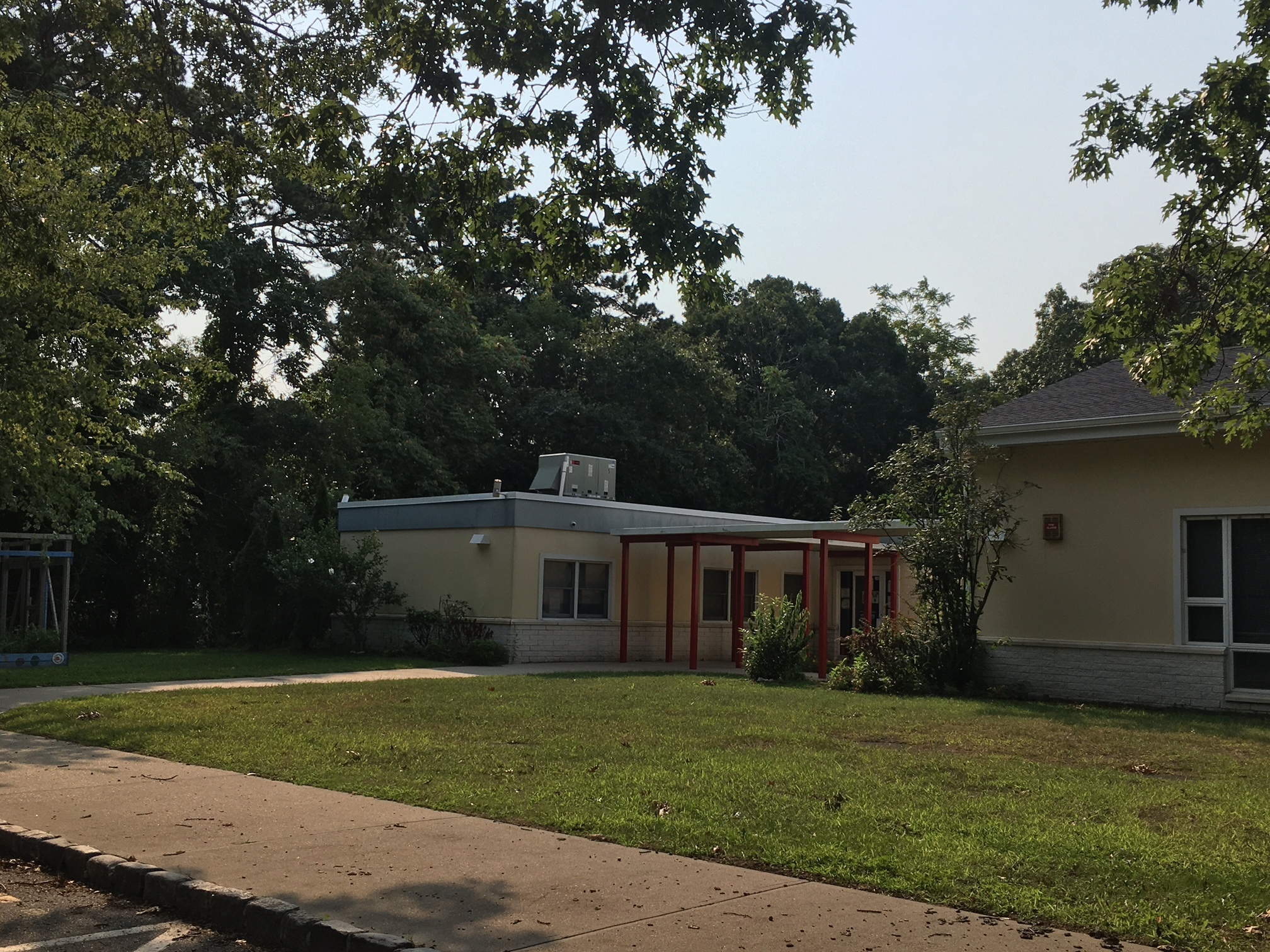
 1 Photo
The community's wish list includes the expansion of the existing Riverside Child Enrichment Center on Flanders Road.
Asked to articulate a wish list in furtherance of a Riverside revitalization grant application, members of the Flanders, Riverside, Northampton Community Association repeated the same list they have offered for the past seven years.
With the deadline for an application for a New York State Downtown Revitalization Initiative grant that could have an award of between $10 million and $20 million looming, FRNCA members met virtually with Southampton Town Deputy Supervisor Frank Zappone and the town’s grant writer Jen Mesiano on September 9 to strategize how best to pursue funding for three priority projects.
Funding could be used to jumpstart the sewer project, for the construction of the Riverside Maritime Trail Park and Shoreline Restoration, and for the expansion of the existing Riverside Child Enrichment Center on Flanders Road so that it can accommodate a full-sized Children’s Museum of the East End outpost.
The town has applied — unsuccessfully — for the money every year for the past five years. Mr. Zappone pointed out that, as a state offering, there’s a lot of competition for the funds. Long Island municipalities that were successful had greater population densities and proximity to the Long Island Rail Road.
This go-round, Ms. Mesiano’s strategy will emphasize “the community engagement piece,” she said.
Riverside projects and improvements and revitalization have had “persistent community support,” something other grant awardees don’t have, the consultant said.
That’s true, FRNCA President Vince Taldone acknowledged. When a new 7-Eleven was proposed in a gas station on the Riverside Traffic Circle, he noted, 150 people came out in opposition to a project “so flagrantly in conflict with the vision we all support.” When the community’s way of life is threatened, “the troops come out … it’s always easy to get people to come out when there’s something to fight against,” he said.
But some of the projects on the list have been in holding patterns for years.
Generating community interest and input for the maritime park and trail, a vision that was birthed over a decade ago, and for the downtown revitalization, dubbed Riverside Rediscovered in 2014, wasn’t a huge challenge, Mr. Taldone recalled. “We had so many visioning sessions, every aspect of the plans for revitalization was outreached to the community. The excitement was so great, and years go by, and there’s nothing.”
“People are just tired,” Mr. Taldone said in an interview. The frustration level is high among active community advocates and others “just don’t come anymore.” People have lost heart, he said.
For well over a year, civic groups provided input for the Riverside Revitalization Action Plan. Adopted in 2015, it’s centered around creating an “optional overlay” zoning code, which gives property and business owners the freedom to decide if they want to develop under current zoning or a new zoning code that will incorporate mixed-use zoning in certain areas of the hamlet.
Key to forward movement on the plan is the creation of a sewer district to serve the envisioned 300,000-square-foot area of commercial development located around the base of Flanders Road and the traffic circle.
Once the sewer district gets underway, “Everything will fall into place,” FRNCA board member Sandy Adams offered during the brainstorming session. It is the crucial element to revitalization, she emphasized, adding, “I keep hoping we’ll hear news of it.”
Mr. Zappone agreed. It is the pivotal item and “behind the scenes progress” is going on, he promised. “We’re moving in the right direction ever so slowly,” he said.
Another goal that could be realized with grant funding relates to the enhancement of the area’s natural assets, and the completion of a public park.
The Riverside Maritime Trail Park and Shoreline Restoration project, already the recipient of grants for design and engineering, is a target grant project.
Located off Flanders Road, across from Old Quogue Road, overlooking the Peconic River, the proposed park plan, as presented to FRNCA in February 2020 includes a dog park, several trails, a kayak launch, three fishing piers and an outdoor performance area, among other features. The effort to build the park dates back to 2013, but the desire to create some open access to the river is at least two decades old. FRNCA teamed up with Riverside Rediscovered, the organization formed to focus on the hamlet’s revitalization, to conduct extensive outreach to community members to assess what their priorities were for the park.
Riverside Rediscovered was created by Renaissance Downtowns — a developer in Huntington Station chosen to oversee the revitalization effort. The need for community meeting places was a third aspect of revitalization efforts under discussion last week. It was noted the space is sparse for both gathering and events. There could be opportunities along the waterfront, Mr. Taldone said, speaking of the Riverside Maritime Park.
Tijuana Fulford of the Butterfly Effect Project, an empowerment program for young girls, said organizations have used space at the David W. Crohan Community Center on Flanders Road, “but it’s not ideal.” There’s a need for space at the heart of Riverside. Lacking it, she said, “the community feels marginalized.”
Angela Huneault, of Riverside Rediscovered, who is also a FRNCA member, said, “We continue to see how we can use the little areas that are available, but it’s not enough.”
The Southampton Head Start and the town are working on the renovation and expansion of the building on Flanders Road, with the goal of expanding existing space for the Children’s Museum of the East End satellite. According to Head Start Center manager Diane Guzman, there’s a plan in the works for a building addition that would give the museum more space at the site. By next year, neighbors can expect to see a better home more suited for more full blown exhibits.
At the outset of last week’s discussion, Mr. Zappone laid out a trio of goals that would be the underpinning of the discussion.
The first, relating to infrastructure improvements that provide environmental benefits and support future growth include the sewer district, pedestrian pathways, the Maritime Trail and waterfront boardwalk along the Peconic River, and streetscape, lighting, traffic calming enhancements. The infrastructure allows the overlay district to come into being, Mr. Zappone explained.
The second goal looks at ways to enhance and beautify natural, recreational, and cultural assets. It includes the public park development, while the third goal speaks to the investment in community areas, such as the child enrichment center, a community center, and arts and culture initiatives.
“We’re very supportive of each of these goals,” FRNCA’s president said as discussion began. “We’ve been supportive of them for many, many years.”
Mr. Taldone told officials that attendance at the strategy session was low, but it wasn’t because the community lacks enthusiasm. They just don’t know what more to say, how many times to list the same outstanding projects.
“This is our checklist, be exciting to see us check them all,” Ms. Huneault offered.
Free money for the building blocks of the projects is welcome, but, Mr. Taldone, frustrated as he watches projects proceed with town investment, not just grants, in other areas of Southampton said this week, “The town is going to have to spend some money, and until the town is willing to do it, we’re going nowhere.”


