


 3 Photos
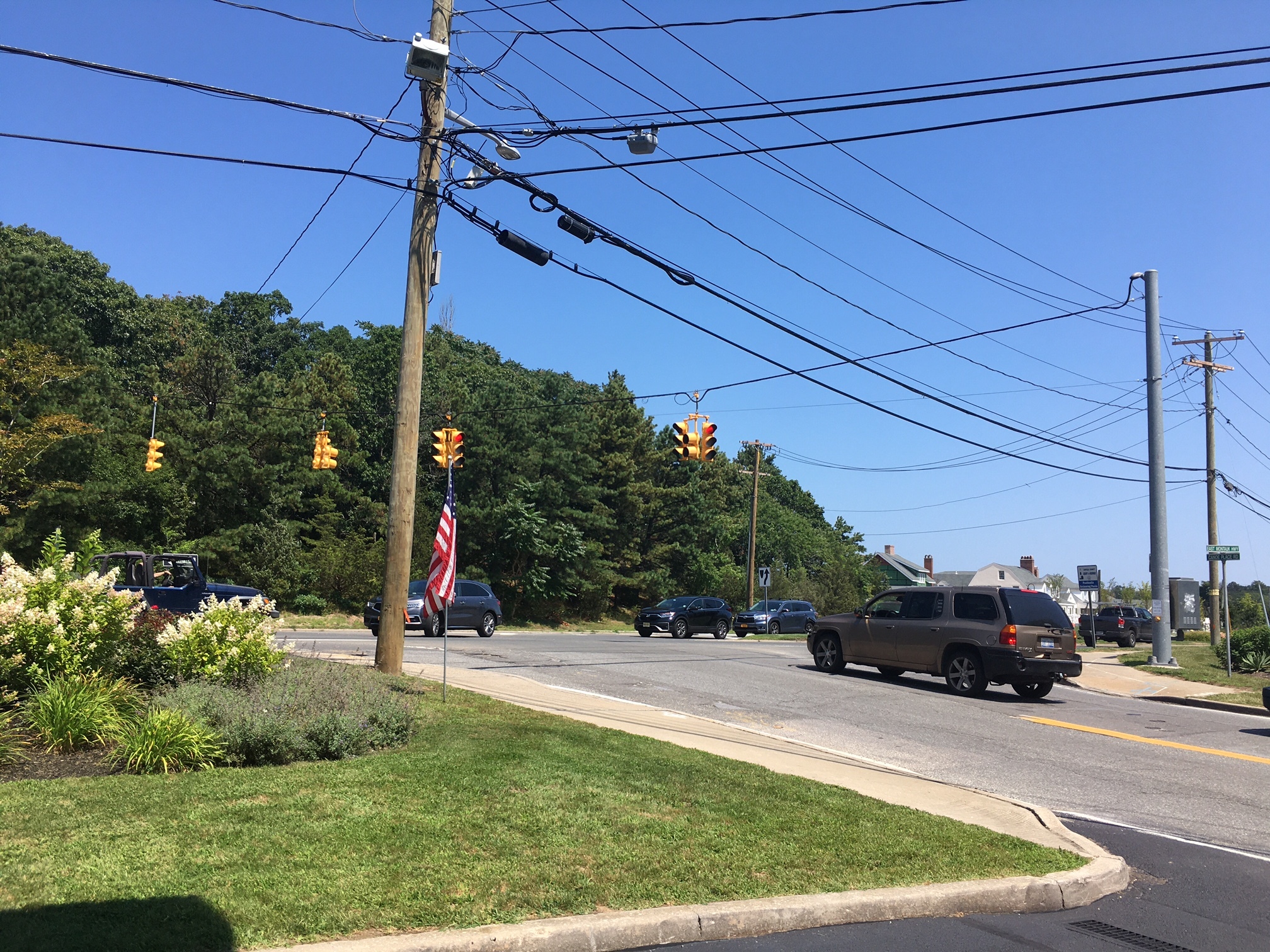
Morning commuters headed east may see a flashing yellow light at the Montauk Highway, Canoe Place Road intersection by the end of this week.
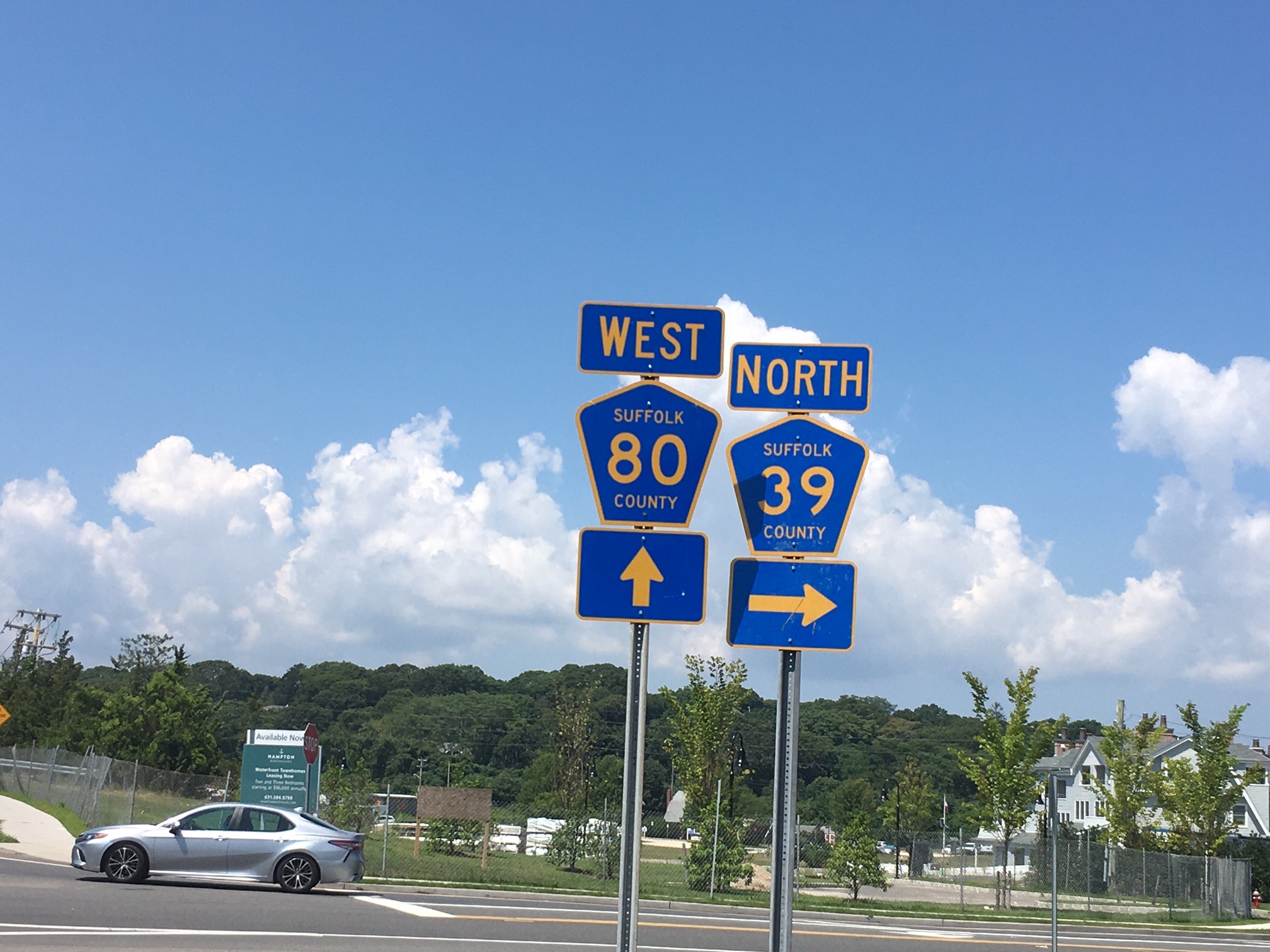
County officials voted to conduct of study of this intersection just east of the bridge in Hampton Bays. KITTY MERRILL
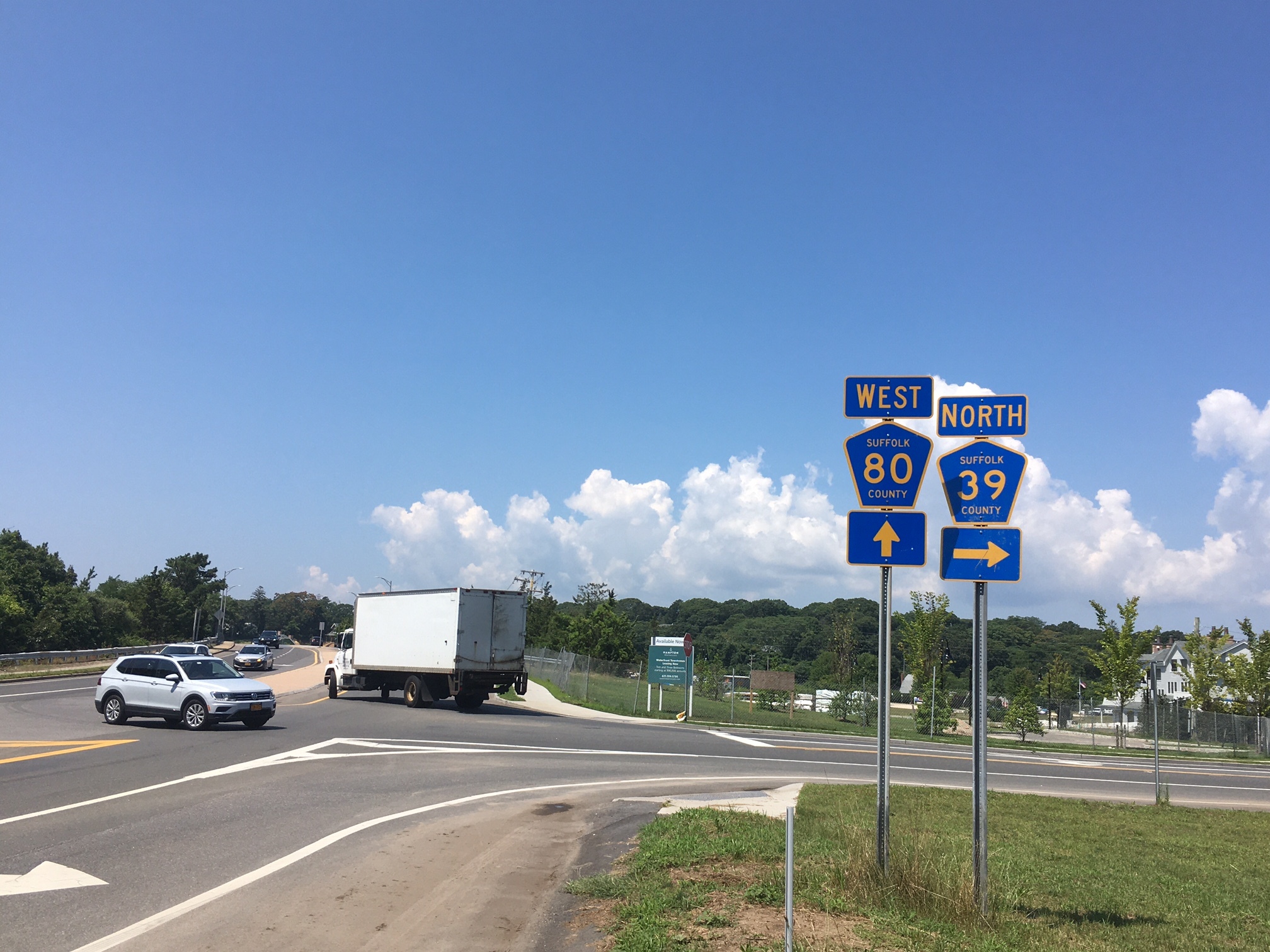
County officials voted to conduct of study of this intersection just east of the bridge in Hampton Bays. KITTY MERRILL
A bite-sized segment — just three-tenths of a mile — of the hellacious commute from points west through Hampton Bays is under scrutiny this week, as town and county officials strategize remedies for morning gridlock in the hamlet and beyond. A roundabout on one side of the Shinnecock Canal, and a blinking yellow light on the other — one a short-term experiment, and the other a long—term construction possibility — comprise the vision.
On Monday morning, Southampton Town Police were stationed near the Canoe Place Road-Montauk Highway intersection to assess existing conditions in advance of the blinking yellow lights pilot program. The experiment announced by Southampton Town Supervisor Jay Schneiderman last month targeted a half-dozen lights at key intersections. The idea was to set signals at the six spots to blinking yellow for two hours during the morning commute in an effort to lessen gridlock.
As of this week, the pilot program pivoted. Southampton Town Police Chief Steven Skrynecki, who was tasked with obtaining permission from state and county officials who hold authority over the targeted roads, said the lights will instead be targeted one at a time, beginning with the Canoe Place Road intersection.
The chief deployed officers to the intersection on Monday morning and the previous Friday morning. The goal was to determine existing conditions at the site and determine how to set up the blinking light. That drivers in a westbound turning lane use the light to flip around and head east was a challenge.
In the hope of avoiding congestion on Sunrise Highway, a volume of commuters will cross northern sections of Hampton Bays on residential side roads, then follow Newtown Lane south to Montauk Highway. They’ll proceed west to the light, then make a U-turn to head east.
The chief pointed out that the move would become dangerous once the light glows yellow. For the five days of the trial, U-turns from the left lane will be prohibited, as will left turns from Canoe Place Road onto Montauk Highway.
The chief plans to place signs prominently warning drivers of the changes for several days. The trial will run from next Monday, August 16, through Friday, August 20.
Once the light is blinking, Mr. Schneiderman underscored, the point is to keep drivers off the back roads and on Montauk Highway. Because the signal is blinking, traffic will keep moving, is the theory.
“We’re really trying to think through all the potential consequences,” the supervisor said. “We’re trying to anticipate what drivers will do. We’ve spent a lot of time and thought on that light.”
“There are a lot of problems in that area,” Mr. Schneiderman asserted.
Several years ago, developers of the town homes on the other side of the Shinnecock Canal, just three-tenths of a mile away, committed to spending a little over $1 million on improvements to the North Road-Montauk Highway intersection.
“They changed it and it’s still a problem,” Mr. Schneiderman said.
Responding to complaints from neighbors in the area, last week Suffolk County Legislator Bridget Fleming put forth a bill that, once it achieves final approval, will direct a feasibility study of the intersection, with an eye toward possibly building a roundabout at the site.
“As volume continues to increase, it’s causing folks to be concerned about traffic snarls at that location, especially during commute times,” Ms. Fleming acknowledged. “We need some serious engineering there so traffic can flow more easily.”
Improvements to the road were listed in the county’s capital budget for 2023, but the local legislator was able to find funding — $250,000 — for a study. The bill to fund the study could be eligible for a vote before the legislature as soon as September 9. “My intention is to keep pushing to get it done,” the lawmaker said.
Should a traffic circle be the preferred option to come out of the study, Ms. Fleming noted, “they are very expensive and complex.” The roundabout in Riverside came in at $5 million.
“Roundabouts are expensive and they need a lot of room,” Mr. Schneiderman concurred. Asked if the western side of the canal might be ripe for a roundabout, he said, “That would be weird. I don’t know if there’s enough room, but it’s probably worth taking a look. I just don’t know.”
Town officials got stung with the poorly engineered traffic circle on Mitchell Lane and Scuttle Hole Road in Bridgehampton. “It’s just not positioned well. It has to be tweaked so you don’t have all these people driving through the center of it,” the supervisor said.
Continuing the theme of traffic rotaries, Mr. Schneiderman noted that community members are studying the idea of roundabouts on either end of downtown Water Mill and eliminating the light at Station Road. “I don’t think it’s a bad idea,” Mr. Schneiderman said.
Many drivers favor the removal of the Station Road light in Water Mill, Chief Skrynecki agreed. It’s on the list of lights targeted in the blinking yellow experiment, he said. However, it’s under state authority and as of Tuesday, the chief had yet to hear back from state officials on earlier requests for bringing lights at certain state regulated intersections into the yellow light experiment. Pending state approval, the light at Station Road in Water Mill and the one at the intersection of St. Andrews Road and Montauk Highway in Southampton would both be very simple to implement, the chief said. Also targeted, but pending state approval, are lights on Route 24 in Flanders at its intersections with Longneck Boulevard and Oak Lane.
Officials are “taking a step back” from another intersection proposed for inclusion in the trial. The chief offered that the CR 39 and Tuckahoe Road intersection is “very complicated to modify.”
The crossing was an integral part of the traffic solutions during the U.S. Open. However, the change required a level of staffing the chief can’t spare at this time of the year. It wasn’t a matter of just a changed out signal, the intersection was manned with police officers. “It definitely showed promise during the U.S. Open,” Chief Skrynecki said. “But it was very manpower intensive at a time when we don’t have a lot of extra.”
As conversation about the blinking lights experiment circulated, people wondered why officials don’t employ the same technique in the afternoons for the hellish westward commute. Mr. Schneiderman explained that at that time of day, businesses are open and cross traffic, with drivers turning off roads into shops or shopping centers is too intensive.
“Doing this in the morning,” he said, “we can better understand how to keep the traffic flowing and what impact the lights are having. Then, maybe roundabouts become the answer to eliminating lights.”


