



 6 Photos
Christopher Gobler
Ph.D. Michael Wright
Dr. Christopher Gobler. MICHAEL WRIGHT
COURTESY SOMAS
COURTESY SOMAS
COURTESY SOMAS
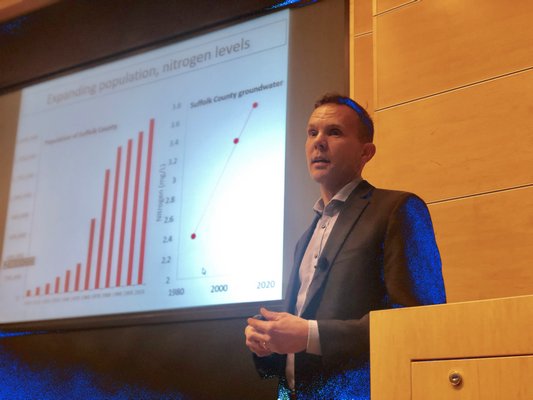
As he often does in his annual State of the Bays symposium, Stony Brook Southampton professor Dr. Christopher Gobler started out his presentation on Friday night at the college with a litany of stark reminders about the dire state that water bodies have been left in by human development on their fringes throughout the world.
From increasingly widespread and denser blooms of algae that can kill fish and other marine organisms by the millions overnight, to atmospheric changes that are expanding the conditions that the blooms thrive in, the challenges in protecting local waters from degradation, or reversing the impacts of the past, are mounting.
But Dr. Gobler, the most well-known leader of a large team of Stony Brook University scientists who have been at the fore of the effort to monitor and study the epidemic of harmful algae blooms on Long Island in the last two decades, also typically then spotlights reasons to think, or at least hope, things may be improving—however incrementally.
In 2018, there were signs aplenty that a wide variety of efforts begun in recent years to stanch water quality’s decades-long downward slide are starting to pay off.
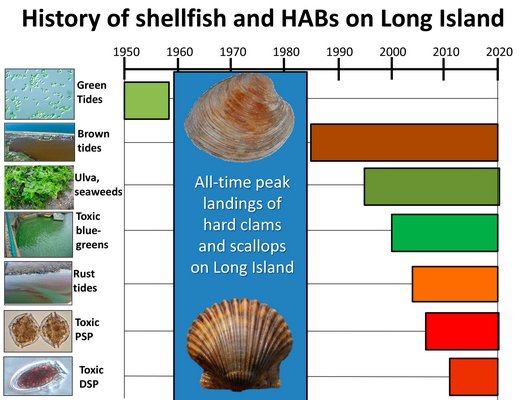
Last year was the first summer in 12 years that there was no bloom of the infamously destructive algae species dubbed “brown tide” in western Shinnecock Bay. Since Stony Brook researchers started dumping millions of hatchery-raised hard clams into the bay, as part of a multi-year program called the Shinnecock Bay Restoration Program, the densities of the brown tides—which decimated once-gargantuan native clam and bay scallop stocks in the 1980s—had been dropping, ahead of the 2018 hiatus.
The giant influx of algae-consuming clams into areas closed to shellfish harvesting, as part of the university program and similar efforts by the Southampton Town Trustees, also has resulted in major improvements in the number of wild clams that baymen are able to dig up from the bottom of the bay—a 700 percent increase since 2008.
And Dr. Gobler said that the populations of new wild clams have been found in almost the exact locations that his scientists had predicted using data on currents and expected drift of larval clams back in 2013, when they were designing the Shinnecock Bay Restoration Project.
In East Hampton, efforts by the Friends of Georgica Pond to remove dense growths of aquatic vegetation that scientists call macroalgae may be credited with less dense blooms of toxic blue-green algae that has plagued more ponds in Suffolk County in the last decade than any other county in the state.
Georgica had been one of the first hot spots in the region for the pea green blooms, which naturally emit a toxin that can be hazardous to the health of any person or animal that ingests or comes in contact with water contaminated by it—even, as has recently been discovered, breathes in spores of the algae, which can blow as much as a mile from the aquatic blooms.
Dense blooms in the pond had been blamed for the death of a dog near the pond in 2012, and had forced the closure of the brackish pond to the harvesting of its famous blue-claw crab population and other recreational activities in most summers.
But since the algae removal program began, using a motorized floating tractor that cleaves off the long fronds and sucks them into a hopper, the blooms have been less severe and shorter-lived.
Beyond the South Fork, improvements on a grander scale have been seen. The amount of nitrogen being poured into Long Island Sound was 60 percent lower in 2018 than it was in 2000, largely because of improvements in stormwater runoff capture, and the “dead zones” in the western portions of the sound, where water quality was so poor for decades that marine organisms could not survive in it, have shrunk to a shadow of their former selves. In Great South Bay, 3,000 acres of new sea grasses have grown back since a sewer pipe that once dumped waste treatment outflow into the bay was extended across the barrier islands and into the ocean.
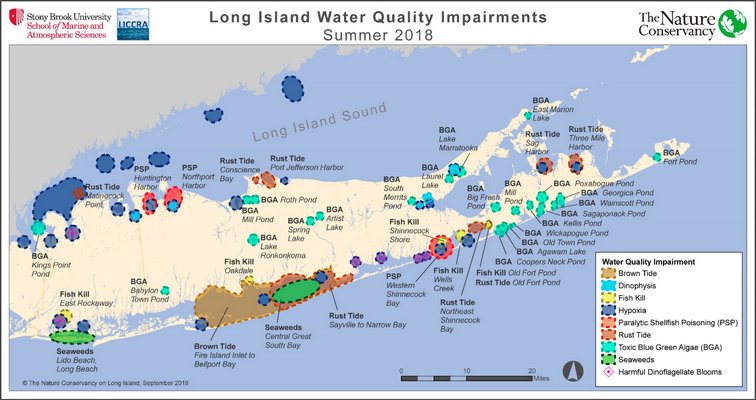
But back to the bad news: While brown tide has seemed, to a degree, to wane in western Shinnecock Bay, blooms of a toxic “red tide” and “rust tide”—two different algae species named for the color they stain the water when they are present—have been persistent, and are even strengthening in some cases.
In 2018, the rust tide blooms, which can kill fish and shellfish that are unable to swim out of an area of a bloom, were more widespread than ever before, stretching from the western reaches of the island to bays on both shores and out to Montauk and Gardiners Bay tributaries.
East Hampton saw severe rust tide blooms in Northwest Creek and Hog Creek and smaller densities in Three Mile Harbor and Accabonac Harbor, which had both been past hot spots.
“So this shows you the changing nature of rust tide,” Dr. Gobler said.
A bloom of the algae that enveloped the racks where shellfish are kept at the Stony Brook marine science laboratory in Shinnecock Hills killed 100,000 oysters.
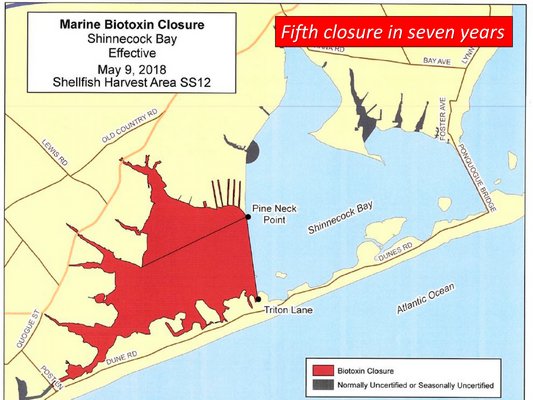
The blooms of red tide, which naturally emit a toxin that can be lethal to humans and forces the closures of shellfish harvesting where it is blooming, appeared for the fifth time in seven years in western Shinnecock Bay—the most occurrences of the algae of any water body on Long Island.
A third, blue-green algae is responsible for canceling the swimming portion of the Mighty Man Montauk Triathlon at Fort Pond two years in a row.
Global warming is likely exacerbating the spread of the algae blooms by giving them a longer window in which to take advantage of just the right combinations of temperature and rainfall to explode their numbers.
The uneven patterns of warming around the globe attributed to climate change, Dr. Gobler said, have warmed the waters around the New York Bight and Cape Cod three times more than the global average in the last 35 years. That has made the “window” for algal blooms 40 days longer than it used to be, he said.
And climate change may be to blame for changes to rainfall patterns on Long Island that also have contributed to conditions ripe for algae blooms. While total annual rainfall amounts have remained about constant for the region, the rain has been coming in shorter periods of very heavy rain. The number of heavy downpours, those dumping 1 to 2 inches of rain in a short period of time, has increased by 71 percent, Dr. Gobler said.
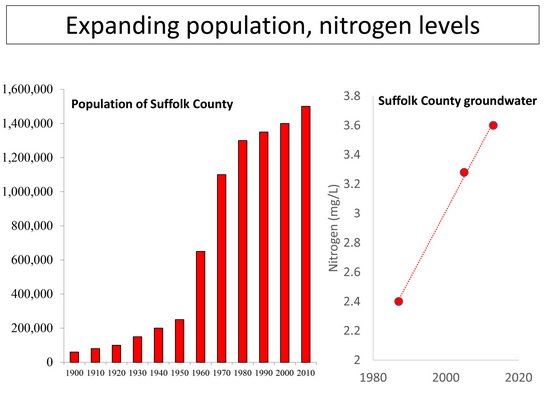
It is those heavy rains that tend to sweep up nitrogen-laden pollutants—like pet urine and lawn fertilizer—from road surfaces and flush them directly into surface waters, where the nutrients feed algae blooms.
The mounting challenges of an environment that is welcoming to destructive algae blooms makes the efforts to reverse the most deleterious effects of past human behavior even more urgent, the veteran scientist said.
“These are the things that are coming: warmer temperatures, more rain, higher nitrogen inputs,” Dr. Gobler said. “That much we know.”


 Michael Wright on Apr 9, 2019