


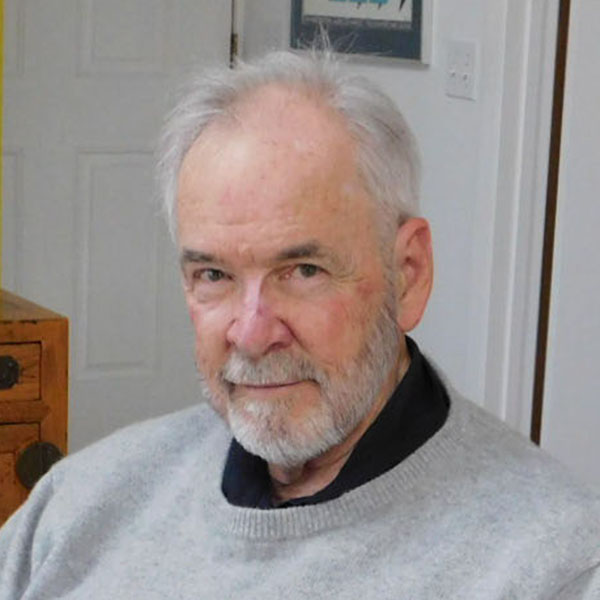
The occasion was my first book, “Reality Police: The Experience of Insanity in America,” which was published by Morrow in 1975. When I signed the contract to write this book, one of my selling points was that I would fake my way into one of the state mental hospitals in New York to see what it was like on the inside. What it felt like to be a patient in one.
And that’s what I did. I got one of my friends to drive me, suitably attired, i.e., like a street person, early one fall evening to Hudson River State Hospital in Poughkeepsie, where he presented me as someone he had found hitchhiking and had let me stay in one of his cabins — he ran a camp in the summer — and told the admitting crew that I had been acting a bit strange and had finally taken a heavy stick to a radio in the cabin, claiming that my wife was shouting at me over the radio, and had smashed the radio.
I sat there looking glum and didn’t say a word. The psychologist who was on duty that night spoke to a nurse: Did they need to put me on a locked ward? They decided against that but did admit me.
I was escorted to a nearby floor and given a shot — I didn’t know what it was — then taken to a bed in a dormitory holding about 16 other beds. They took my duffel bag away from me and helped me into bed. I noticed at once that underneath the bottom sheet was a rubber sheet. Everybody else was asleep.
I realized after about an hour of trying to sleep that I was extremely thirsty. I had seen a water fountain in the hallway. I got out of bed and set out to walk there for some water.
I could hardly walk, had to stay close to the wall for support, but finally made it to the water fountain and drank. Then I made it back to bed and fell asleep right away.
That was my first night. I spent a total of 11 days and nights in the hospital, getting to know other patients and the routines, eating the food — my first experience since college of institutional food — and taking the drugs. I was on Thorazine and another anti-psychotic, given in a daily lineup by aides, who were watching over us and also watching television, as were most of the patients. All day.
The aides on the night shift were also watching it at night. All night.
That, in fact, was the most disturbing part of the experience — the noise. We were all so well sedated that the aides had nothing to do at night except watch television, and you could not escape the noise. I found it crazy-making. I like quiet; I tend to be a quiet man, very much like my father. I like to read more than watch television.
So I got up every morning, walked to the institution’s store and bought a New York Times and read it on the grounds. I made no effort to act crazy, or even to discuss my wife talking on the radio, which had supposedly brought me there in the first place.
I had one interview with a staff psychiatrist. I was told to join a group therapy session, where I was relatively belligerent, questioning the drug regime. This was an old hospital; there were patients there who had been taking anti-psychotic drugs for years, and you saw them on the grounds from time to time, walking around jerkily, unable to control their movements or their facial expressions, especially something known as tongue thrust, where the person constantly pushes his tongue out of his mouth. Overall, the side effect of Thorazine is known as tardive diskenesia.
On my ward, there was absolutely no violence. This is the worst part of the mental health system. The public perception is that mental patients are gun-waving maniacs who shoot up schools or kill police or accost people on the sidewalks. The statistics show that mental patients tend, by a considerable percentage, to be less violent than the general population as a whole.
I saw very little craziness, either. Drugs have a lot to do with this. When you lined up to get your drugs, the aides who administered the pills checked your mouth after they handed them out to make sure you swallowed them. There were somewhat odd eating patterns. One man at lunch every day made a point of being first in line and took eight or nine pieces of white bread back to his table every day, nothing but the bread, no other food.
One catatonic man, who never said a word to anybody, was seen one day pooping on the floor as he walked around, then stooping as if to eat what he had deposited. An aide noticed and kept this from happening.
One young man, a bipolar individual in a manic phase, owned a small pocket tape deck and kept pushing cassettes into it, a different one every 30 seconds or so, and blasting out the sound. That, too, was crazy-making.
I got out after 11 days, called my then-wife, and she came and got me. It had been a sad time, and I cried most of the way home.
What got to me was the hopelessness. Most people did not have my options. I had faked my way in, and I knew what I had to do to get out. The real patients were not faking — they were there for a reason, and what they basically had was very little hope. They were not so much crazy as inept: They did not know how to live and survive in the outside world. They were daily shipped off to an IBM factory, where they made boxes, and they knew, bitterly, how demeaning that was.
This column was occasioned by a New York Times piece on the subject, titled “A Fatal Shove on the Subway and a Broken Mental Health System” (February 6). Yes, it is broken. It has always been broken, from the first attempts in Europe to deal with the mentally ill to today.
The truth is, nobody knows how to deal with the mentally ill. No one knows what causes schizophrenia or even what it is. I was hardly the first to fake my way into a mental hospital and report on it. At the time, I had a collection of old books written by people who had done just what I did. Some of them dated from the middle 1800s.
None of them concluded with workable solutions.
Mental health has a long and sad history. I have read a good deal of Freud — Freud on dreams, Freud on various patients. I read most of the concurrent discussions about the mental health system and its many failures. I know something of the long history of madness in Western societies.
It all still makes me sad.
Rage, conspiracy theories, racism — in a way the whole society seems to have gone mad right now. Witness the Trump cult. It’s hard for an educated man or woman to understand how anyone sane can put his or her trust in such a figure, known to be a liar, with more than 30,000 of his lies documented in The Washington Post, a serial abuser of women. In many senses of the word, a criminal.
It is a time in history when it is hard to be fully human, fully engaged in the social fabric.
More Posts from Anthony Brandt


