


 1 Photo
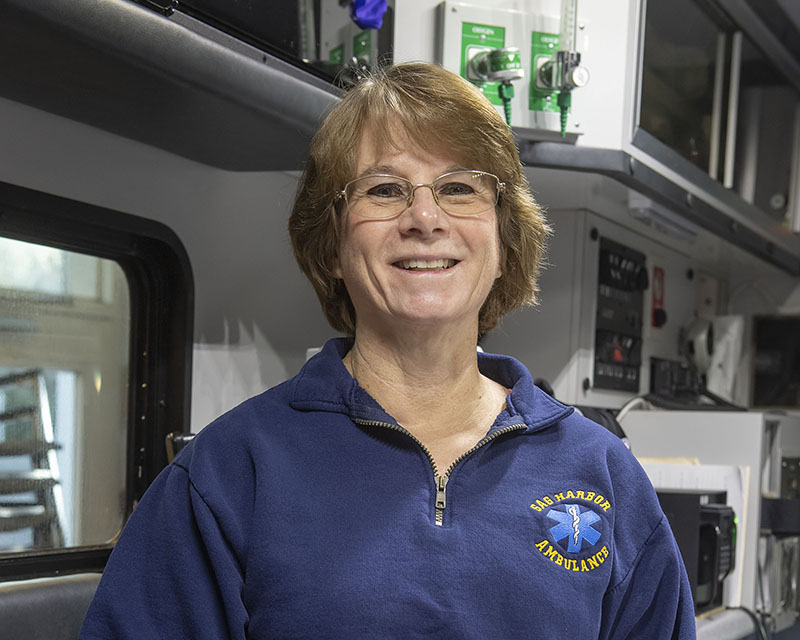
Deborah O’Brien Sag Harbor Volunteer Ambulance Chief Debbie O'Brien, photographed on December 10th, 2020
Quogue Village Police Sergeant Daniel Bennett is holding court at a table set up under the awning outside of Schmidt’s Country Market on a sultry Saturday morning, dispensing advice and a free cup of coffee, courtesy of the Patrolmen’s Benevolent Association, to passersby out for a pastry or a weekend stroll around the Village Green.
Bennett is here for a “Coffee With a Cop” event, and a steady parade of residents approaches the officer for the meet-and-greet opportunity. One expressed gratitude for the quick response by the local law enforcement agency to a recent medical emergency. Bennett explained New York State Law as it relates to executing a “citizen’s arrest” to one resident, while another wanted to know how to deal with loud parties and a possibly intoxicated neighbor, and thanked Bennett for his advice.
Coffee With a Cop is a program that started in 2011 in Hawthorne, California, by police officers there who were looking for a way to build community ties and trust in a casual and informal setting, which is not the typical civilian interaction with police. In the 12 ensuing years, the program has taken off around the country, where such events are now held in all 50 states and are lauded by police agencies and police reform advocates alike for their simple but effective way of building community buy-in with the work undertaken by cops.
Bennett had some gratitude of his own to share when he was asked about another successful liaison now afoot in the Village of Quogue — the Family Services League’s “DASH” program, which “provides an option that was not there before,” said Bennett, when it comes to dealing with police interactions with persons in some sort of crisis via substance abuse or who have a behavioral health or other mental-health issues, including suicidal ideation.
DASH is shorthand for the Family Service League’s Diagnostic, Assessment and Stabilization Hub, launched in 2019 to provide police across Suffolk County with difficult calls for service where it is not immediately clear whether a person needs to be hospitalized or not. The organization set up a hotline for police who can reach out for an assist when dealing with persons in crisis and launched a pilot program with the Southampton Town Police Department in 2021 to roll out the new initiative.
That program has been a big success, said Dr. Jeffrey Steigman, the chief strategy and innovation officer with the Huntington-based Family Services League, and the program quickly expanded to other agencies in the town, including the Quogue Village Police.
“It’s been game-changing in terms of what we developed,” said Steigman, recalling how his organization had meet with all the East End police chiefs and concluded that “there was a great need for this type of collaboration, and part of that is aligned with police reform efforts generally — a natural way to figure out how to move the needle and best serve the community.”
The pilot program, said Steigman, helped to build a “proof of concept” that was then embraced by the Suffolk County Police Department and East End agencies.
The problem, said Steigman, was that in the past, agencies were “reflexively bringing people to the hospital,” which didn’t always “result in optimal outcomes,” if people were simply seen and released back into their communities without some sort of after-care plan.
His organization is now licensed by the State of New York and offers a crisis stabilization center, a hotline, and a mobile crisis outreach team, noting that “the three components of the crisis continuum” has helped to divert a lot of persons in crisis away from the hospital and into a care network suited to their needs.
Most of the East End agencies who participate, he said, rely on a telehealth process to provide officers with a field assessment of a person in crisis.
“While they are on-scene, we initiate a telehealth encounter” and assist the officers in triaging and assessing the person’s disposition in order to figure out what to do — continue de-escalation, or dispatch mobile crisis at that time or subsequently for a wellness check, or arrange for transportation to the crisis center. The FSL can also “determine that there is no imminent risk but provide treatment options. In the minority of cases we may determine with the officer that they are in imminent risk and need to be transported to the hospital.”
Steigman noted that 80 to 85 percent of all the calls the FSL receives involve individuals who do not ultimately require hospitalization and added that in June of this year the organization got 349 requests for telehealth interventions across the county, with about 40 percent of those coming from the East End “and the most prevalent in terms of departments is Southampton and Riverhead. But we’re also involved with Southold, Shelter Island, Quogue, Sag Harbor and East Hampton town and village.”
The DASH program, he said, wouldn’t have been possible without the advocacy of State Assemblyman Fred W. Thiele Jr., beginning about eight years ago and following the suicide of three students at East Hampton High School in 2013. The FSL stepped in then to create a program, working with local school districts, to develop a process where if a student was in crisis, “they would have real time access to our staff” — instead of just being driven to the hospital. “Between that and then taking the next steps and working with law enforcement — that has been the proverbial game-changer,” said Steigman.
Back at the Coffee with a Cop event, Quogue Village Mayor Robert Treuhold has stopped by the table and sips at a cup of coffee while engaging with Bennett and the stream of residents dropping by the table. Treuhold is a big fan of the DASH program, too. “Anything any of us can do in the village to help with mental health, behavioral health issues — that’s a good service,” the mayor said.


