


 1 Photo
A wave of opposition is rising against a proposed Southampton Village law that would allow supermarkets to be built in the highway business district.
Village officials have said that a 68,950-square-foot lot owned by the Glennon family that is currently housing a shuttered automobile dealership on the village’s eastern border with Water Mill sparked the drafting of the proposed legislation. The legislation itself seeks to amend the village code to allow a supermarket to be built, as a special permit use and with Village Board approval, on parcels zoned highway business.
The Glennons already have an arrangement with The Fresh Market, a North Carolina-based grocery store chain, to apply for just such a use should the village approve the law, according to Bob Silver, the broker for the family. And their attorney, Gil Flanagan of Bourke, Flanagan and Asato P.C. in the village, has said that preliminary sketches have been drafted.
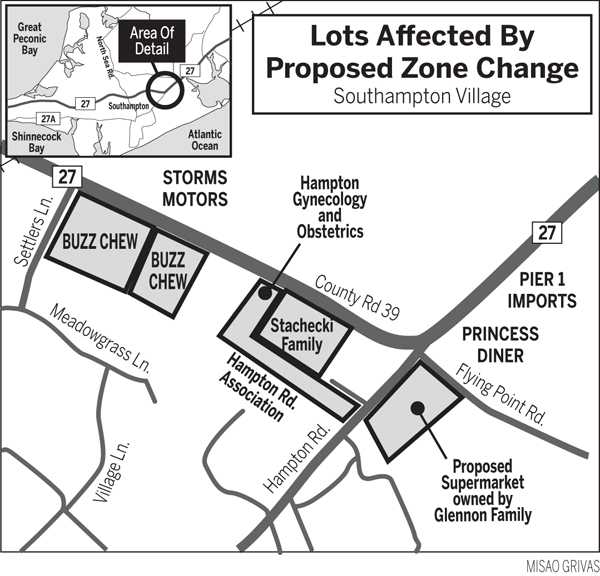
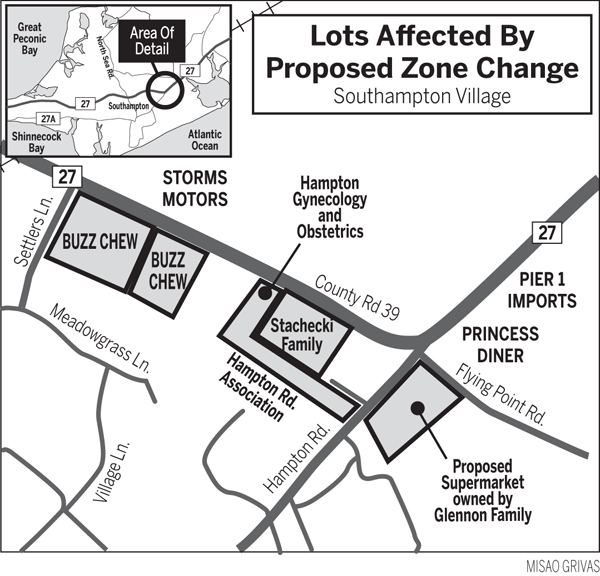
Village officials have repeatedly stated that there are nine total lots that the law would apply to, though they have not identified any of the properties, maintaining that the law is being drafted with a singular focus. An examination of tax maps of the highway business district reveals just four other sites, aside from the Glennons’ land, that would meet the criteria, and all are largely developed already.
The Water Mill Citizens Advisory Committee has unanimously voted to oppose the village’s proposed zoning changes and plans to send a letter of objection to village officials this week, CAC Chairwoman Rachel Verno said. She and other Water Mill residents are planning to attend a public hearing on the law scheduled for Thursday, January 12, at a Village Board meeting that begins at 6 p.m. at Southampton Village Hall on Main Street.
Two local grocers—Dennis Schmidt, who owns Schmidt’s Market on North Sea Road in the village, and Mike DeGennaro, the owner of Avanti Market and Southampton Wines, both of which are in the Water Mill Shoppes plaza off Montauk Highway in Water Mill—have charged that a new supermarket would hurt their businesses.
The legislation, meanwhile, took a small step forward last Thursday, December 8, when the Village Planning Commission recommended the adoption of the law. Planning Commission Chairman Siamak Samii submitted a letter of support in place of the presentation he was originally slated to give.
“The proposed law is a welcome and necessary addition to the village code to provide additional supermarket activity and use within the confines of the village proper without burdening the intrinsic nature and architecture of the historic district of the village business district,” Mr. Samii’s letter states.
But opponents counter that the highway is not the place for a supermarket. The “high-traffic” volume generated by a grocery store directly contradicts the intent of highway zoning, which is to produce “low-traffic-producing” businesses, Ms. Verno said. She added that it was part of the reason the CAC also objected to the Tuckahoe Main Street proposal, a plan that was defeated last year and called for a 40,000-square-foot King Kullen, among other buildings, along County Road 39 in Tuckahoe.
Ms. Verno also said the legislation could be interpreted as spot zoning—a charge that Southampton Village Mayor Mark Epley has denied.
“There were multiple things that happened at one time,” the mayor said this week about how the legislation came about. He said the village recognized a need for a grocery store, determined there were no suitable sites in the village business district, and therefore started looking villagewide. He added that the Tuckahoe Main Street proposal popped up around the time that the Glennon family, the owners of the lot at 630 Hampton Road that fronts Flying Point Road, approached him about the possibility of placing a supermarket at their site.
Still, Ms. Verno and others are not convinced that things transpired that way.
“This feels more like an applicant came to the village and said, ‘We’d like to be at that location,’ not the other way around,” Ms. Verno said on Tuesday. She added that she serves on the town’s County Road 39 committee, and that a need for a supermarket on the highway has never been discussed.
According to village officials, a supermarket at the Glennon site would satisfy those residents who want another local grocery store. The plan would also help spruce up one of the gateways to the village, they said. At the same time, the measure would prohibit development as large as the proposed Tuckahoe Main Street project in nearby Tuckahoe that locals—and the village itself—resoundingly objected to last year.
Under the proposed law, a supermarket ranging from 10,000 square feet to 20,000 square feet could be built as a special permit use on a handful of village highway lots that measure at least 60,000 square feet, or just shy of 1.5 acres, and front County Road 39 or 39A or Flying Point Road. The Glennons’ lot is the only one that fronts the latter. Special permit uses require Village Board approval.
The mayor noted that passage of the law would not override Suffolk County Department of Health decisions or traffic studies, for example. “It’s just not a rubber-stamp saying, ‘Hey, somebody’s going to get an approval,’” he said.
The other sites that would be eligible include a gynecologist’s office, a house owned by the Stachecki family, and two lots owned by Buzz Chew Chevrolet-Cadillac, according to Village Tax Receiver Danielle Burns.
Mr. Silver, the broker for the Glennons, was present at last week’s Village Board meeting, but did not speak publicly.
Mr. Schmidt, in addressing the board last Thursday, touched on a similar point to Ms. Verno’s. In 1978, before he owned his first market, the village building inspector scolded him for suggesting zoning be changed so that he could open a market at the site of a closed gas station on Hampton Road.
“Now, here we are, 30 years later, and that’s what we’re doing,” he said. “We’re changing the zoning to accommodate someone or something that I don’t see the reason for.”
Large supermarkets in Bridgehampton and Hampton Bays, short drives east and west of the village, respectively, negate the need for a new supermarket in the village, he added. “We’re cutting up the pie. We’re really cutting it up,” Mr. Schmidt warned. He also criticized the board for scheduling a public hearing for January, when many locals are away.
“Competition’s fine,” Mr. DeGennaro said. “I believe in free markets and capitalism, but with the government changing the laws to allow other competitors in, I think it’s a bit of an unfair advantage, that the local businesses will suffer.”


 Colleen Reynolds on Dec 14, 2011