


 3 Photos
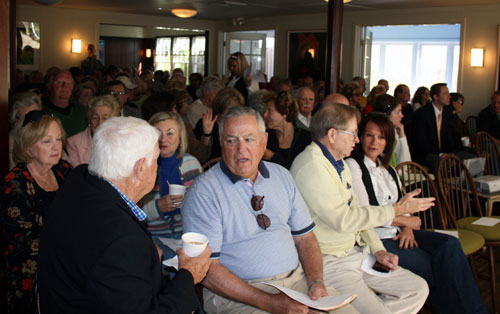
More than 100 people turned out for the Jewish People Opposed to the Eruv meeting on Sunday morning at Starr Boggs. JESSICA DINAPOLI
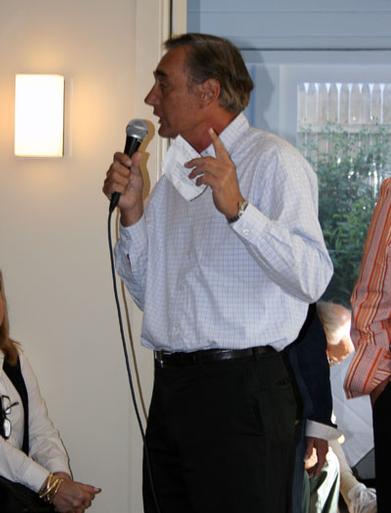
Hal Kahn

the communications director for the Jewish People Opposed to the Eruv
The leaders of a Jewish group fighting the establishment of a designated area in Westhampton Beach in which Orthodox Jews would be exempt from certain religious rules, urged more than 100 people at a Sunday morning meeting to sign petitions in support of their position.
The petitions will be submitted to village officials, and to the utility companies which would have to agree to the placing of strips of PVC piping on telephone and power line poles that would delineate the boundaries of the area. Within the proposed one-square-mile area, called an eruv, Orthodox Jews may bypass religious restrictions and push or carry things—including wheelchairs, baby carriages and strollers—to temple on the Sabbath. The synagogue first proposed the eruv to the Westhampton Beach Village Board in February.
At the meeting, held at Starr Boggs restaurant in Westhampton Beach, by an organization called Jewish People Opposed to the Eruv, the group’s founder and president, Arnold Sheiffer, spelled out why the group opposes the idea; he also chronicled the history of the Hampton Synagogue’s push to establish an eruv in the village.
Mr. Sheiffer, a longtime Westhampton Beach resident and Manhattan media executive, ended the hour-long meeting by telling people to sign a petition to be handed to the Long Island Power Authority and Verizon, stating that the community opposes the eruv. There also was a petition to be signed in support of an 18-page legal memorandum, spelling out the opponents’ case against the eruv. It was written by constitutional attorney Marci Hamilton. Ms. Hamilton was hired by another anti-eruv group, called the Alliance for the Separation of Church and State in the Greater Westhampton Area, to draft the opinion.
On Monday, Mr. Sheiffer said that more than 150 people had signed each petition. He added that he is expecting more signatures.
“The eruv is not the issue,” Jack Kringstein, the vice president of Jewish People Opposed to the Eruv and a resident of Remsenburg, said at the meeting. He added the eruv would change the community for the worse. He did not explain what he meant.
Mr. Sheiffer asserted at the meeting that the eruv prevents Jewish people from assimilating into their surrounding culture—a fact that he believes goes against Jewish law.
“They in no way observe the customs of the community—it becomes a place unto themselves,” Mr. Sheiffer said Monday, expanding his comments about the effects of the eruv. “That’s the way they want it—they don’t talk to anyone, women don’t have the same rights. We don’t want a special area set aside for any religion. We want to maintain a secular community.”
Mr. Kringstein said that Jewish People Opposed to the Eruv will be submitting a petition to the utility companies arguing there is a code in Westhampton Beach that prohibits the placement of signs on utility poles. Mr. Kringstein and Mr. Sheiffer cite the code to differentiate Westhampton Beach from Tenafly, New Jersey, a community that had a six-year-long battle over an eruv. Tenafly did not have such a restriction, Mr. Kringstein said.
The petition for LIPA and Verizon states that the group “objects to the use of utility poles and wires for any religious purpose” and states that using poles and wires violates a section of the code for Westhampton Beach Village.
Building Inspector Paul Houlihan has said that he does not consider the PVC-piping that would be used to demarcate the eruv, to be a sign.
The synagogue has withdrawn its application to the village for the eruv in order to suspend the review process but plans to resubmit it. Synagogue President Morris Tuchman said last week in an e-mail that the application would not be in the village’s hands for at least another two weeks. First, the synagogue will be submitting a legal opinion on the eruv authored by Manhattan attorney Robert Sugarman.
At Sunday’s meeting, Mr. Sheiffer asked attendees to remember the eruv issue over the winter, and to keep discussing the issue throughout the off-season.
Hal Kahn, the communications director for the group, said that attendees should read the blog against the eruv that he authors. The blog can be found at stopthewhberuv.blogspot.com.
Quiogue resident Irene Barrett lauded Jewish People Opposed to the Eruv for its efforts, and also told audience members to attend winter village trustee meetings and work sessions.
“I’ve been involved in this since March, and this presentation was fabulous,” Ms. Barrett said at the meeting.
She said that she believes that Hampton Synagogue founding Rabbi Marc Schneier will try to “sneak in” the eruv sometime between November and May.
At the meeting, Mr. Sheiffer said that the concerns of Jewish People Opposed to the Eruv followed from a Hampton Synagogue mid-summer information session on the eruv. At that meeting, Manhattan attorney Joel Cohen read e-mails that had been received, expressing anti-Semitic remarks, and provoked a large number of people attending the information session to leave the meeting.
Mr. Sheiffer and others in the audience Sunday aimed barbs at Rabbi Schneier. “The rabbi said the eruv was going to be black two-by-fours, then he said pipes ...” Mr. Sheiffer said. “The rabbi doesn’t know what the eruv is going to be, and neither do I.”
Others complained of the rabbi’s personality, and claimed that the synagogue ignores village rules. One man, who did not wish to have his named printed, asked whether or not the rabbi owned the Hampton Synagogue.
Mr. Sheiffer said that it was the “50th time” he had heard that question and went on to say that he hopes to have members of the group determine the truth about the ownership of the synagogue. Mr. Sheiffer formerly served as the treasurer for the Jewish Center of the Hamptons in East Hampton and said that its financial information was made available at monthly meetings.
“My understanding is that they absolutely do not do that,” Mr. Sheiffer said about the Hampton Synagogue.
Mr. Kahn said that he believed that Rabbi Schneier had 100-percent financial control of the synagogue.
The Hampton Synagogue did not return phone calls on the matter before publication.
In a PowerPoint presentation Sunday, Mr. Sheiffer stated that the synagogue held a loud wedding with amplified music on September 7. Additionally, Mr. Sheiffer said that the synagogue violates village parking rules and uses amplified music. According to minutes from Westhampton Beach Village Planning Board meetings in the early 1990s that were shown in the presentation, Rabbi Schneier promised the board there would be no amplification or parking issues because of restrictions on the Sabbath.
Mr. Sheiffer said that the rabbi has not stood by his word.
“This goes to the basis of trust here. If he signs an agreement with the village, he has to follow the rules,” Mr. Sheiffer said. “In Jewish law, you’re not supposed to bear false witness or tell lies. You’re not supposed to say to someone ‘my congregation is Orthodox’ and it’s not.”


