


 1 Photo
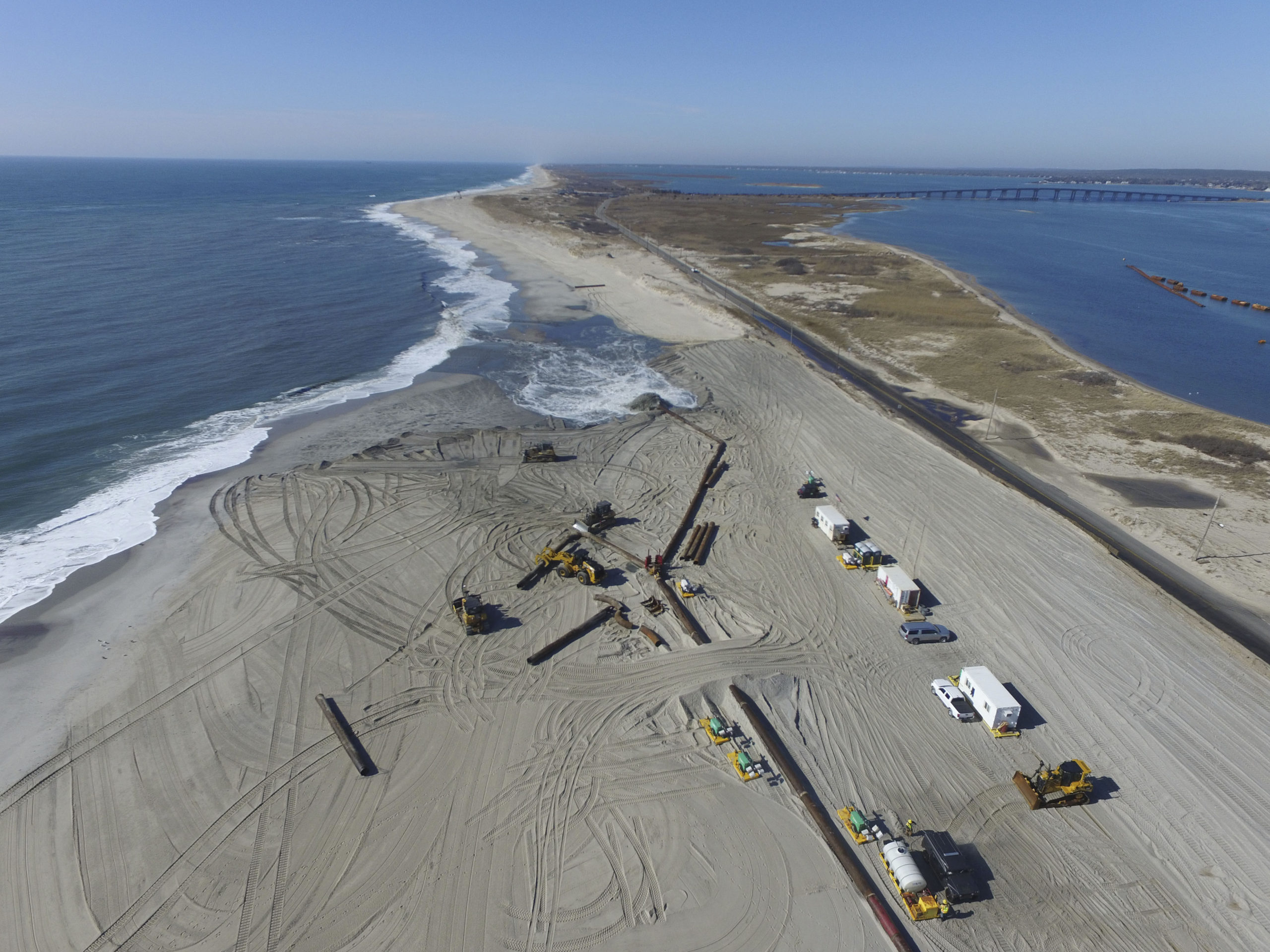
Crews were dredging west of the Shinnecock Inlet in Hampton Bays on Monday.
Dredging operations are underway at the Shinnecock Inlet, as crews continue to pump hundreds of thousands of cubic yards of sand onto the beach just west of the jetty in Hampton Bays.
Southampton Town Supervisor Jay Schneiderman said he visited the scene on Sunday and described the beach as “enormous.”
“It’s all the way down the jetty — not to the end, but it’s getting close to the edge,” he said on Monday. “I had gotten an update a week ago, and [Great Lakes Dredge and Dock of Oak Brook, Illinois] had already done 100,000 yards. My guess is that they’re probably around 300,000 yards, maybe more.”
The beach where the sand is being deposited was heavily eroded in the fall as a barrage of coastal storms impacted the area.
The first breach of the dunes protecting places like Sunday’s on the Bay and the Shinnecock Commercial Fishing Docks took place in October and, up until a few weeks ago, Mr. Schneiderman and officials from the Town Highway Department and Suffolk County have been trying to prevent another breach by maneuvering sand back into a dune formation.
“It’s great to go down there, having spent a good part of my winter working to hold back a breach from forming and holding back the tides,” he said.
At one point, county crews dredged sand from inside the inlet onto the beach, though the next storm that came through swept a big portion of it back to sea.
Pleas made to U.S. Representative Lee Zeldin and Senator Chuck Schumer seeking emergency actions to replenish the beach resulted in a quicker-than-expected solution. The U.S. Army Corps of Engineers agreed to accelerate the bidding process from a 90-day procurement to 10 days to expedite the dredging. Great Lakes Dredge and Dock submitted a bid for $10.7 million and won the project.
Now, their crews are working to pump 600,000 cubic yards of sand into “the bowl” — a scooped-out area of beach that is starved of sand due to the east-to-west littoral drift being interrupted by the jetties at the inlet — while also restoring the sand dunes to a height of 15 feet and 140 feet from the shore.
The idea is that, when finished, the beach will be at the same width that it was 15 years ago.
“For me, to go out there now and see what’s there is a huge relief for me, knowing, basically, it was like rewinding a clock by 15 years, to the beach that was there 15 years ago,” Mr. Schneiderman said. “It will probably take another 15 years to make it disappear, but they’re coming back in three to five years to replenish it again to make it wider. They’re building it back to the conditions by which the [Fire Island to Montauk Point] plan was engineered as a starting point.”
This particular part of the plan is called the West of Shinnecock Inlet — or WOSI — emergency replenishment project.
Restoring the beach, Mr. Schneiderman explained, is crucial for the area. “We have three restaurants, several marinas, a commercial fishing dock and commercial fish packing, plus a bunch of bathing beaches. Plus the fact that it’s a barrier beach protecting the mainland,” he said. “So there’s several reasons why this is important.”


 Greg Wehner on Feb 26, 2020