


 1 Photo
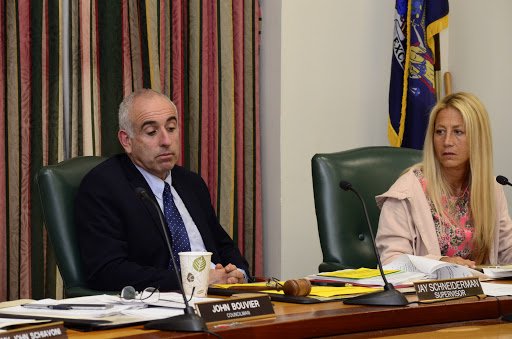
Southampton Town Supervisor Jay Schneiderman and Councilwoman Christine Scalera at a recent public hearing to discuss the Hampton Bays Downtown Overlay District. GREG WEHNER
The Southampton Town Board’s plan to revitalize Hampton Bays came under fire on Tuesday.
Several Hampton Bays residents spoke at a public hearing at Southampton Town Hall to discuss aspects of the proposed Downtown Hampton Bays Overlay District, a form-based code that, according to Southampton Town Planning and Development Administrator Kyle Collins, was designed to create a “vibrant and walkable downtown” similar to those found in Sag Harbor and Southampton Village.
For nearly a decade, the town has been working with community groups, including the Hampton Bays Civic Association, to develop a corridor study detailing the aspects of a walkable downtown.
The Town Board approved the study in 2013 and subsequently hired New York City-based Historical Concepts, an architecture and planning firm, to transform those recommendations into a pattern book, which was finalized in June 2017.
However, Hampton Bays resident Mary Pazan, a former member of the Hampton Bays Civic Association, said that the board’s latest revisions to the overlay district do not reflect the community’s recommendations and, even further, disregards their concerns.
Under the proposed plan, the town has suggested the establishment of four distinct zoning districts. Those include the central downtown district, a transition district, an edge district and open space—each of which is specifically designed to enhance the hamlet and encourage a variety of retail stores, restaurants, offices, service-related businesses, hotels, and cultural, recreational and assisted living facilities, according to a draft version of the plan.
Instead, Ms. Pazan said that the “ill-conceived” plan will push the hamlet to its brink with development.
“Build, build, build seems to be the mantra,” she said. “The board seems to act in spite of the best interest of the taxpayers in Hampton Bays.”
Based on a 10-year build-out scenario, the hamlet can expect to see an increase in residential density—by roughly 147 full-time apartment units—as well as increases in solid waste generation and water usage, according to a supplemental draft environmental impact statement, or EIS, prepared by Charles “Chick” Voorhis of Melville-based Nelson, Pope & Voorhis.
According to the draft EIS, water usage in the hamlet is expected to increase from 75,494 to 141,176 gallons per day, and sanitary waste generation is expected to increase from 62,787 to 128,829 pounds per day—requiring infrastructure upgrades to the Hampton Bays Water District and the installation of a sewage treatment plant.
Additionally, the Hampton Bays School District can expect to see an additional 15 students. Mr. Collins said that the financial impact on the school would be covered primarily by an anticipated increase in tax revenue from future development.
Hampton Bays resident Ray DeAngelo, however, was skeptical that the impacts to the school would be as minimal as Mr. Collins predicted. “It’s science fiction that there’s only going to be 28 kids coming out of 248 apartments,” he said.
He also argued that the intent of the form-based code is, in fact, moot, noting that big-box stores—precisely what the community doesn’t want to see in the hamlet—are the future of Hampton Bays regardless of whether the Town Board approves the plan.
Stores are closing all over the place,” he said pointing to the Hampton Bays United Artist movie theater, that will close its doors in December. “I know these people want all these shops, it’s not going to happen. They’re not sustainable.”
In fact, Mr. Voorhis explained that, if approved, developers are not bound by the form-based code. He explained that it is in essence an “overlay” of the town’s pre-existing zoning code, which he said will continue to be used by the town’s regulatory boards to determine what can and can’t be developed.
Additionally, hamlet resident Gayle Lombardi stressed that several aspects of the plan were not consistent with the community-driven corridor study.
For example, she pointed to the proposed transition district, which, if approved, would allow for first floor residential apartments—an aspect that she said was never discussed with the community.
She argued that the hamlet could not endure any more density, calling the residential aspects of the plan “extremely offensive.”
“There’s a lot of good things in the plan, but these elements have to be removed,” she said.
Mr. Collins, however, confirmed that the transition district does not allow for first-floor residential units along Springville Road or Montauk Highway.
While a large majority of residents who spoke at the meeting were either opposed or concerned over the town’s plan to revitalize Hampton Bays, there were a select few who were in favor of it.
Susan von Freddi, president of the Hampton Bays Beautification Association, said that the form-based code would help promote local businesses and bring a much needed vibrancy to the hamlet’s main street.
Maria Hultz, president of the Hampton Bays Civic Association, agreed, although she suggested that the Town Board provide some form of incentive to community-based shops rather than big-box stores. “We’re looking forward to seeing a very pretty town,” she said.


 Valerie Gordon on Jun 26, 2019