



 9 Photos
Janice Landis
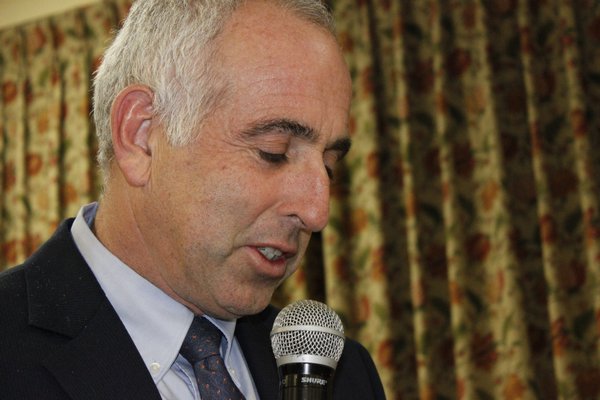
president of the Hampton Bays Civic Association poses questions to members of the DEC. VALERIE GORDON
Jay Schneiderman attended the Hampton Bays Civic Association meeting. VALERIE GORDON

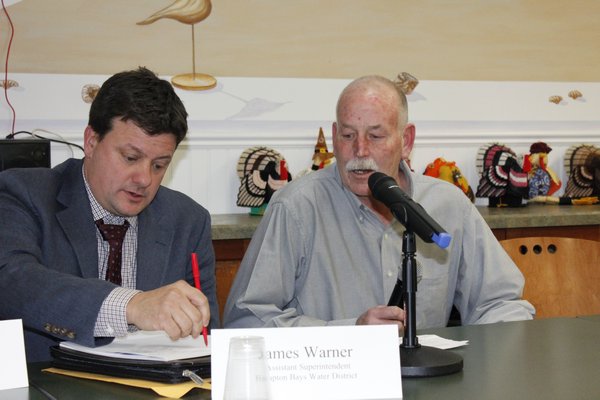
John Collins and James Warner answer questions about the carbon filtration system. VALERIE GORDON
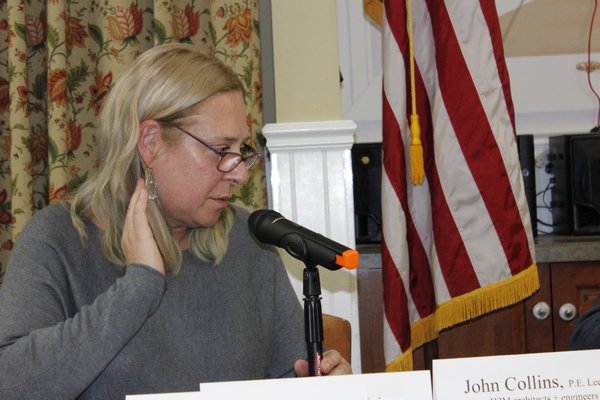
John Collins of H2M Architects and Engineers answers questions regarding the carbon filtration system. VALERIE GORDON
Mary Pazan of the Hampton Bays Civic Association poses questions to members of the DEC. VALERIE GORDON
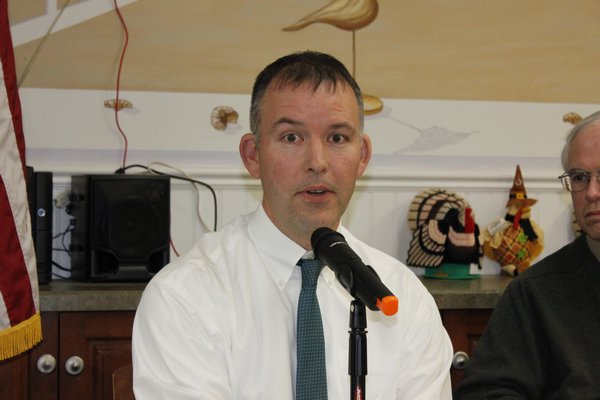
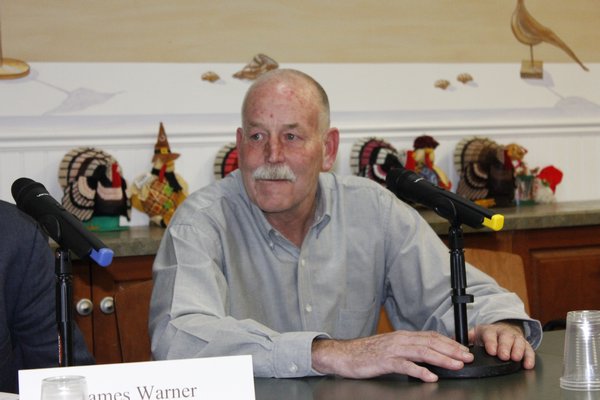
James Warner answers questions regarding water quality. VALERIE GORDON

Brian Jankauskas answers questions regarding water quality. VALERIE GORDON

Steven Karpinski answers questions about water quality. VALERIE GORDON
The Hampton Bays Fire Department may be required to pay $100,000 in maintenance costs every two years for a new carbon filtration system if they are found to be responsible for the contamination of two drinking water wells used by the hamlet’s municipal water system.
State Department of Environmental Conservation officials announced at the Hampton Bays Civic Association meeting on Monday that the fire department is under investigation by the DEC after routine testing of the Hampton Bays Water District’s wells located between 100 and 150 yards of the fire department’s main firehouse on Montauk Highway detected traces of two unregulated chemicals found in firefighting foam formerly used to put out gasoline fires.
The HBWD shut down the two wells over the past year after the two chemicals—perfluorooctane sulfonate, or PFOS, and perfluorooctanoic acid, or PFOA—were found. Further testing revealed that the water contained 0.073 parts per billion, or ppb, which is “slightly” more than the Environmental Protection Agency’s limit of 0.07 ppb, according to Robert King, superintendent of the water district and also a commissioner with the Hampton Bays Fire Department. Mr. King did not attend Monday’s meeting.
The DEC has suggested that the contamination likely will be traced to firefighting foam used during training exercises at the hamlet’s Montauk Highway firehouse. The Hampton Bays Fire Department is currently the only site being investigated at this time, according to Brian Jankauskas, an environmental engineer with the DEC.
HBWD customers are using water provided by nine other wells that presently meet U.S. Environmental Protection Agency standards for PFOS and PFOA, according to the district.
The Hampton Bays Fire District’s attorney, Stanley Orzechowski, was not present at Monday’s meeting but said in a previous statement that the department would cooperate with the DEC but also would hire its own investigators to probe the 2-acre property.
If found to be the source of the contamination, the fire department property could be added to a state Superfund list—described as any land in the United States that has been contaminated by hazardous waste and poses risks to human health or the environment, Mr. Jankauskas said.
None of fire district's four fire commissioners returned phone calls on Tuesday.
A carbon filtration system will be installed on the two contaminated wells by next spring. It is estimated to cost $1.2 million upfront and approximately $100,000 every two years afterward for maintenance costs to replace the granular activated carbon filters, for which the Hampton Bays Fire District would be responsible for purchasing if found responsible.
Assistant Water District Superintendent James Warner confirmed at Monday’s meeting that the majority of the $1.2 million will be covered by a state grant of $720,000, and that the remaining balance would be covered by reserved settlement money from a previous lawsuit after MTBE, a gasoline additive, was found in the hamlet’s aquifer approximately 10 years ago.
As of now, the two wells will be the only wells out of the hamlet’s 11 that are slated to get the costly filtration system, Mr. Warner said. He explained that the system will remain in place for as long as it is needed, adding that “if it takes two years, they will be in place for two years, or if it takes 20 years, they’ll be there for 20 years.”
Once the filtration system is in place the wells will be tested monthly for both PFOA and PFOS. He confirmed that once complete, the system will remove “100 percent” of the contaminants.
It is unknown at this time how long the two contaminated wells will be out of commission, but State Department of Health employee Steven Karpinski confirmed that “the exposure has been ceased.”


 Valerie Gordon on Nov 28, 2017