


 3 Photos
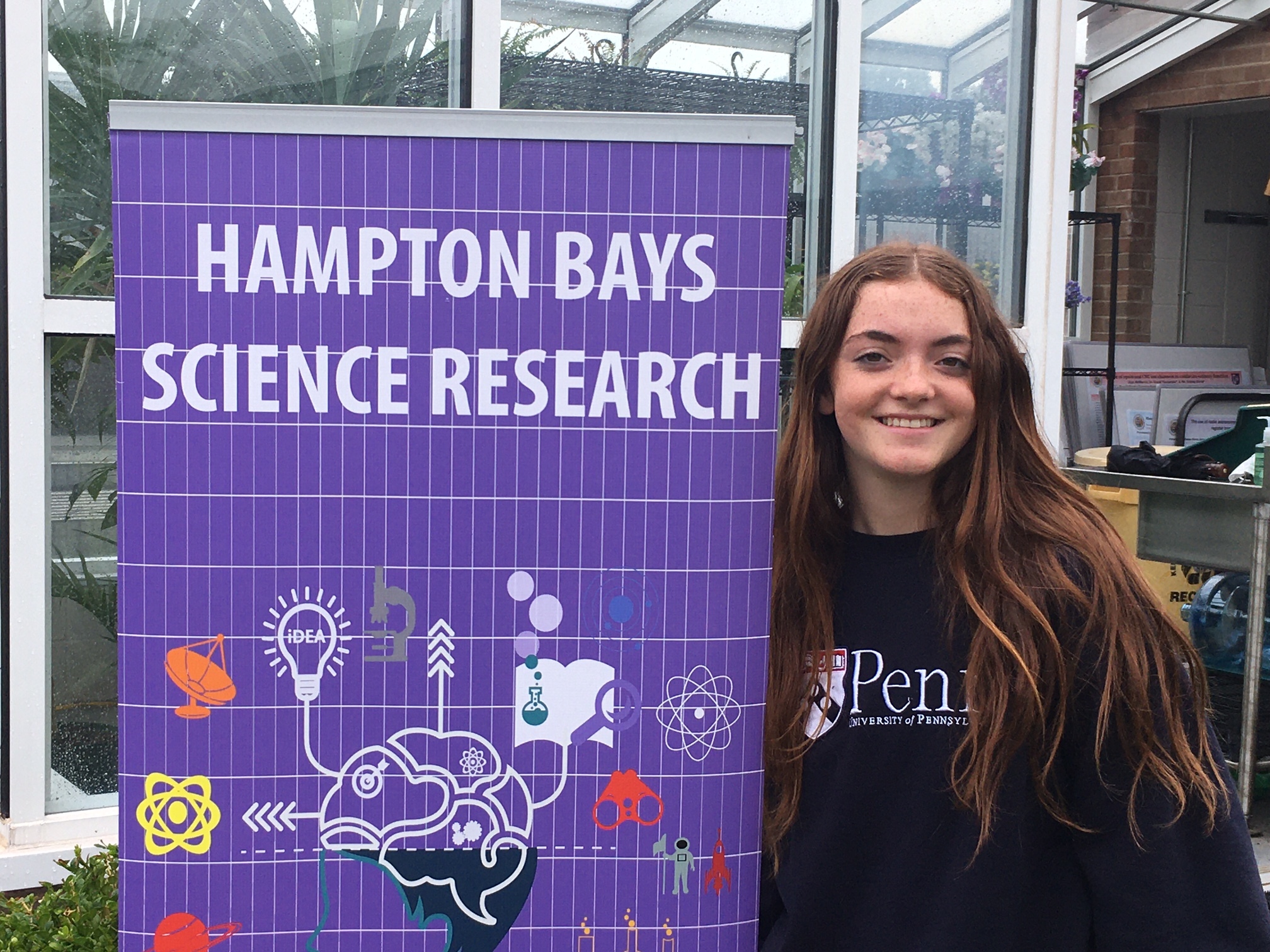
Hampton Bays High School senior Lily Simpson-Heavy
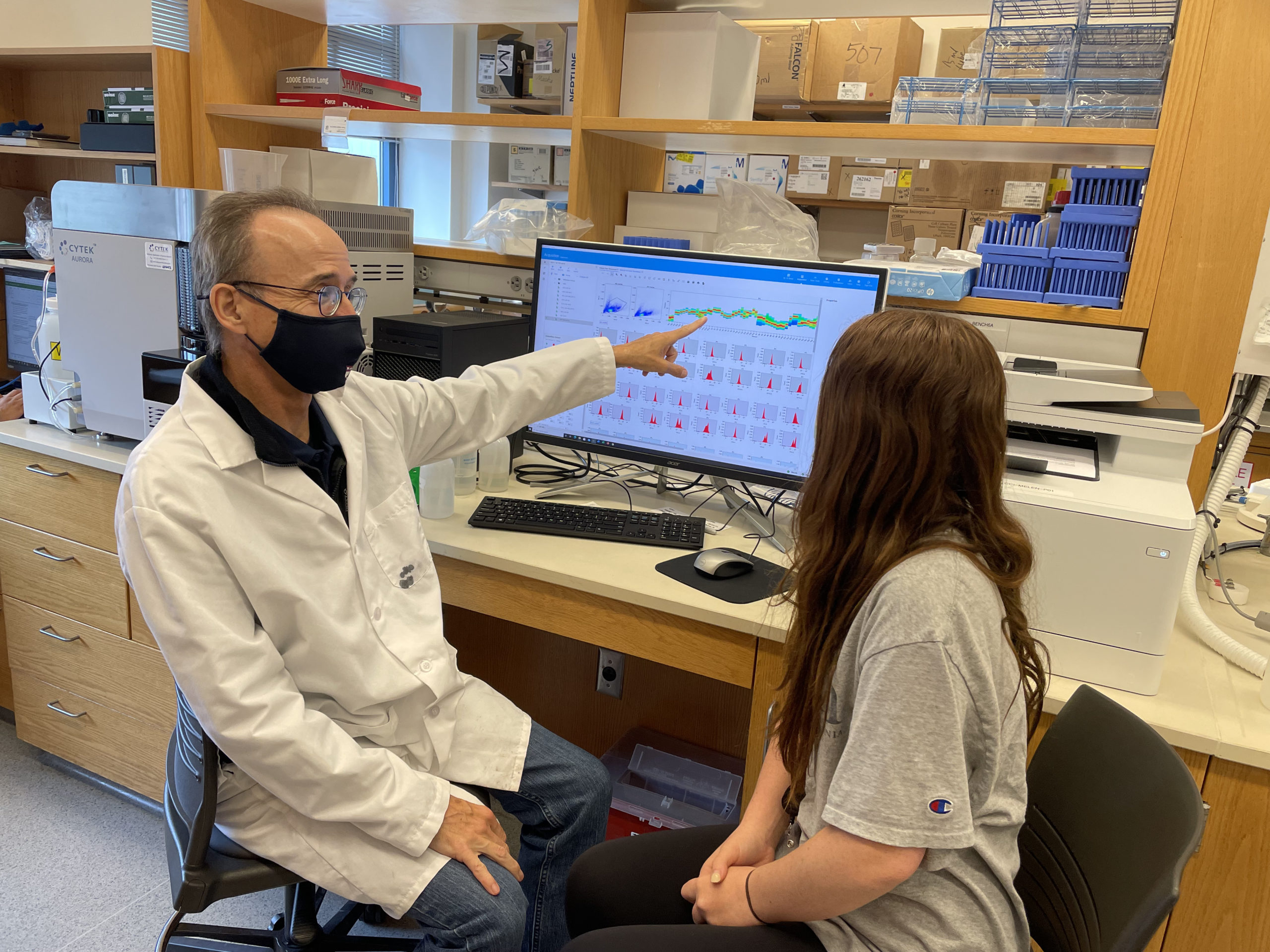
Lily Simpson-Heavy with mentor Dr Jos Melenhorst.
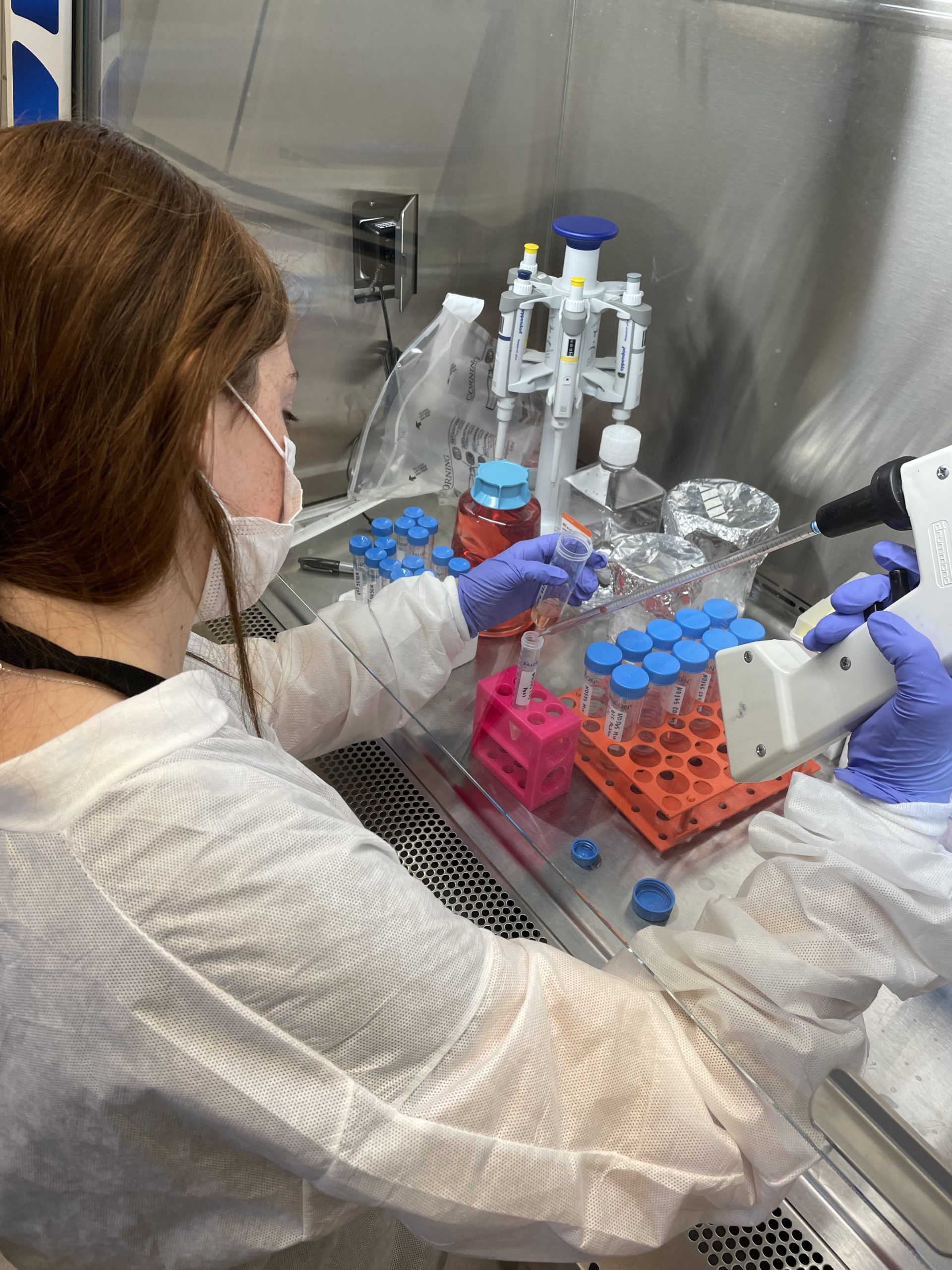
Testing samples
When Lily Simpson-Heavy was in the eighth grade, she already knew what studies she wanted to pursue in high school, and beyond. Her Uncle Rocky Mandile had lung cancer due to his efforts as a first responder on September 11, and when he learned what she wanted to do, she recalled, “He said, ‘Why don’t you fix me?’ He was joking, like ‘Find a cure, I know you can do it.’”
Her uncle was the original inspiration when she was about to enter high school, Ms. Simpson-Heavey recalled this week, but as she delved deeper into her cancer research, now a senior at Hampton Bays High School completing her fourth year in Dr. Stephanie Forsberg’s Science Research class, she’s seen how the success of her research can have a widespread impact
Last summer she was chosen to travel to Philadelphia to work alongside PhD recipients and candidates with mentor Dr. Jos Melenhorst at the Melenhorst Laboratory at the University of Pennsylvania Center for cellular immunotherapies.
“My research overall focuses on a novel cancer therapy known as Chimeric Antigen Receptor (CAR) T-Cell therapy. The center of this therapy is a type of immune cell known as a T-Cell. For the purpose of treating cancers such as CLL [a type of leukemia] among others, patient T-Cells are modified in a lab to present a protein on the cell surface which allows it to recognize and fight off cancer cells,” she explained.
“My research specifically focuses on understanding which type of T-Cell is the best for use in this immunotherapy. I studied several T-Cell subsets in the presence of cancer cells to study which were most effective at producing a prolonged immune response in vitro.”
While last year’s COVID-related shutdown was a negative for many, for Ms. Simpson-Heavey, it afforded the opportunity to work remotely with UPenn scholars and the renowned Professor Melenhorst, whose work on CAR T-Cell therapy received the National Clinical Research Achievement Award from the Clinical Research Forum in 2019, which recognizes the 10 most outstanding clinical research accomplishments in the United States during the preceding 12 months.
“I connected with my mentor in the middle of the pandemic in June 2020, when I sent him an email asking if he would be willing to help me take the next step as research,” the 12th grader related. “He met the idea with enthusiasm and has been so helpful at every step. He has and continues to dedicate so much time to helping me and fostering my curiosity. He has truly become an inspiration in my life and always challenges me to be a better researcher. I am extremely lucky to have someone in my life at his level in the science world that helps guide me and has offered me so many amazing opportunities.”
Locally, Dr. Forsberg oversees Ms. Simpson Heavey’s efforts, while High School Principal Christopher Richardt enthused, “Lily is an absolutely amazing student. She makes us proud every single day.”
In Philadelphia last summer, she lived with other UPenn students, getting a taste of what college life will be like. She worked every weekday in the lab, and reported that “within two weeks I was free in the lab to run my own projects, working alongside PhD students.”
CAR T-Cell therapy is being applied to all types of cancer, Ms. Simpson-Heavey explained, but her specific focus is on a type of blood cancer. “I was able to grow my own cancer cells and work with blood samples to study different varieties of the same therapy. The goal was to determine which subset was most effective as a therapy.”
Working with blood samples brought over from patients at the hospital at UPenn, the student separated out specific T-Cells using a centrifuge or microbead magnets.
She’s been invited back to the lab next year and continues to work with members of the lab remotely.
“She goes to virtual lab meetings every week on top of being a high school student,” Dr. Forsberg pointed out. “As unfortunate as the pandemic has been, Lily did her research the whole time.”
“The year in quarantine allowed me to set up weekly meetings with my mentor, and establish more time than I would normally have to put into my research” Ms. Simpson-Heavey said. That extensive interaction laid the foundation for her summer at UPenn. The circumstances allowing her to go to UPenn just fell into place and, she said, “I got extremely lucky.”
The team she worked with hopes to publish its research within the next few months.
In addition to UPenn, Ms. Simpson-Heavey is applying to Duke University and Rice University in partnership with Baylor Medical School. The plan is to major in biology on a pre-med track.
And it’s a journey that started in eighth grade. “It’s a pretty big commitment,” Ms. Simpson-Heavey said of the four-year research class at Hampton Bays High School, “But I really wanted to do research that would have impact on people’s lives.”
“When I met Lily, she knew from the beginning, she said, ‘I want to do cancer research,’” Dr. Forsberg recalled.
And while work in the lab alongside graduate students and her mentor was rewarding, a visit to the Center for Cellular Immunology stood out. Of CCI, she said, “some of the most well known researchers, who were the forefathers from the field come from there.”
There was a wall of photos of patients who had responded successfully to therapies they studied. She learned of Emily Whitehead the first child to receive CAR T-Cell treatment for her leukemia. At age 5, her doctors said she’d die.
“She’s my age now,” Ms. Simpson-Heavey informed. “That’s what drives me to do this research, because it’s so impactful.”
At UPenn she said, “where the hospital and the research center are so connected. In the room next door someone could be finding out that they’re going to start this new therapy and their life could really change.”
The teenager told of observing a patient meeting, where a family was given hope after being told their loved one was terminal. “That’s something really powerful,” the student scientist said. “I’m super grateful to be a part of something that can change people’s lives.”
“Doesn’t it make you feel good, that we’re in good hands with the next generation when you meet someone like Lily?” Dr. Forsberg asked. “It does for me.”


