


 1 Photo
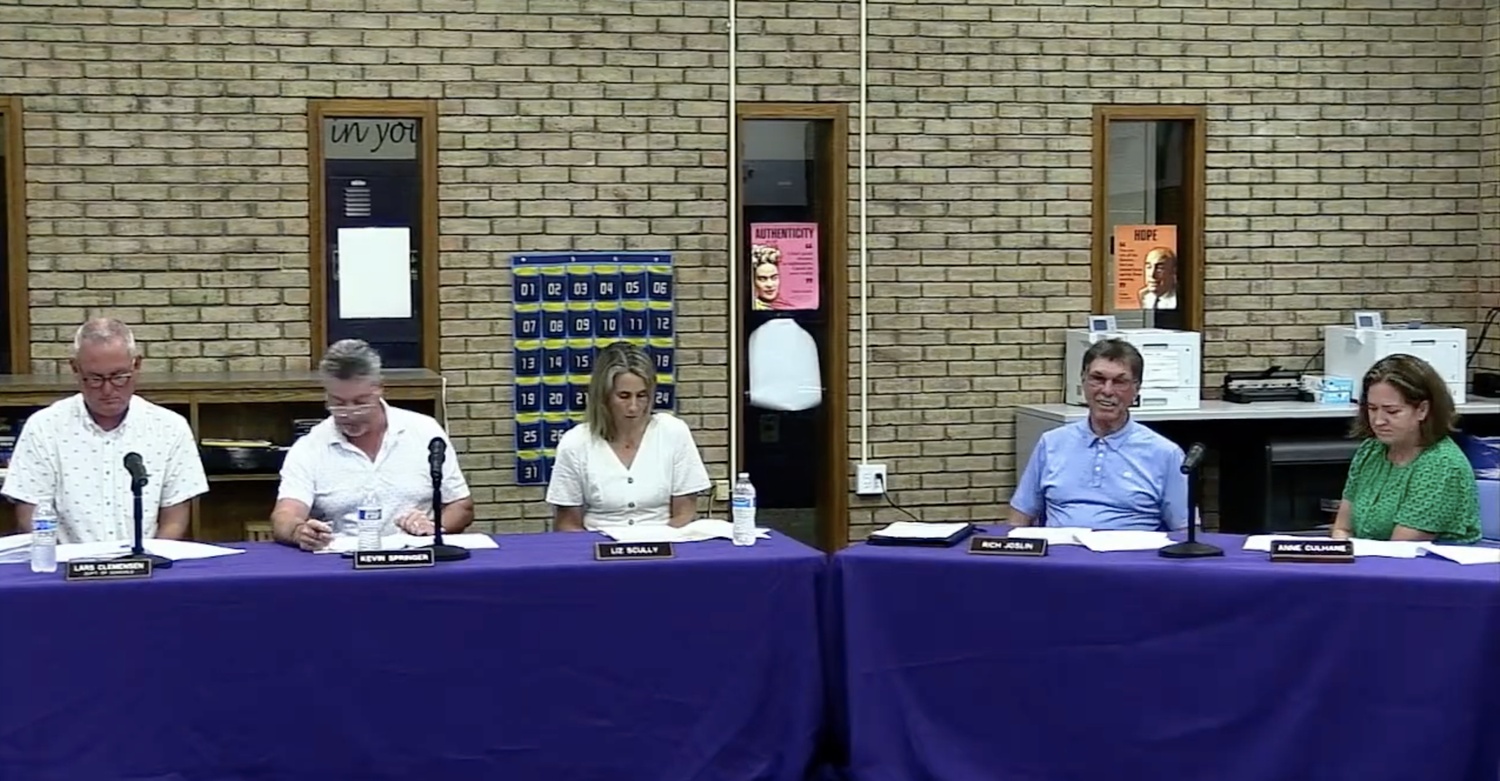
Hampton Bays School District's Board of Education during its July 15 reorganizational meeting.
Hampton Bays middle and high school students will be instructed to store their smart devices in their lockers as part of the school district’s new policy in response to Governor Kathy Hochul’s distraction-free schools law for bell-to-bell smartphone restrictions.
Superintendent of Schools Lars Clemensen said at a July 15 Board of Education meeting that all internet-enabled devices that are not school-issued are restricted at the high school level. Those types of electronics were already banned from the elementary school.
“I want to manage expectations. It is going to be a cultural change,” Clemensen said. “It’s something we’re going to have to work through this fall.”
He said student and parent education will happen over July and August. Administrators will discuss the aims of the policy, the benefits of a distraction-free environment, the reasons the student had difficulty following this policy and how the district can help the student contribute to a distraction-free environment.
High school students used to be able to use internet-enabled devices during lunch, study hall and passing periods. Those with translation services or who require medical-monitoring may be permitted to keep electronic devices on them.
“That could be tricky to work out,” the superintendent said. “We’re going to work with the class leaders on the rollout and enforcement of this.”
The distraction-free schools law signed by Hochul requires bell-to-bell smartphone restrictions in K-12 school districts statewide, starting this fall for the 2025-26 school year. As part of that law, public school districts statewide must finalize and publish their distraction-free policy by August 1.
For students out of compliance with the policy, the device will be held in the school office until the end of the school day. The building principal will communicate the procedure for retrieval, which could include either the student at the end of the school day or a parent. Repeated instances will result in the device being held in the school office daily for longer periods of time.
The district may not impose suspension from school if the sole grounds for the suspension is that the student accessed an internet-enabled device as prohibited by the policy, but the district may utilize consequences under the district’s code of conduct, including detention, in-school suspension and exclusion from extracurricular activities. The district may also utilize assignments on the detrimental impact of social media on mental health, smartphones in school or other relevant topics.
Hochul’s bell-to-bell policy creates a statewide standard for distraction-free schools allows schools to develop their own plans for storing smartphones during the day — giving administrators and teachers the flexibility to do what works best for their buildings and students — and also secures $13.5 million in funding to be made available for schools that need assistance in purchasing storage solutions to help them go distraction-free. It also requires schools to give parents a way to contact their kids during the day when necessary.
“If kids are distracted in the classroom, they aren’t learning, it’s that simple,” State Senator Patricia Fahy said. “Right now, students spend more than 90 minutes each school day on their phones.
“With New York’s new cellphone ban, students will be able to focus on what matters most — learning, building social relationships and preparing themselves to enter a career or college.”


