


 1 Photo
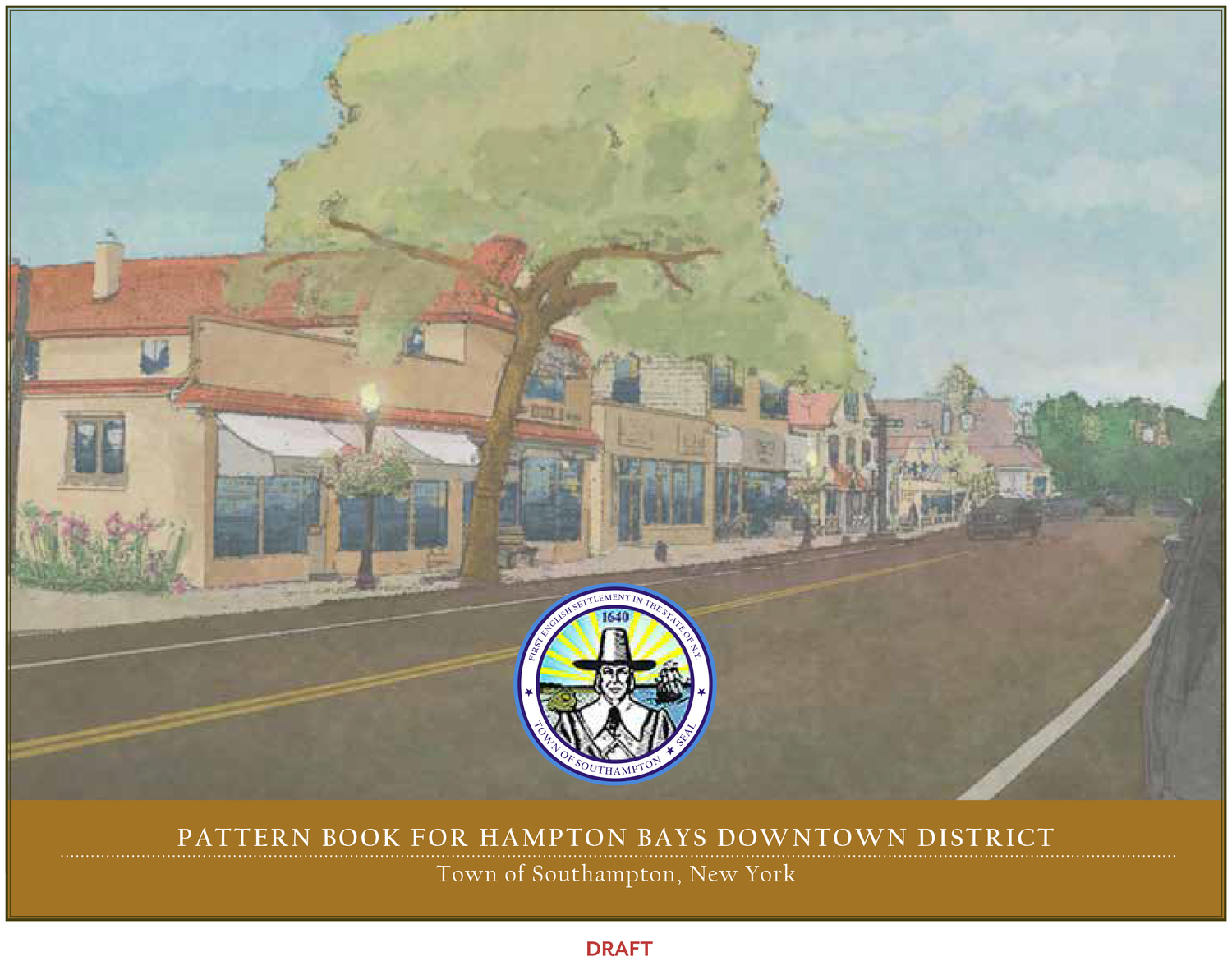
Six months after the Southampton Town Board approved a resolution to update a “pattern book” for Hampton Bays that it had adopted as part of a now-annulled Hampton Bays Downtown Overlay District, the board heard about minor updates to it last week as it moves toward a public hearing to formally adopt it.
Six months after the Southampton Town Board approved a resolution to update a “pattern book” for Hampton Bays that it had adopted as part of a now-annulled Hampton Bays Downtown Overlay District, the board heard about minor updates to it last week as it moves toward a public hearing to formally adopt it.
The pattern book — prepared by Historical Concepts, an architectural partnership that provides traditional architecture and planning services to developers and residential and civic clients — serves to guide developers and architects to ensure that development conforms with the historical character of a locality.
The November 2023 resolution to update the book referred to the desire to effectively plan for orderly growth in the hamlet’s center to “ensure future development is consistent with the goals and objectives of smart growth while safeguarding community character.”
On the heels of a long presentation about a potential sewage treatment plant to serve the hamlet’s commercial core at the board’s May 23 work session, Janice Scherer, the town’s planning and development administrator, told the board that updates to the pattern book were largely cosmetic, such as removal of “Downtown Overlay District” terminology in favor of “Downtown District.” Names of past Town Board members were deleted and those of new board members added, and an appendix was added, she said.
The pattern book applies to the hamlet’s core business district. “This is really meant to be a village business guidebook for things that happen, mixed-use or otherwise,” Scherer said. It essentially advises developers and architects as to “what to do and what not to do in the downtown setting of Hampton Bays.” Despite architectural similarities across hamlets throughout the town, it is “very much tailored to where it’s for,” as there is “different vernacular and context that you’re in based on the time period it was built and the buildings that are there.”
In preparing the pattern book, Historical Concepts had gathered data pertaining to block lengths, street widths, and building heights, Scherer said, likening the data to the DNA of a town. Recommendations include smaller block lengths, she told the board.
“Our block length in Hampton Bays is 1,800 feet long,” she said. “It’s a ridiculous amount of block length, where in a successful place, there’s something within 200 feet. If you’re a pedestrian, you’re going to meet something every 200 feet.”
Councilman Tommy John Schiavoni described a walkable downtown as a “vision that the community wanted.”
The pattern book includes a variety of building styles, Schiavoni said. Architecture does not have to be exclusively traditional in design, Scherer agreed, but guidelines include building features such as windows and doors, cornices and porticos.
“Really, it comes down to scale and proportion,” she said, “because sometimes you see a building and you don’t know why you don’t like it, and it most likely is because it’s not in scale or proportion somehow, and your eye knows this, but you don’t know why.”
A public hearing on adoption of the pattern book is expected to be noticed at an upcoming meeting of the Town Board.


