


 1 Photo
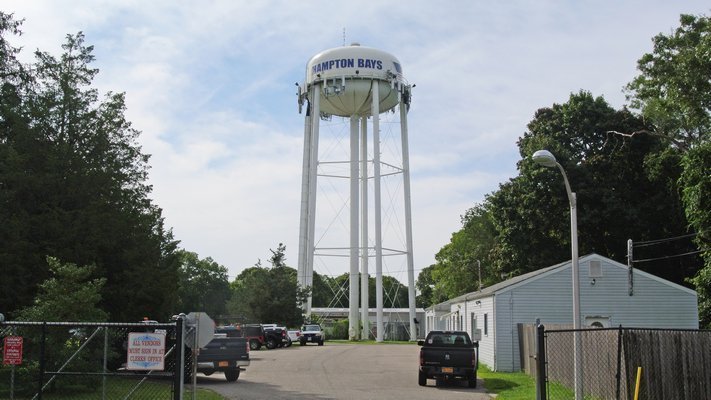
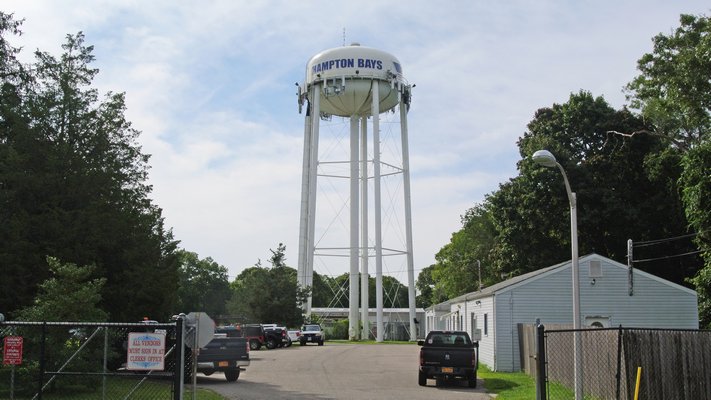
The Hampton Bays water tower. VALERIE GORDON
An attorney for the Hampton Bays Water District and Southampton Town filed a lawsuit this week against five manufacturers of aqueous firefighting foams that also contain the pair of chemicals that have contaminated drinking water wells in Hampton Bays.
Filed on February 21 in Suffolk County Supreme Court, the complaint charges that the five manufacturers—the 3M Company in Delaware, Buckeye Fire Protection Company in North Carolina, Chemguard Inc. and Tyco Fire Products in Wisconsin, and National Foam Inc. in Pennsylvania—knew that the two chemicals posed a health risk.
Both chemicals—perfluorooctanesulfonic acid, or PFOS, and perfluorooctanoic acid, or PFOA—were recently found in three of the water district’s 11 wells, according to authorities. Robert King, superintendent of the Hampton Bays Water District, has said that the wells were turned off after the contamination was detected and remained so as of this week.
The water district is seeking to recover “substantial past and future damages”—the complaint does not list an exact dollar amount—for the cost of cleaning up the contamination that the State Department of Environmental Conservation is blaming on the firefighting foam. The foam often was used for firefighter training and putting out gas fires, according to the complaint filed by the Melville-based law firm Napoli Shkolnik PLLC, which was retained by the town in the fall.
Since the contamination was discovered last year, the Town Board, which serves as the commissioners of the water district, allowed the district to spend $1 million to install carbon filtration systems on the affected wells. The work is expected to begin within the next week and to be completed by June, according to Mr. King.
The same manufacturing companies have come under fire in recent months following the discovery of additional PFOS and PFOA contamination on the South Fork.
Last year, the Suffolk County Water Authority filed two separate federal lawsuits in the Eastern District Court of New York against the same five firms for contamination by the same chemicals. That lawsuit was in response to the contamination of private wells in Westhampton and Westhampton Beach, as well as on Quiogue, that was traced back to firefighting foam used on the Air National Guard base at Francis S. Gabreski Airport in Westhampton.
In January, reports showed that 63 contaminated wells near the East Hampton Airport in Wainscott had traces of PFOS and PFOA. No lawsuits have been filed.
The production of PFOS and PFOA was banned by the U.S. Environmental Protection Agency in 2002, but traces of the chemicals remain in the water. The New York State Clean Water Infrastructure Act now requires all New York-based water systems to test for the contaminants.


 Amanda Bernocco on Feb 23, 2018