


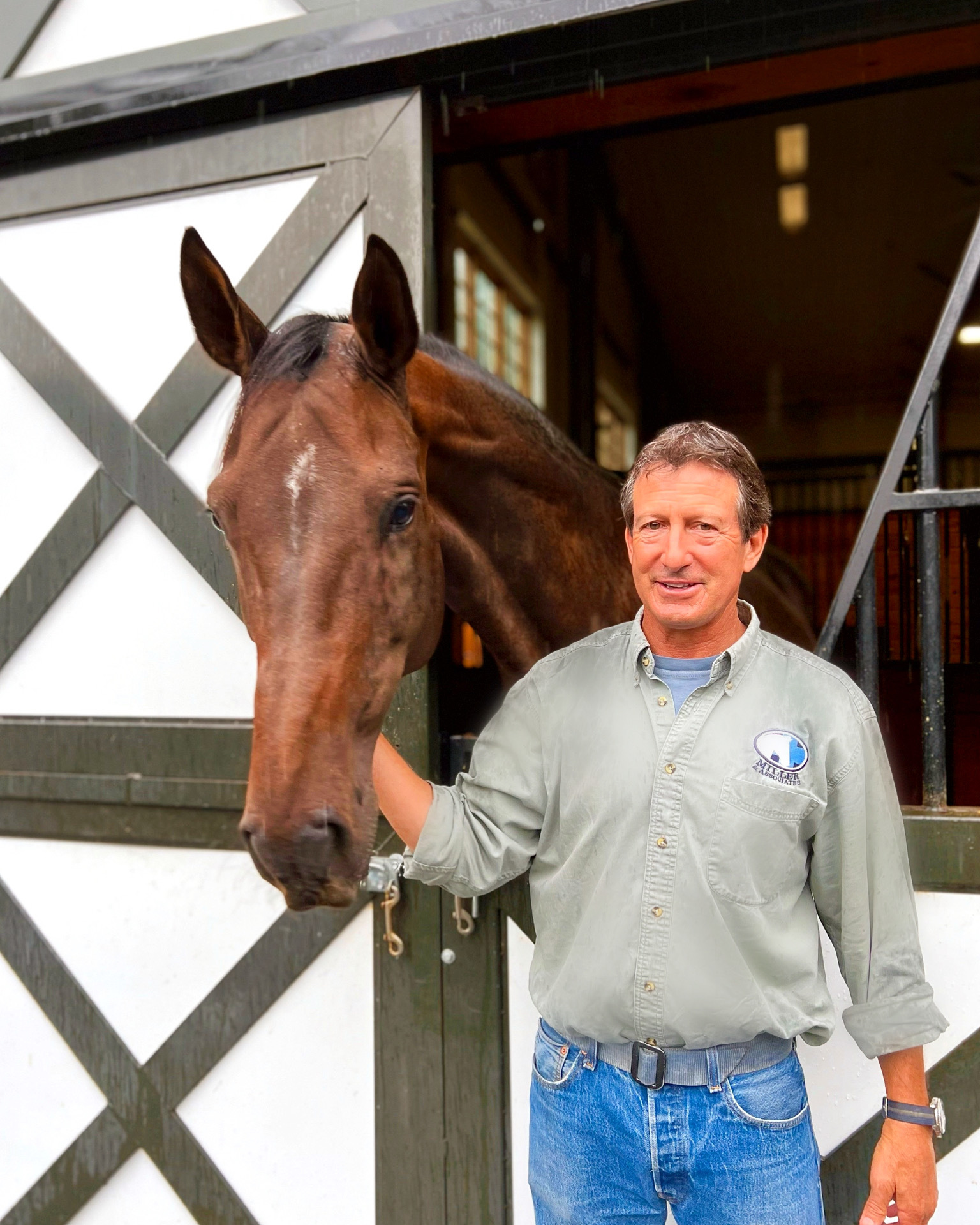
 1 Photo
Dr. Christopher "Kit" Miller, an equine vet based in Brewster, New York, is the official veterinarian for the Hampton Classic. He was one of the authors of a study that created a DNA test that identifies Lyme Disease in horses.
Several years ago, equine veterinarian Christopher “Kit” Miller was called upon to treat a horse that had become severely ill in the space of roughly 24 hours while at the Hampton Classic Horse Show.
The horse, a Swedish warmblood mare, was at the week-long show in Bridgehampton to compete with a junior rider in the jumper division. Overnight, the horse developed a fever and then quickly developed other worrying symptoms related to the central nervous system and brain.
It was immediately clear that the situation was dire, according to Miller, whose veterinary practice, Miller and Associates, is based in Brewster, New York, but has served as the official veterinarian for the Hampton Classic for years.
Upon examination, it was not immediately clear what the source of the horse’s fever or other symptoms was, and a routine PCR test for Lyme disease came up negative. But it was clear that the horse needed some kind of treatment immediately, to avoid what could have been a very bad outcome.
“This was a horse we’d cared for for years, and she was normally very gentle and kind, but all of a sudden became unmanageable,” Miller recalled in an interview late last month. “She was impossible to be around, and it made treatment really difficult. When she was approached by the vet, she became violent and also had symptoms of unsteadiness on her feet.”
Miller said that because of her unsteadiness and extreme behavioral changes, treating the mare was an extraordinary challenge, and the horse was referred to an equine hospital in New Jersey.
The story could have had a tragic ending. When a horse’s behavior devolves to that point, they become nearly impossible to treat. And, more importantly, being unable to stand reliably on four legs is akin to a death sentence for a horse.
The mare ultimately made a full recovery, and her case is part of what could lead to a breakthrough in the identification and treatment of a disease that has frustrated both veterinarians and doctors treating human beings for decades.
Steven Schutzer, a physician, scientist and professor at Rutgers University in New Jersey, has been leading the development of a special DNA test that has accurately identified Lyme disease in horses, and could potentially have application for humans and dogs as well.
A study on the test was recently published in the Journal of Veterinary Diagnostic Investigation, and Miller was one of the authors of that study, along with Thomas Divers, the veterinarian who led the equine team on the paper and who is a professor of medicine and co-chief of Large Animal Medicine at Cornell University. Other scientists on the study included Claire Fraser and Emmanuel Mongodin of the Institute of Genome Sciences at the University of Maryland School of Medicine; Rodney Belgrave of Mid-Atlantic Equine Hospital in Ringoes, New Jersey; and Rachel Gardner of B.W. Furlong and Associates in Oldwick, New Jersey.
While neurologic Lyme was suspected in the case of the sick mare, the standard PCR test came back negative. The unreliability of those tests for Lyme makes it difficult to diagnose with any certainty. In humans, the presence of a bull’s-eye rash is often, but not always, present, which can help solidify a diagnosis, but with dogs or horses, a skin rash would not be evident. Early detection is essential with an illness like Lyme, because it will lead to early treatment and thus a better chance at recovery.
Schutzer and his team developed a “genomic hybrid capture assay,” a highly sensitive test that identified the Lyme pathogen in a sample of the horse’s spinal fluid, confirming the initial diagnosis. The test works by first selectively isolating DNA from the microorganism causing the disease.
“The method is like having a special, specific ‘fishhook’ that only grabs Borrelia burgdorferi DNA and not the DNA of other microbes, nor the DNA of the host (animal or human),” Schutzer said. “Detecting DNA of the disease is a direct test, meaning we know you have active disease if it’s circulating in the blood or spinal fluid.”
Schutzer explained that the test was developed to help diagnose other hard to detect diseases like Lyme. “It’s basically a way to concentrate or enrich any bad pathogen DNA that might be there in the sea of human or horse DNA,” Schutzer said. “You get a more concentrated sample, so when you do a sequencing test, you’re going after a bigger target.”
Miller explained that Lyme is fairly prevalent in horses, particularly in the Northeast, and that there is a “whole spectrum of clinical science that can be attributed to Lyme,” from an acute infection of the central nervous system to more subtle signs. But he said even a more subtle infection can affect a horse’s health and athletic ability. Being able to definitely test for the disease would be a game-changer, he said. “It’s something that would be an enormous benefit for practitioners, as well as for owners and for the horses.”
He added that the more accurate test could have far reaching implications. “Because of the current state of relying on tests that we know are inaccurate, we’re at as much risk of overdiagnosing as underdiagnosing,” Miller added. “That also puts us in jeopardy of missing other diagnoses. If we just hang our hat on a Lyme diagnosis, we may miss other important problems.”
Schutzer said that he and his team are still refining the test, and that the sick mare gave them an opportunity several years ago to try it out, adding that there are less restrictions when it comes to trying out a new test on an animal than there would be on a human. He said further research will be required — and more funding to accelerate it — before the test could potentially be made available to humans.


 Cailin Riley on Sep 7, 2022