


 1 Photo
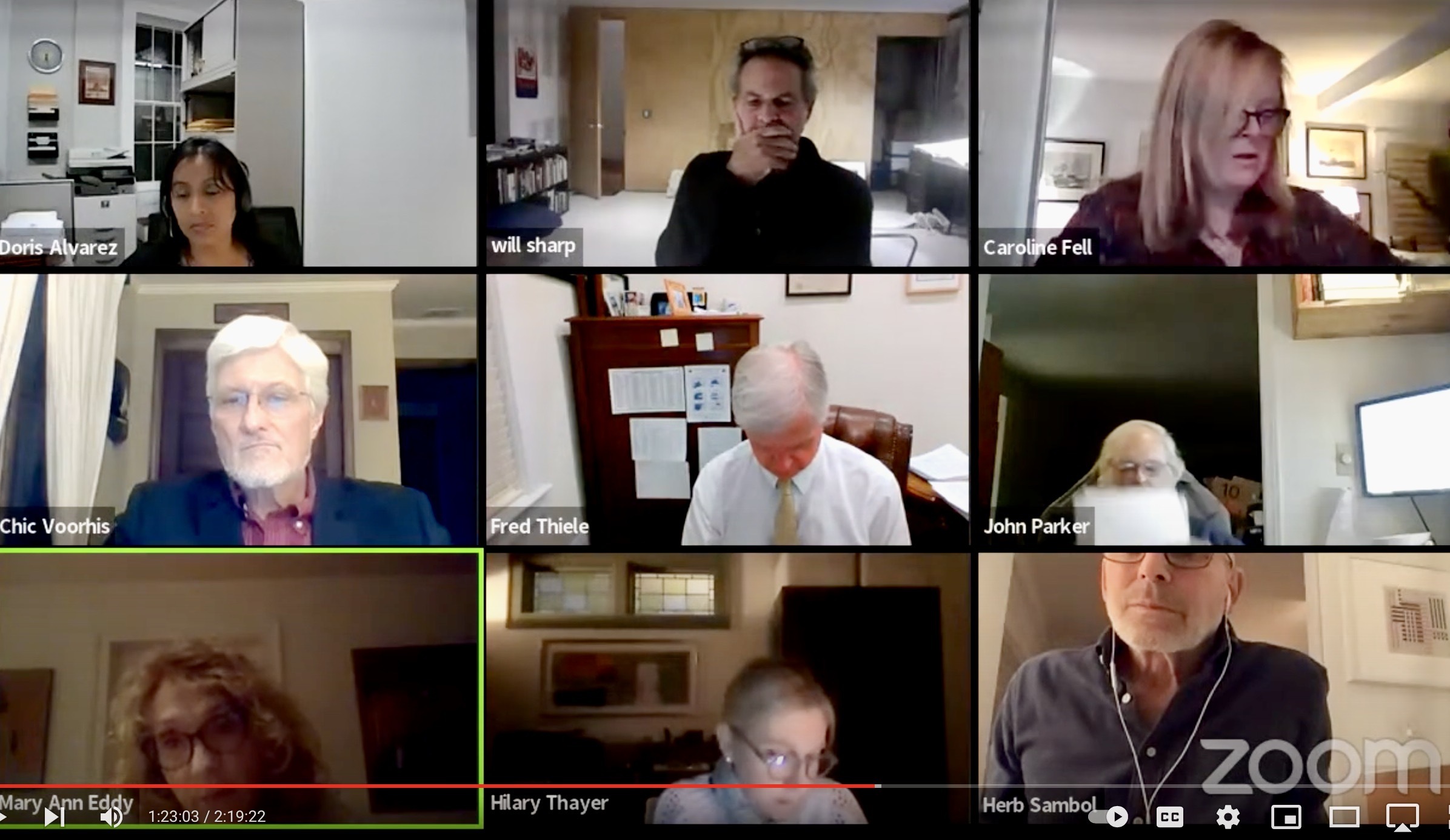
The Harbor Committee's December 2 Zoom session.
The Harbor Committee agreed last week to ask the Sag Harbor Village Board to tweak its proposal for a Waterfront Overlay District so that it requires at least a 10-foot setback from the street property line for any future new construction in the Village Business zone along Bay Street. Current regulations there require no setback.
“All these buildings, if they get redone, can go right up to the sidewalk, the way the Bagel Buoy building does,” complained Harbor Committee chair Mary Ann Eddy at the panel’s December 2 Zoom meeting, referring to the stretch of Bay Street between Division and Rysam streets.
The absence of a setback requirement in the underlying zone “just laughs at what we are doing” with rain gardens and permeable paving projects to minimize street runoff into the bay, she said, and someday will make strolling Bay Street “like being in Manhattan.”
Eddy made her remarks as the panel wrapped up its review of the Village Board’s waterfront overlay proposal for compliance with the village’s LWRP, or Local Waterfront Revitalization Plan, a non-binding formality required by village protocol.
Eddy initially had other issues, but the lack of a setback requirement was the only one that remained a concern after the Village Board’s planning consultant, Kathy Eiseman of Nelson, Pope & Voorhis LLC, told her that they had been addressed.
At the panel’s request, State Assemblyman Fred W. Thiele Jr., the Harbor Committee’s attorney, agreed to prepare a draft letter to the Village Board asking for the setback requirement to be added to the code, but otherwise finding the Overlay District proposal in compliance with the LWRP.
The Overlay District proposal, in the works for more than a year and currently in the public hearing phase before the Village Board, is intended to add a layer of regulation and control over development along Sag Harbor’s commercial waterfront. The hearing is scheduled to continue at the next meeting of the Village Board on Tuesday, December 14.
Among other business at its December 2 session, the Harbor Committee rebuffed applicant Blair Effron’s request — made through his planning consultant, Mike Schiano of Interscience Research Associates — that he not be required to establish “covenants and restrictions” (C&R) legally protecting the proposed native vegetative buffer that he will be providing on his property at 34 Long Point Road.
A standard condition of approval for his application for a wetlands permit — Effron wants to install an I/A septic system, remove non-native vegetation and build walkways on his waterfront property — Schiano said his client considered it “overreaching.”
“Your client is not getting picked on,” Eddy told Schiano. “This is the way we do business.”
She added “it’s kind of a surprise” to the board “that it’s a surprise” to the applicant and, noting that properties change hands, explained, “We just like to know the plans we approve will survive a change in ownership.”
The committee approved only one application at the meeting, Evan Wildstein’s request for a wetlands permit to allow a phragmites removal and control project at his property at 16 Notre Dame Road.
The panel tabled the application to allow its planning consultant, Chic Voorhis, to verify that C&R paperwork will be submitted before the board votes to approve the application at its January 6 meeting.


