


 3 Photos
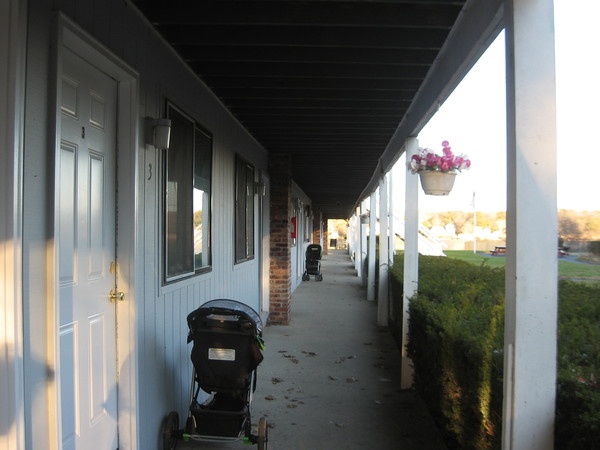
Baby strollers and flowers indicate signs of change at the Hidden Cove Motel in Hampton Bays.
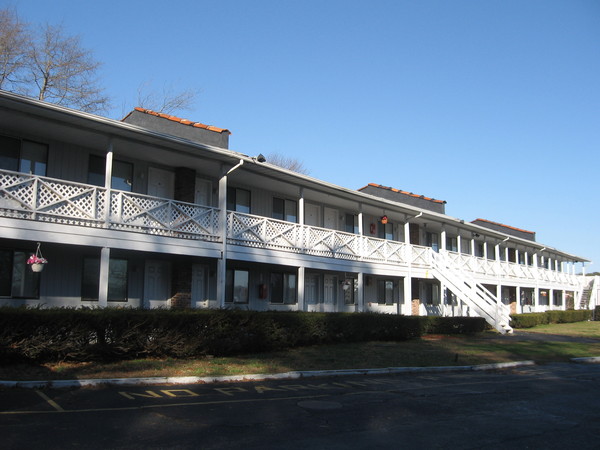
Homeless families are settling into their new

temporary accommodations at the Hidden Cove Motel in Hampton Bays.
Desiree Burgess, 38, has just finished removing a pan of bubbling lasagna from the oven on a recent Thursday afternoon. Her infant son, Desmond, is sleeping peacefully in his playpen while her husband, Shedrick, a veteran of the U.S. Navy, greets guests with a smile when they come to the door.
This scene of domestic tranquility could easily be found in any town across the United States, as families gather to share dinner in the comfort of their warm homes.
But Ms. Burgess and her family are homeless.
The room where they are staying, which features a small kitchenette, is one of 32 at the Hidden Cove Motel in Hampton Bays. Their room is cozy, clean and welcoming. It is also temporary, though that has not prevented it from becoming the epicenter of controversy that has divided the community.
The decision by the Suffolk County Department of Social Services to utilize the Hidden Cove Motel as a full-scale homeless shelter has neighbors who live on West Tiana Road, near the facility, furious. For weeks, they have galvanized and reached out to elected officials to try and prevent the DSS from utilizing the site, stating their belief that a homeless shelter will send property values plummeting and create a plethora of safety and quality of life concerns.
Currently, the Burgesses are one of 19 homeless families temporarily housed at the motel, the only homeless shelter of its kind in Southampton Town. The next closest facility is in Riverhead Town, according to DSS officials, and the bulk of the homeless shelters are placed in western Suffolk County, in Bellport, Bayport, Central Islip, Brentwood and Huntington. There are no shelters in East Hampton Town.
The Hidden Cove Motel, once its transformation is complete, will be able to house up to 30 homeless families at once, and will serve as one of 53 such shelters now being run by the DSS.
Those low-income residents who had been renting rooms at the motel on a weekly or monthly basis were informed in November that they were being evicted to make room for the new homeless shelter, which is run under the auspices of Community Housing Innovations Inc.
The uproar, according to Gregory Blass, the commissioner of the DSS, has succeeded in feeding the fears of those who unfairly view all homeless as dangerous criminals, drug addicts, alcoholics or lazy individuals who choose not to work. And he says that recent efforts by Southampton Town Supervisor Anna Throne-Holst and Suffolk County Legislator Jay Schneiderman, who have been working with neighbors who were trying to block the opening of the Hampton Bays shelter, have stirred up a simmering pot of prejudice against the homeless.
Ms. Throne-Holst has decried the fact that DSS began moving families into the facility without notifying the town, an action that Mr. Schneiderman has said violates a county law that caps the number of homeless allowed to live in one facility at 12. This week, Ms. Throne-Holst sent a letter to the operators of the motel stating, in part, that individuals cannot be housed at the facility for more than one month, or the operators risk violating town code.
The DSS, Mr. Blass maintains, is directed by the state to house all of the county’s homeless, a task that has become more challenging now that there are more than 500 homeless families in Suffolk, a number that continues to grow. He also said his office is not required by law to notify towns and villages whenever they open a new shelter in the county, and that privacy laws preclude disclosure of their locations.
“To what end should we have given them a head’s up? So they could ambush us?” Mr. Blass asked, referring to Ms. Throne-Holst’s demands. “It’s the sensationalism that the politicians have fostered that has contributed to this exaggerated and deplorable image of the homeless.”
Mr. Blass is working to put an end to those misconceptions, explaining that there is a new face to homelessness in Suffolk County—and across the nation. He said many factors, such as climbing unemployment, a sluggish economy and a rash of foreclosures, in addition to situations that involve domestic violence, have led to unprecedented numbers of homeless families in Suffolk, and a surge in the number of first-time homeless who are seeking emergency and temporary shelter as they try to repair their shattered lives.
“It’s a perfect storm,” he said.
Still, Mr. Blass stresses that the shelters are meant to be temporary, and residents must work toward finding themselves permanent shelter. The average family, he said, typically spends four to six months in emergency housing like that now being offered at the Hidden Cove Motel. Mr. Blass also pointed out that those placed in the facility must follow stringent rules, including honoring curfews, and allow for the inspection of their rooms. Security is present on site and staff is available 24 hours a day.
Despite complaints raised by some Hampton Bays residents about increased criminal activity and noise due to the presence of the homeless, a recent visit to the motel did not reveal any glaring problems. Additionally, a Freedom of Information Act request filed with the Southampton Town Police Department revealed that police have responded to 16 calls originating at the Hidden Cove Motel since November 1, and have been called to the site four times since December 1, when the DSS originally hoped to evict those still paying rent to make room for the homeless. Of those four calls, three were aided cases—or residents seeking medical help. The other call pertained to a complaint about an abandoned vehicle, according to police records.
In November, before the motel was turned over to the DSS, the dozen calls included three domestic disputes, one warrant execution, a complaint about an intoxicated person, and several aided cases.
Southampton Town Police Lieutenant James Kiernan said it is too early to know if a full-scale shelter will result in a spike in the number of police calls. “I would say [the motel] is going to bring police activity either way,” he said, referring to its prior use as low-income housing.
DSS officials say they do not expect an uptick in criminal activity, explaining that most of those seeking temporary shelter, like Ms. Burgess and her husband, are regular folks who have simply fallen on hard times.
Ms. Burgess said her family arrived on Long Island in February from South Carolina, where she had worked as a housekeeper in the Myrtle Beach area for 19 years. She explained that she lost her job and they moved back to Long Island so she could be near family in Mastic.
Unable to make ends meet, they slowly lost all of their savings and were forced to seek emergency housing. They’ve been living at the Hidden Cove Motel since November.
Both Ms. Burgess and her husband are actively seeking work and, in a recent interview, said they were days away from moving into permanent housing in Ridge. “I can’t wait to get the baby into our own place, so we can have a Christmas tree,” she said.
While looking for work, Ms. Burgess said she often spends up to two and a half hours on buses each day—and does so with a smile. “Just because you have to come to a shelter, it doesn’t mean it’s the end of the world,” she said. “Life goes on.”
And for the rest of her life Ms. Burgess said she’ll remember the grace and kindness of CHI staffers, including Mary Denning, a caseworker who oversees the Hidden Cove Motel. Despite her difficult circumstances, Ms. Burgess is upbeat and smiling.
“Even though I’m at the lowest point of my life, living in a shelter, you can’t be down,” she said. “I’m thankful that I’ve met so many beautiful people who have helped us here.”
Ms. Burgess and her family are not unique. At the present time, there are 512 homeless families in Suffolk County, according to Ed Hernandez, the deputy commissioner of the DSS.
“The number has gone up dramatically,” he said, explaining that, in January 2008, there were 285 homeless families in Suffolk County.
Similar spikes have been witnessed in the number of single people who are homeless; their numbers have jumped from 170 in 2008 to 239 today, he said.
In response, the DSS has opened four full-scale homeless shelters over the last three years, and currently rents rooms at 18 motels across the county to handle the influx. As of the end of November, there were 896 adults and 1,097 children in Suffolk County in need of emergency housing, according to Robin Barnett, acting division administrator in housing services for the DSS.
Mr. Hernandez said another factor that has contributed to the surge in homelessness is that certain municipalities have begun to crack down on low-income and, sometimes, illegal housing, reducing the stock of affordable housing. Also, he said, with foreclosure rates skyrocketing, there are fewer rental properties on the table. Job loss due to illness or cutbacks is another issue.
“A lot of people are living paycheck to paycheck,” Mr. Hernandez said. “If something happens to that paycheck, it creates a situation.”
Mr. Hernandez also pointed out that a federal welfare reform law was passed in 1996 that limits the number of years an individual can remain on public assistance to five years. New York is one of 14 states that offer federal safety nets that extend the benefits, with some restrictions, beyond the five-year mark.
Additionally, there are no residence requirements in place in New York State to apply for emergency assistance. Therefore, people can move into the state and, on the same day, apply for emergency housing.
“Why they come to Long Island is the question we keep asking,” Mr. Hernandez said. “This is one of the highest rent areas in the nation.”
Both Mr. Hernandez and Mr. Blass explain that Suffolk County follows federal regulations while some other areas, including New York City and Nassau County, have been accused in the past of improperly denying emergency housing to the homeless. “We’re taking the burden from neighboring counties,” Mr. Hernandez said.
That does not mean, however, that all applicants are immediately given assistance in Suffolk County.
Those seeking help must first sit down for an interview with an emergency needs worker, according to Kimberly Staab, DSS’s division administrator for client benefits. The two work together to fill out an application. Next, a determination of eligibility is made and is followed by a second interview. At this time the applicant must provide proof of homelessness, which can include an eviction notice or a letter from relatives stating they have no place to live. Once they are approved, they are put on a track to secure employment and, eventually, homes of their own.
Another goal, DSS staffers agree, is to keep children in their own school districts and minimize the time they must spend on buses. Only two children now living at the Hidden Cove Motel are currently attending the Hampton Bays School District, DSS officials said, despite fears raised by some locals that a 30-room homeless shelter will result in a spike in student enrollment.
Contrary to public misconception, and barbs from some residents stating that the homeless living at the Hidden Cove Motel are enjoying their view of the water, most of the homeless are actively working toward finding permanent housing.
“They don’t want to be homeless forever, and they want to go back to their communities,” Ms. Staab said. “They want their friends, their neighbors, their families, their doctors and their stores. They want everything that they’re used to.”
Added Mr. Blass, “Nothing is less significant to them than a water view.”
Rosemary Dehlow, the Long Island director of Community Housing Innovations, said she has seen a dramatic increase in the number of individuals seeking emergency housing who are employed at least part-time but still cannot make ends meet. Those families, she said, must contribute a portion of their earnings to pay for their housing.
Brandi K., who is homeless and declined to give her last name, now lives at Hidden Cove Motel with her 2-year-old son, Brandon, and her boyfriend, Jason. She said the motel has provided her with shelter from a very difficult storm in her life. “Being homeless is frightening, especially when you have a son and you are not going to be able to feed him,” she said.
Brandi explained that she and her family were originally placed in a shelter in Brentwood and transferred to the Hampton Bays motel in November. Ironically, she said she had lived at the Hidden Cove Motel in the past, until she could no longer afford the rent. She said she quit her most recent job with Panera Bread following a disagreement with a manager.
Still, she plans to land a new job soon. “We need our own place,” Brandi said.
Mr. Blass, meanwhile, hopes to assuage the concerns of West Tiana Road neighbors, emphasizing that those homeless who fail to follow the rules of the DSS are kicked out of the program. He was quick to add that the unfair picture of the homeless now being painted by some neighbors and certain elected officials does nothing to help those who are struggling to get on with their lives.
“To suggest they are criminals or drug users is completely false,” Mr. Blass said. “They are motivated to repair their shattered lives, despite the prejudice these politicians have painted with their negative brush.”


