


 12 Photos
A trap door reveals a staircase in Sag Harbor resident JoAnn Bradley's home on Liberty Street
which is believed to have been a stop on the Underground Railroad. ALYSSA MELILLO

A trap door reveals a staircase in Sag Harbor resident JoAnn Bradley's home on Liberty Street
which is believed to have been a stop on the Underground Railroad. ALYSSA MELILLO
A trap door reveals a staircase in Sag Harbor resident JoAnn Bradley's home on Liberty Street

which is believed to have been a stop on the Underground Railroad. ALYSSA MELILLO
A trap door reveals a staircase in Sag Harbor resident JoAnn Bradley's home on Liberty Street
which is believed to have been a stop on the Underground Railroad. ALYSSA MELILLO

A trap door reveals a staircase in Sag Harbor resident JoAnn Bradley's home on Liberty Street
which is believed to have been a stop on the Underground Railroad. ALYSSA MELILLO
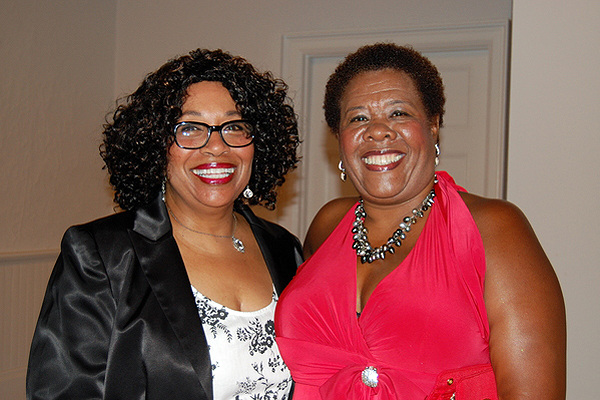
Eastville Community Historical Society Historian Kathleen Tucker
left
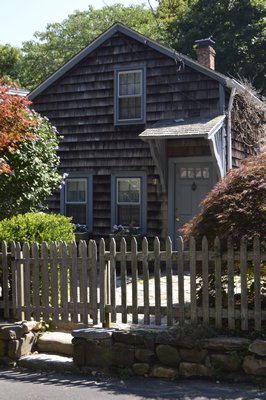
It was 1993 when JoAnn Bradley first moved into her 19th-century summer home on Liberty Street in Sag Harbor. One day, the Brooklyn Heights resident was carrying a computer that she intended to store in a closet underneath the staircase. But because the machine was heavy—or perhaps due to simple fate—Ms. Bradley dropped it.And the floorboards moved.
“The floor sank in,” she recalled one afternoon this week, “and I said, ‘How can the floor sink?’”
Curious, but also nervous, Ms. Bradley moved a rug that was draped over the closet floor and lifted up the shifted boards. What she discovered both startled and excited her—a rickety, dusty staircase that led into a cold, dark cellar.
A dark cellar that, as a woman of color, Ms. Bradley suspected could only mean one thing: a hiding place for slaves.
A stop on the Underground Railroad.
For years, residents of the Eastville neighborhood in Sag Harbor have been gathering clues that are leading them to conclude that the Underground Railroad—a route traveled by thousands of runaway slaves that often included underground tunnels and hideaways in places like the cellar below Ms. Bradley’s house—had a large presence in the village, possibly as a long-term stop along the way to freedom for escaped slaves.
Spearheading the research is the Eastville Community Historical Society, which was founded in 1981. Over the last three decades, the organization has acquired a goldmine of information on Sag Harbor’s connection to that historic era.
Other homes on Liberty Street, as well as on Hempstead Avenue, feature hidden trap doors that lead to gritty old cellars. The St. David African Methodist Episcopal (AME) Zion Church on Eastville Avenue has two trap doors as well, one under a pew and one under an altar, that are suspected to be connected to the Underground Railroad.
Georgette Grier-Key, director and chief curator for the Historical Society, said that the type of people who populated Sag Harbor during the mid-1800s, who included Quakers and abolitionists, also contribute some pieces to a very complex puzzle.
But even though these pieces are very persuasive to Ms. Grier-Key and others in Eastville, she said they still need concrete, definitive proof in order for their claims to have validity. That would mean discovering any kind of firsthand documentation, whether it be letters, diary entries or even census papers.
“We’re trying to bring pieces together,” Ms. Grier-Key said. “There are gaps. [But] we do believe that there is a strong presence.”
A Telling History
Slavery played a major role in American history, dating back to the 1600s, when the first Europeans began settling here. Eventually, owning African slaves became the norm in the South, and those individuals spent their lives in cotton or tobacco fields on large plantations. It wasn’t until the 1800s when the antislavery movement began to take off, and abolitionists started to pave the way to freedom for enslaved blacks with the help of the Underground Railroad.
Sag Harbor was populated by whalers and Quakers in those days, the latter being known for their abolitionist efforts. In the early 1800s, the house that Ms. Bradley lives in now was built and owned by Lewis Cuffee, a man JoAnne Carter, treasurer and former president of the Eastville Community Historical Society, described as an abolitionist.
Mr. Cuffee went on to help found the St. David AME Zion Church with another known abolitionist, the Reverend J.P. Thompson, who served as the church’s first pastor. It is believed that Rev. Thompson and Mr. Cuffee worked with the Quakers to facilitate Underground Railroad stops within the community.
Sag Harbor’s history as a whaling community also adds to the speculation about an Underground Railroad presence. Boats that docked at various ports may have transported runaway slaves up to Connecticut and Rhode Island, where they were then able to travel on foot to freedom in Canada.
Ms. Grier-Key also noted more clues that she and others think could mean that Sag Harbor was part of the path to liberty. Coincidentally, “Liberty” Street contains the most homes with trap door cellars like Ms. Bradley’s, and Hempstead Avenue—named after the Hempstead family, known for being slaveholders on Long Island—also features similar houses. It is also known that a number of families owned slaves on Shelter Island, and the proximity of it to Sag Harbor could have meant at least some connection to slavery.
Debunking The Evidence
While Ms. Grier-Key said she would like to believe that Sag Harbor was a significant part of the Underground Railroad, Kathy Tucker, the Eastville Community Historical Society’s historian, is not entirely convinced by the evidence at hand.
Ms. Tucker said slavery definitely had its presence on Long Island—in addition to Shelter Island, the North Fork was also populated with many slave owners, as were Setauket and the William Floyd estate. Ms. Tucker, however, was quick to debunk all of the leads her colleagues say they have discovered.
The trap doors and underground cellars inside the homes on Liberty Street and Hempstead Avenue, Ms. Tucker said, could have been used to store food so it would stay cool, in the days before refrigeration. As for the St. David AME Zion Church, the underground space could have been where the choir stayed before and after church services.
Ms. Tucker also noted that during an interview she conducted with an elderly man in the 1980s, he told her his grandfather once saw slaves walking up the street. That, however, could mean anything, as there were free blacks in Sag Harbor, the historian said.
“If there were black people, you could have come to the conclusion that they were slaves,” Ms. Tucker said. “They may not have been slaves. They could have just been black people. It’s possible a lot of people make up history.
“They may have been hidden [in Sag Harbor] for a short amount of time, but nothing permanent,” she continued, adding, “It’s not impossible for them to have come.”
Searching For Answers
Despite the lack of definitive proof, members of the Eastville Community Historical Society remain hopeful that one day they will find documentation that will validate all of their speculations. Any documentation that is found, however, would most likely be from slave owners themselves, as most slaves were not literate and would not be able to keep journals or write letters.
Ms. Grier-Key said that not only would the discovery be big for Sag Harbor, but it would complete the narrative of a group of people who have become an integral part of the village’s community.
“It’s American history. A lot of people do not believe that slavery was in the free North,” she said. “People have the conception that the Hamptons is Gatsby, rich and wealthy, and they don’t notice the presence of the blacks and Native Americans and poor people.
“Knowing the foundations of these communities [is important],” Ms. Grier-Key continued. “It’s really a story about endurance. People walk up and down these streets and they still don’t know.”
Ms. Grier-Key asks that anyone with information about Sag Harbor’s link to the Underground Railroad contact the Eastville Community Historical Society at (631) 725-4711, or at eastvillechs@gmail.com.


 Alyssa Melillo on Aug 27, 2014