


 1 Photo
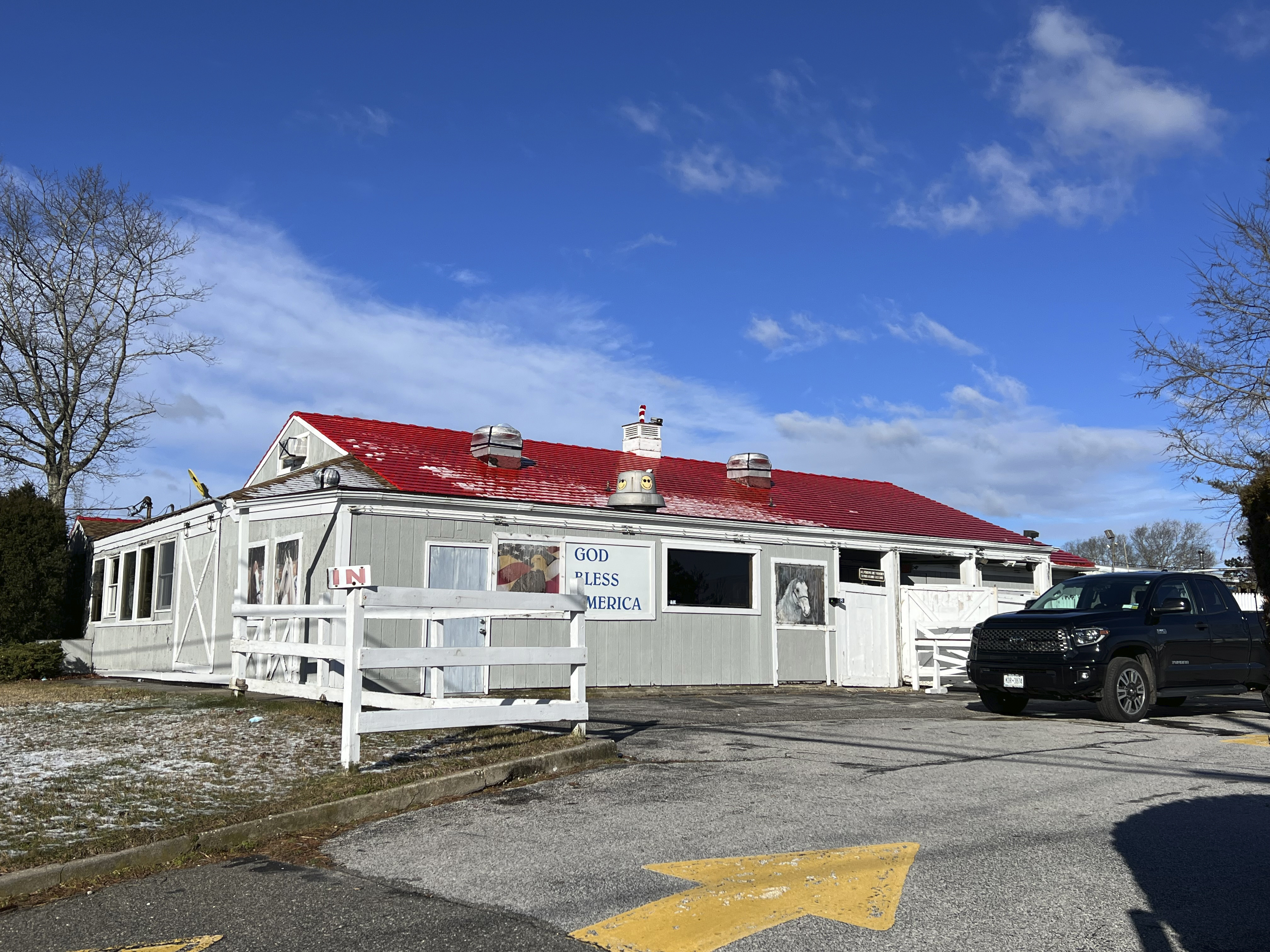
The old Boardy Barn in Hampton Bays. DANA SHAW
Only about five minutes into a pitch of plans to build a 68-unit hotel on the former Boardy Barn property, a member of the Hampton Bays Civic Association suggested a show of hands to get an early idea of whether residents of the hamlet thought the plans were something they liked the look of, at least at first blush.
A majority of the more than 100 people in the room raised their hands in approval — surprising even the hoteliers, who had brought only a conceptualized plan and a simple artist’s rendering of the modern hotel that they hope to be able to build.
Robert Salvatico, whose family owns the Indigo Hotel and the Holiday Inn & Suites in Riverhead, said that the “Hamptons-style” hotel he and his partners plan to propose to the Town of Southampton in the near future would be a 3-star level facility, moderately priced — which is “not cheap” on summer weekends — with a restaurant and bar open to both guests and the public, possibly a pool, and 25 to 30 employees.
But Salvatico emphasized that the plans would be molded to fit what the community would support. “Our plan is a conceptual plan, so we’re here to hear from you — we want your input, your ideas,” he said.
One person in the audience said she hoped the hotel would have a restaurant open for breakfast seven days a week, something she said the hamlet is sorely in need of — and that Salvatico said his vision for the facility would definitely include.
Several others peppered questions aimed at getting the hotelier to promise that the hotel would never become long-term housing, and that rooms would never be booked by state or county homeless or indigent housing programs, like other hotels in Hampton Bays have been.
The hotel representatives said in as many ways as they could come up with that such things were not in their business model.
“[Long-term stays] is not in the business model — it’s not a great plan for us,” Salvatico said. “It’s not beneficial for us to accept somebody beyond a month, because it creates a residency situation, which is not a great look for us. We’re very much a transient facility.”
Accepting public housing subsidies would “absolutely not” be in his group’s business plan, he added. “Our plan is to run a first-class facility. I know the sensitivity in this community, having seen what’s happened to so many of these motels. That is not the business that’s going to make us successful.”
He said the hotel would be a “soft brand” affiliated with Hilton Hotels, so it would be under their oversight and quality control — without the chain hotel branding and design.
At an approximately $20 million development cost, he said that there will also be banks and investors keeping close tabs on how the hotel is operated to protect their financial stakes.
“The banks are going to be watching us, Hilton has a reputation we need to respect … our reputation is all we have,” Salvatico said.
Prompted by audience members at the March 31 meeting, he said the group would support community events and activities much like the Boardy Barn commonly did — something he said has been “a hallmark” of his family’s hotels in Riverhead — and would be open to discussing other community benefits the developers could offer Hampton Bays to help garner support.
“We don’t win if you don’t win,” Salvatico said.
Community support for the idea will likely be essential because the town zoning code does not currently allow a hotel to be built on the Boardy Barn property. That stretch of Montauk Highway is a highway business zoning district, which does not allow hotels.
So David Gilmartin Jr., the attorney representing the hoteliers, said the group plans to ask the Southampton Town Board to “tweak” the zoning code to allow hotels in the highway business zone and possibly other changes to make them easier to create in general.
“It’s my view that the zoning code is really out of date with respect to hotels,” Gilmartin, a former Southampton Town attorney, told the crowd. “It requires 11,000 square feet of lot space per unit — that’s four units per acre — so that’s why you have not seen a new hotel developed in the Hamptons since the 1950s, when the zoning code was adopted.”
The early plans the hoteliers brought to the group show the 68 rooms split between 40 to 45 standard studio-style hotel rooms, and the remainder suite-style rooms suitable for family sharing in an approximately 34,000-square-foot, two-story building.
The restaurant and bar, he said, would be geared toward guests but open to the public and with an eye to not trying to compete with established restaurants in the area — serving breakfast and “light lunch, and maybe light dinner.”
At the Indigo Hotel in Riverhead, which Salvatico’s family opened in 2010, the group has live music four nights a week, and he said that would be something they might like to have in Hampton Bays as well.
The employees, he said, would be drawn as much from the local community as possible.
Salvatico was asked why the group didn’t just buy one of the existing hotels in the hamlet rather than acquiring the Boardy Barn property and trying to convince the town to embark on the time-consuming process of changing the code to accommodate their plans.
The size of existing hotels, which are typically 25 rooms or less, does not fit the financial model, or the market demand, that the hoteliers see existing on the South Fork.
“Availability is the best ability in our business,” Salvatico said of the Boardy Barn property. “And my family and I learned the hard way in Riverhead that sometimes those conversions of old facilities can be very difficult as compared to building something new.”
The suggestion also turned the group to a sore point: the former Hampton Bays Diner, which at the time was on the verge of being torn down.
Some said the site would have been a great place for the hotel — or almost anything more welcoming to the hamlet than the two medical office buildings that are to be built on the cleared land.
“The diner is gone. We have to move past that,” Town Planning Administrator Janice Scherer told the crowd.
“It’s unfortunate,” she added. “We wanted to scoot them over and get that as the gateway — I tried really hard to get that to happen — but, you know …”


 Michael Wright on Apr 17, 2025