


 7 Photos
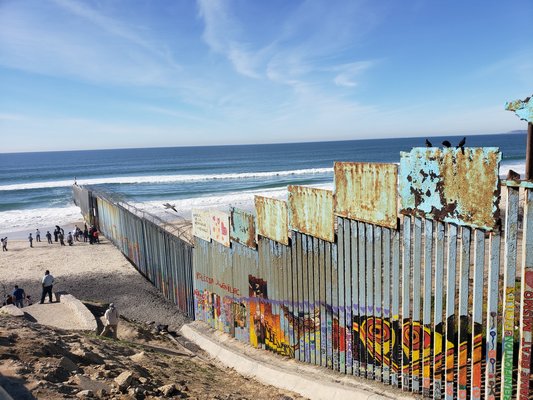
The border wall between Tijuana and San Diego ends in the Pacific Ocean. COURTESY LISA VOTINO-TARRANT
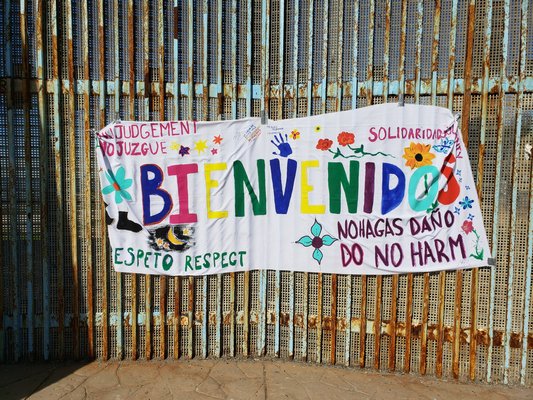
A welcome sign hung on the border wall. COURTESY LISA VOTINO-TARRANT
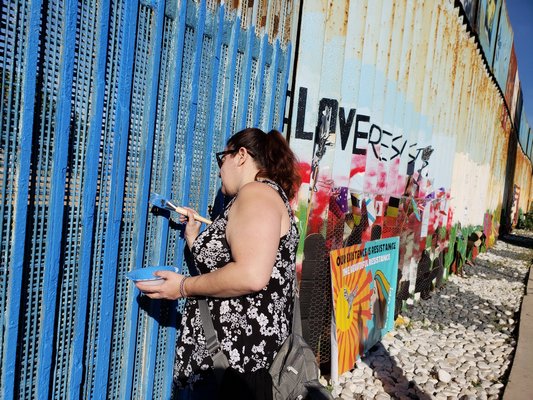
Lisa Votino-Tarrant painting an area of the border wall in Tijuana
Mexico. COURTESY LISA VOTINO-TARRANT
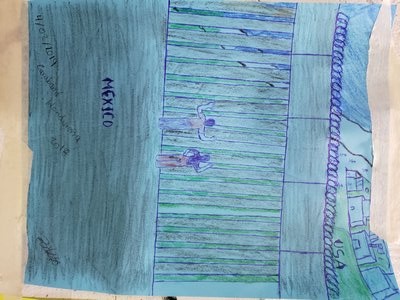
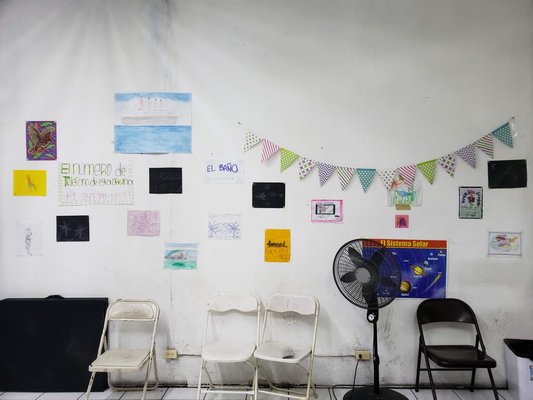
Some of the artwork on display in the volunteer-run community space in Tijuana

where Ms. Votino-Tarrant worked. COURTESY LISA VOTINO-TARRANT
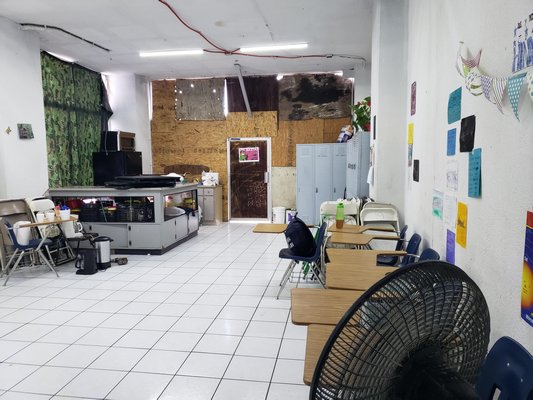
One of the drawings on display in the volunteer-run community space in Tijuana
“Mama, can you help them?”That was the question 6-year-old Lily asked her mom, Lisa Votino-Tarrant, last year while they watched images of families being separated at the Mexico border on their living room TV.
About six months later, Ms. Votino-Tarrant was in Tijuana, Mexico, writing emergency contact information on the skin of babies’ backs in black Sharpie, in case they were taken away from their parents at the processing center—so it would be easier to reunite them later.
“I always had a Sharpie on me,” said Ms. Votino-Tarrant, who just came back from her third trip to the border city in Mexico since January. She described how she would pass the marker around while people waited for their registration numbers to be called, so they could scribble down phone numbers on their arms or on the insides of their clothes, in case their phones or documents were ever taken away.
That was just one of her roles as a volunteer helping asylum seekers from around the world as they attempted to find sanctuary in the United States.
Whenever a number was called, about 10 people hopped into a van and were transported to the San Ysidro port of entry facility to officially turn themselves over to U.S. Customs and Border Protection. Some of them, Ms. Votino-Tarrant never saw again. Many others were returned to Mexico as they waited for their court hearings instead of waiting on the U.S. side—a federal protocol that was enacted the day she arrived in late January.
This new procedure resulted in the need for more assistance in Tijuana, as a growing number of asylum seekers waited, homeless and unemployed for months, facing an uncertain future.
“So many of the people I worked with were beaten and robbed in Tijuana, had their documents stolen,” she said, adding that despite the hardships, many of them stayed optimistic and made the best of the situation.
Choosing to volunteer at the Mexico side of the border put her own safety at risk, as well. She recalled having a gun pointed at her head by Mexican federal police as she hoisted children atop car roofs to avoid the thigh-deep monsoon flooding. Looking back at it now, she laughed and shrugged at the absurdity.
Ms. Votino-Tarrant, who lives on the Shinnecock Indian Reservation, has done immigration advocacy work for over 15 years, attending protests, marches and municipal board meetings throughout Long Island, and even partaking in a volunteer delegation trip to Oaxaca in 2016.
Lily began tagging along once she was old enough, becoming her mom’s “partner in crime.”
When Lily suggested helping the separated families, her mom realized that she had to fly down there, despite the fact that she is not bilingual. Still, “I had zero reasons to say ‘no’ and a thousand reasons to say ‘yes,’” she said recently. She knew since her trip to Oaxaca that the Mexico side of the border needed volunteers.
For her first trip, she traveled alone to join Sanctuary Caravan, a group of volunteers who were helping migrants at the border, and worked with them for two weeks. They were actually leaving the day after she arrived, to her surprise, but she decided to stay anyway to help in whatever way she could.
Ms. Votino-Tarrant worked with a couple of other volunteers—a combination of U.S. citizens and asylum seekers—to run a makeshift office space out of an old nightclub, which provided a bathroom, shower, toiletries, toys, supplies, and a place for people to rest. She described it as a safe space for people waiting in legal limbo.
It was in that rundown building where she experienced “the highest of highs and the lowest of lows,” she said, as she gradually considered more and more of the over 100 people who came through its doors every day to be her family.
She met and assisted people from various countries and all socio-economic classes—a much more diverse crowd than she had originally anticipated. Most people sought asylum from the Central American countries of El Salvador, Guatemala, Honduras and Nicaragua, but she also saw large groups from Haiti, Ghana, Guyana, and even Iran, Russia and other countries, who were under the impression that Tijuana had one of the easier ports of entry into the United States.
“I’ve never seen such hope and love in my entire life,” she said of the asylum seekers. “The people at the border are superheroes. They’re not rapists and murderers. They’re veterinarians and doctors and lawyers and teachers,” she explained, saying meeting the people was the best part of being there.
“What a lot of it is, is that they’re people who gangs, the military and the government couldn’t corrupt. So they’re coming for safety here. So we’re not getting the worst of people—and, in my experience, we’re getting the best.”
She also shared the worst part of the experience. People would ask her, “What’s America going to be like for me?” Working on incidents of immigrant hate crime throughout Long Island as a community organizer, Ms. Votino-Tarrant knew what happens to some immigrants in detention centers, courts and everyday life.
“It makes me the most sad thinking about what they could possibly face,” she said, recalling that she was particularly distraught over the hate crime involving the murder of Ecuadorian immigrant Marcelo Lucero in Patchogue in 2008.
She became so invested in the people and the work in Tijuana that she took two more trips there, one in March and the other in April, to support people through their court appearances in San Diego and help open a women’s and children’s shelter. She would bring extra luggage each trip filled with donations from people on Long Island who wanted to help.
For her first trip, she made a GoFundMe page to cover her travel expenses and was able to raise enough funds. But after deciding to return to Tijuana, she kept the page up for additional travel funds, as well as donations to help those at the border. She had raised a total of $6,620 as of April 22.
Adelita Simon, the director of the community space in Tijuana, said she no longer considered Ms. Votino-Tarrant a volunteer, but, rather, a family member.
“She is the one person who proved to me that not every white volunteer who doesn’t speak Spanish has ‘white savior’-ism,” Ms. Simon said, referring to a phrase used to describe the perception of self-serving motives of white people helping non-white people in less-developed countries. “She’s someone who humbly wants to help people. And no matter what people say, no matter people telling her she can’t do this, she can’t do that, she gives everything she can to provide for people.”
Because of her cheerful attitude and experience with children—along with being Lily’s mom, she works at the Bridgehampton Child Care and Recreational Center as an executive assistant—she was naturally drawn to the families that sought safety, many of whom spent months traveling from their home countries to the border city. “She has a very special bond with kids,” Ms. Simon said.
On her first day there, Ms. Votino-Tarrant said she found a stack of artwork from the asylum seekers and began taping them to the walls for everyone to see. Many children drew images representing their homesickness and feelings of hope that they would be allowed into the United States.
From that point on, she became the curator of the migrant art space, providing art supplies for anyone seeking a creative escape from their undesired situation and continually adding new work to the colorful collection.
Ms. Votino-Tarrant said she wants to exhibit the entire collection in New York soon. She is currently coordinating with her fellow volunteers who are still in Tijuana to mail her all of the artwork and find venues that would be willing to put them on display.
Ms. Votino-Tarrant said she plans to return in about a month to continue her support. Volunteers there are in the middle of opening a new office space nearby to replace their current location, so she was considering traveling back once it is operational.
In addition to that, she spends her time in between trips speaking at community centers and immigration conferences about her experiences—and the experiences of the asylum seekers.
“One of the big things that I kept hearing over and over again down there was, ‘Please go back and tell them what’s happening here. Please go back and tell them my story.’ I must have been told that, like, five or 10 times a day from people,” she said.
“So when I came back, I was, like, you know what? People need to know what’s actually happening at the southern border and not what all the noise is.”


 Anisah Abdullah on Apr 22, 2019