


 7 Photos
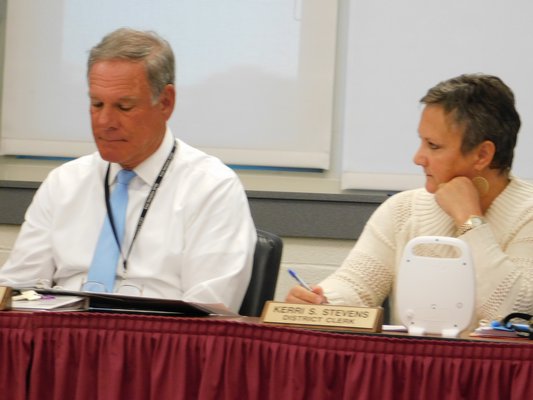
East Hampton School District Superintendent Richard Burns and District Clerk Kerri Stevens at the most recent school board meeting announcing the vaping forum. ELIZABETH VESPE
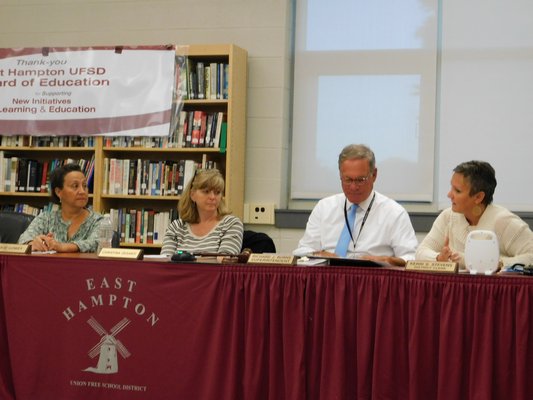
School board member, Jacqueline Lowey, school board vice president, Christina DeSanti, East Hampton School District Superintendent Richard Burns and District Clerk Kerri Stevens at the most recent school board meeting announcing the vaping forum. ELIZABETH VESPE
School board member, Jacqueline Lowey, school board vice president, Christina DeSanti, East Hampton School District Superintendent Richard Burns and District Clerk Kerri Stevens at the most recent school board meeting announcing the vaping forum. ELIZABETH VESPE
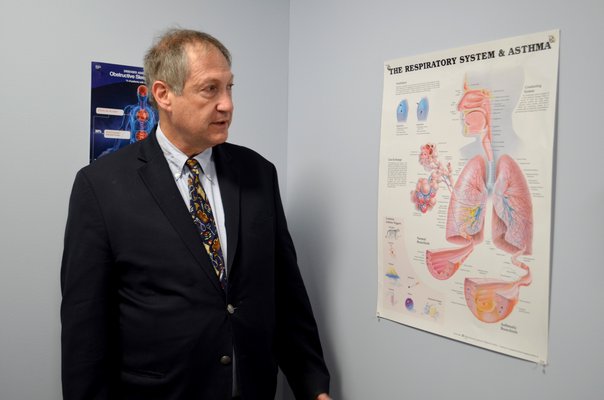
Dr. Howard Sklarek, a pulmonologist at Stony Brook Southampton Hospital, recommends everyone to stop vaping until vape products are proven to be safe. ANISAH ABDULLAH
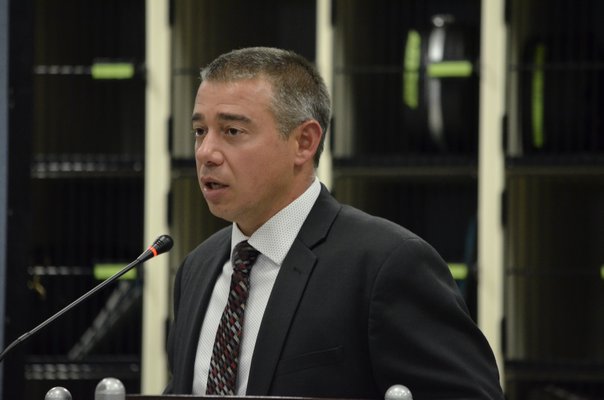
Southampton High School Principal Dr. Brian Zahn announcing the vaping forum to the school board on September 17. ANISAH ABDULLAH
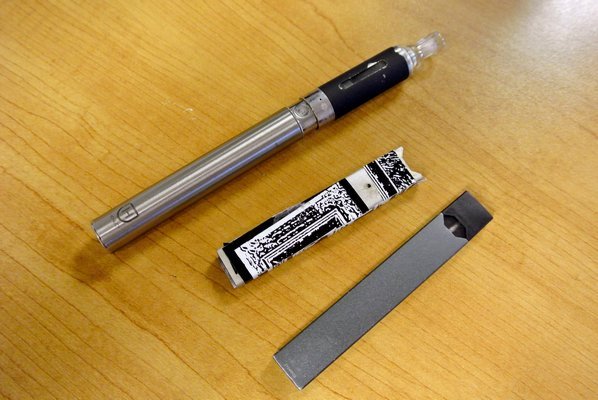
Examples of different vapes. PRESS FILE
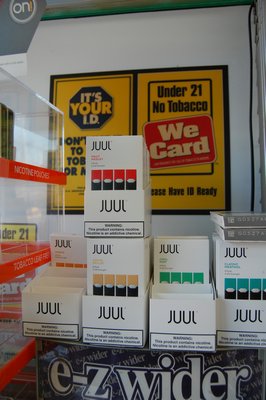
A display of Juul e-cigarettes. PRESS FILE
In the last month, two adults with a history of vaping have been admitted to Stony Brook Southampton Hospital for acute respiratory failure, tying the East End into the national outbreak of vaping-related hospitalizations.
First reports of hospitalizations and deaths associated with the use of vape pens, also known as e-cigarettes, came about a month ago, immediately bringing the issue to the national spotlight and leading federal agencies to investigate the outbreak.
Matters have escalated quickly since then. The number of reported cases nationwide has been rising at an alarming rate. New York State implemented a ban on flavored e-cigarettes and, now, local school districts are planning community vaping forums to tackle rampant use in schools.
There have been 530 cases of vaping-related lung injury throughout the country as of September 19, according to the Centers for Disease Control and Prevention. Seven deaths have been reported from six states.
In New York, 93 cases have been reported as of September 24 and that number has grown every week. Four days prior, that number was at 81. Of the 81 cases, 17 percent were teenagers — similar to the nationwide ratio of 16 percent — and 56 percent were under the age of 25.
The State Department of Health first received reports of those numbers in early August and the state has taken swift and drastic action since then to address what Governor Andrew Cuomo called a “public health crisis.”
On September 17, New York became the second state to ban the sale of flavored e-cigarettes and nicotine e-liquids effectively immediately, in an effort to mitigate teen vaping.
“New York is not waiting for the federal government to act,” Mr. Cuomo said in a prepared statement, “and by banning flavored e-cigarettes we are safeguarding the public health and helping prevent countless young people from forming costly, unhealthy and potentially deadly life-long habits.”
Almost 40 percent of 12th grade students and 27 percent of high school students used vapes in New York in 2018, according to data from the DOH, which blames flavored e-liquids as the reason for the youth appeal to vaping. In four years, usage among high school students increased by 160 percent.
The most popular vaping device among teenagers, and within the country, is Juul, a sleek black e-cigarette shaped like a USB flash drive that uses disposable cartridges called “pods.” Each cartridge contains roughly the same amount of nicotine as one pack of cigarettes, according to the manufacturer.
The sale of tobacco- and menthol-flavored products are still permitted in the state, but DOH Commissioner Dr. Howard Zucker is reviewing a ban on menthol flavor and will provide a recommendation within two weeks, the governor’s office stated.
Southampton and East Hampton school districts are joining forces to host call-to-action forums next month to address youth vaping. Southampton’s forum will take place on October 3 and East Hampton’s on October 2, both at 7 p.m. in their respective high school gymnasiums.
District administrators, student activists and local health officials will speak at the events, as well as national medical experts Dr. Victor DeNoble and Dr. Bonnie Halpern-Felsher who can offer expertise on the dangers of vaping and how young people make health-related decisions.
High school principals in both districts introduced the forum to their respective school boards on the evening of September 17.
“We are really excited about this opportunity,” Dr. Brian Zahn, the principal of Southampton High School, said at his district’s meeting. “It’s an amazing experience that we have to get our students involved in this very important national topic.”
Dr. Zahn said that school administrators are partnering with the district’s chapter of Students Against Destructive Decisions, or SADD, to engage the community and take action.
“We’re on the front lines of it every day,” Dr. Zahn said to the board. “But hearing from the mouths of our students in terms of the impact that it’s having not only in our classrooms and our hallways, on our athletic fields, on our buses, but also on their social lives and everywhere else, in their own households, it’s just astonishing.”
The two districts are also collaborating with Peter Emerson, a former White House aide with deep ties in Washington, D.C. Dr. Zahn explained that this partnership could publicize the local school districts’ efforts on a national scale.
“Teenage vaping and the concerted efforts to market liquid-based nicotine to our children have created substantial health risks and financial strains on our school systems. We hope everyone can come out for what will be two very informative evenings,” said Adam Fine, the principal of East Hampton High School.
The state DOH will begin enforcing the ban on Friday, October 4, two weeks after it was implemented, to ensure that retailers are no longer selling flavored vaping liquids. They can face fines of up to $2,000 per violation.
When the ban was announced, Mr. Cuomo also directed the DOH and State Police to crack down on retailers who sell the products to underage buyers. Most counties’ minimum legal age to purchase liquid nicotine is 18, but some counties raised the age to 21 this year, including Suffolk and Nassau counties.
In Suffolk County, 32 establishments were issued violations in September as a result of a sting operation that centered on underage vape sales. The Suffolk County Police Department and the state DOH conducted the sting, called “Operation Vape Out,” from September 4 through 18. County Executive Steve Bellone and Police Commissioner Geraldine Hart announced the results on September 24.
It is unclear how enforcement would occur for online sales. Additionally, the Shinnecock Indian Nation’s legal department is reviewing whether the tribe should adhere to the state ban, Tribal Council Chairman Bryan Polite said on Thursday.
The American Academy of Pediatrics, or AAP, wants New York to take the ban a step further and prohibit the sale of menthol-flavored vaping products as well, according to Dr. Louis Goldblum, a part-time physician at Southampton Pediatrics in Hampton Bays and a current member and former president of AAP’s New York chapter covering Queens, Brooklyn and Nassau and Suffolk counties.
Dr. Goldblum said members of his chapter’s executive board recently met with communities within the chapter’s coverage area as well as various elected officials to warn them of the dangers associated with vaping.
“As a pediatrician, I’m amazed when I see kids — and I practice out on the East End — who vape. It is so common,” Dr. Goldblum said, noting that he is “so happy” the state implemented legislation to address the issue.
The ban could prevent young vape users from forming or maintaining a nicotine addiction, which may have led to some of the reported health problems, but most patients in the nationwide cases reported using vape products containing THC, the psychoactive compound found in cannabis, according to the CDC.
Vape cartridges containing THC are either purchased from marijuana dispensaries or from the black market, the latter of which is not subject to oversight regarding the chemical makeup of such products.
The local cases are part of that majority statistic as well. Both of the patients at the Stony Brook Southampton Hospital admitted to vaping cannabis compounds, according to Dr. Howard Sklarek, a pulmonologist who has been practicing for more than 20 years.
So although the state ban does not address THC usage, Dr. Sklarek said, “as far as our community, [the ban] might be the most important thing to do right now,” referencing the prevalence of youth vaping.
Dr. Sklarek said he considers the two Southampton cases to be more like one-and-a-half, as one was deemed a “probable” case and the other a “questionable” case. The probable patient developed acute lung injury and acute respiratory failure and the questionable patient had acute respiratory failure and asthma-like symptoms without having asthma, the doctor explained.
Both patients were discharged after a short period of time and their symptoms improved quickly after taking appropriate medication.
“Right now, we don’t know what the actual cause is. A couple of different pathologies in the lungs and until we can tie a specific product — nicotine alone, nicotine with cannabis, or cannabis alone, or flavors, we haven’t targeted anything — we’re not sure,” Dr. Sklarek said. “My recommendation is not to use any of them.”


 Anisah Abdullah on Sep 26, 2019