


 3 Photos
As it gets deeper into hunting season, the issue of whether preserved land can—or should—be used for deer hunting is being contested among Southampton Town officials and hunters.
Since its inception in 1999, Southampton Town’s Community Preservation Fund has preserved more than 3,000 acres of land, as open space or farmland, or for its historic, recreational and environmental value. This year, the town’s Community Preservation Department has partnered with the State Department of Conservation to identify 430 acres of Southampton Town-owned land to cooperatively manage with the state for hunting. Those properties are Southampton Hills, Noyac Preserve, Tuckahoe Swamp and Barrel Hill, which opened for archery deer hunting on October 1, according to Southampton Town’s website.
For the cooperative properties with the DEC, the season for bow hunting ends on December 31. Noyac Preserve also is open through January 31 for hunters using long bows or firearms.
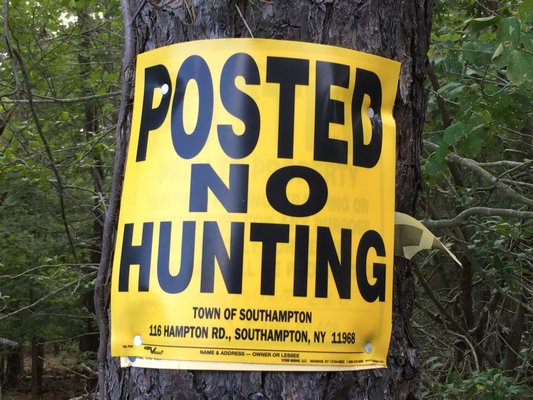
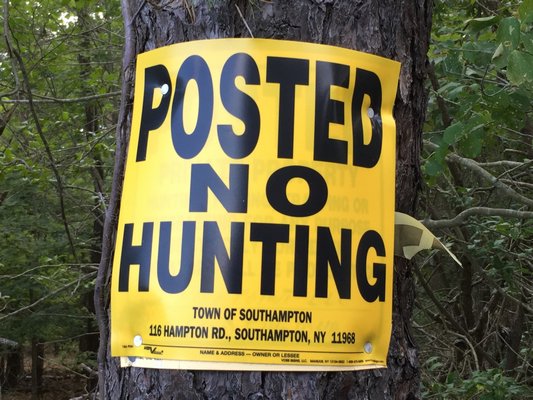
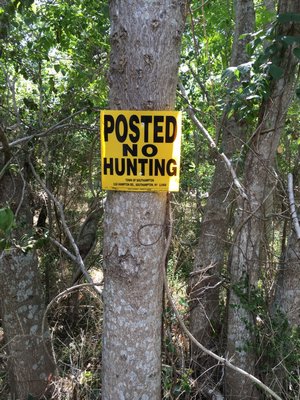
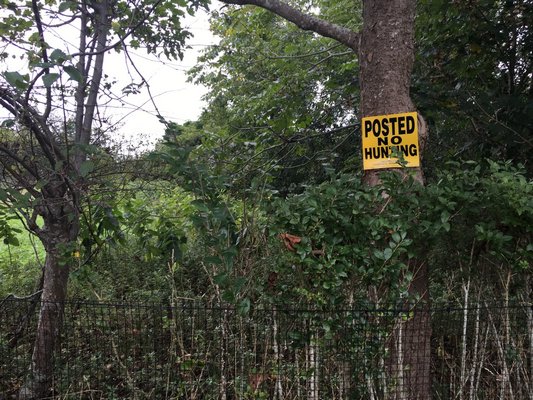
At several other CPF properties, however, the Community Preservation Department has posted “no hunting” signs. That has angered hunters who say they have used those lands for years. In addition, local hunters like Michael Tessitore of East Quogue have raised concerns about the department banning hunting on any town-owned properties without input from the Town Board.
“I want to see the CPF continue to preserve land, whether for water quality or open space, and allow that land—if it falls within guidelines of the New York State environmental conservation hunting laws and regulations—to be utilized by hunters as well as hikers and bird watchers,” said Mr. Tessitore, president of East Quogue-based nonprofit corporation Hunters for Deer, on the phone this week. “If I am not within 150 feet of a house—that hunting is legal. I should be allowed to hunt that property.”
According to the town’s website, hunters using a bow must be 250 feet away from any school, playground or any occupied structure—or 150 feet for bow hunting—unless the property is owned or leased by the hunter or a member of their immediate family, or by an employer, or if the hunter has the property owner’s consent.
“If a hunter is within the zone, it’s not up to the CPF to enforce,” Mr. Tessitore said.
“They [are supposed to] make recommendations,” he continued. “Who is allowing them to make postings when there’s already laws in place to regulate hunting? They’re creating safe havens for deer.”
According to CPF Manager Mary Wilson, an individual can go onto anyone’s land to use a bow and arrow, or crossbow, during hunting season, unless “no hunting” signs are posted around the perimeter of the property and as long as the hunter abides by the setback rules. She said the same goes for town property. “If the property is appropriate for hunting, then you can go on it and bow-hunt,” Ms. Wilson said. “Places that aren’t suitable, you wouldn’t have a hunter on it.”
Christian Killoran, the vice president of Hunters for Deer, said at a recent Town Board work session that he was confused as to why the town has banned an otherwise legal activity on certain CPF lands. He added that he believed the partnership with the DEC was redundant and unnecessary.
“What do they think they’re going to accomplish by an agreement?” Mr. Tessitore added. “The law is already in place about lawful hunting. Southampton Town Police can enforce the laws—we don’t need any agreements. You don’t need an agreement to have Southampton Town to stop a burglar in your house, either.”
According to State Assemblyman Fred W. Thiele Jr., the town does have the authority to allow or deny hunting on any town-owned property. “While the state regulates hunting, the town owns the property, so the town always has the right to decide if they want to allow hunting on the property,” Mr. Thiele said. “Whether the property was owned by the CPF or purchased through the general fund, the basic rule is just like a private owner: The town can decide if they want to allow people to hunt on the property.”
Ms. Wilson said this week that there are several reasons why some CPF properties are posted, including proximity to homes, parks and playgrounds, as well what the other uses are on the property and whether they are compatible with hunting.
She added that there are certain CPF properties that are simply not suitable for hunting, such as town parks, where public safety is a concern. One example, she said, was the Nathaniel Rogers House in Bridgehampton. The 5.6-acre parcel includes a cleared field and a playground with some woods neighboring it. The house itself is currently being restored to become a museum.
She said the department will continue to work to develop five more cooperative hunting areas with the DEC in the town, including Whiskey Hill in Bridgehampton.
Hunters for Deer recently raised similar concerns in the Village of Sag Harbor over a local law enacted a year ago that bans all hunting, trapping or “pursuing wildlife” within the village’s boundaries. Earlier in October, Mr. Killoran went to State Supreme Court in Riverhead to challenge the law enacted last October, and that dispute is ongoing.


 on Oct 26, 2016