


 4 Photos
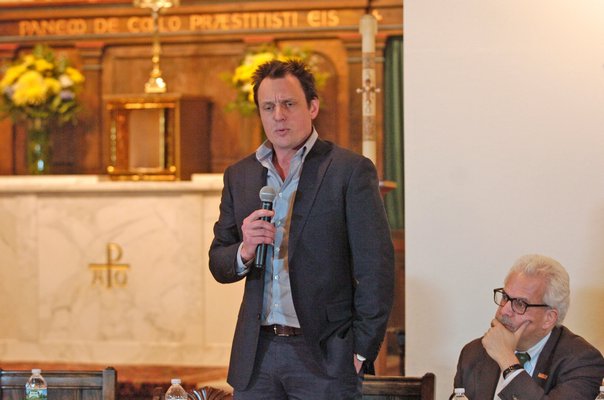
East Quogue attorney Christopher Worth. DANA SHAW
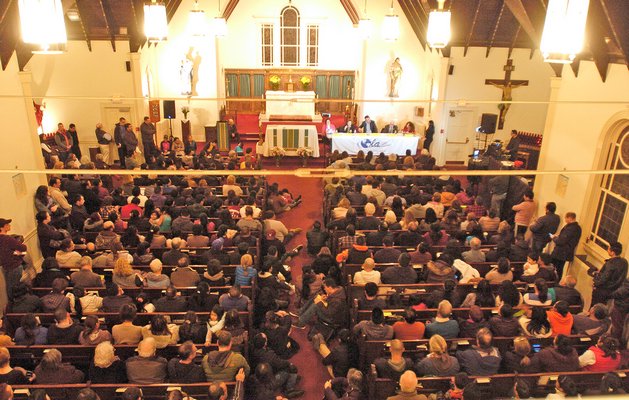
Hundreds of people packed the Queen of the Most Holy rosary Church in Bridgehampton on Tuesday evening for a forum hosted by OLA. DANA SHAW

OLA hosted a community forum on Tuesday evening at the Queen of the Most Hold Rosary Church in Bridgehampton which drew hundreds of people. DANA SHAW
Minerva Perez
The walls of the Queen of the Most Holy Rosary Church in Bridgehampton were lined with people Tuesday night as hundreds of immigrant men and women sought to learn what they can do in the wake of President Donald Trump’s new national immigration policies and potential U.S. Immigration and Customs Enforcement raids.
The leaders of Organización Latino-Americana of Eastern Long Island, a nonprofit that works to inform, empower and celebrate the East End’s Latino and Hispanic communities, quickly put together Tuesday night’s forum to discuss the issues now facing the South Fork’s community of immigrants, many of whom are now living in fear over possible deportation.
And it appears that their concerns are well-founded, according the panel of experts who otherwise tried to comfort the estimated 400 people gathered inside the church.
Minerva Perez, executive director of OLA, said she thought it was important to bring in experts—including officials from Empire Justice of East Islip, Latino Justice of New York City, Make The Road New York of New York City, and Christopher Worth, an East Quogue attorney who specializes in immigration issues—to address their concerns and answer specific questions about new national immigration policies.
“There is a lot of fear in the community—and there is good reason for that,” Mr. Worth said.
The attorney explained that, in the past, the federal government was primarily focused on undocumented immigrants wanted for serious crimes, and especially felonies, noting that those were the primary targets of ICE agents for deportation. But under new policies, Mr. Worth warned that those who are in the country illegally could now face possible deportation for less serious crimes and offenses—a shared fear among many in the immigrant community.
“It’s important to know who your neighbors are,” Mr. Worth said, suggesting that those immigrants who are in the country legally should strive to find out if their fellow tenants are undocumented and, therefore, potential targets.
Ms. Perez noted that many people in the immigrant community are afraid of U.S. Immigration and Customs Enforcement raids, or getting their permanent residency taken away. She pointed out that the rampant rumors of local sightings of ICE officials, paired with reports in the national media of ICE raids in other states, including those on the Mexican-American border, are heightening the fears among the East End’s immigrants. So far there have been no reports of ICE sweeps on the South Fork.
Members of Tuesday night’s panel of experts helped explain what constitutional rights immigrants have—including the right to remain silent—and gave them tips on how to prepare themselves for potential interactions with ICE agents.
“It’s not a crime to be an immigrant,” Cheryl Keshner, a senior paralegal with Empire Justice, told those in attendance, an observation that was followed by a roaring applause.
Still, she also offered a few tips for immigrants so they can be properly prepared whenever they are confronted by ICE agents. Her tips included always carry identification, memorize their immigration identification numbers and keep all legal documents in a safe place.
Ms. Keshner also stressed that, especially for those who are undocumented and have spouses and children, that they quickly establish emergency plans in case they eventually face deportation, explaining that they could be sent away without their families.
A few of those sitting on the panel suggested that they put in writing who they would want to take care of their children if they are eventually deported. They also suggested that the safest option, if they want their children to be able to remain in the country, is to entrust their safety to a documented citizen. Officials also suggested that parents give a set of their house keys to another trusted individual, writing down a list of medical information for their children, and keeping a list of emergency contacts that a friend could use if the parents are deported.
One audience member using an index card that was then read aloud asked for advice on how to talk about the current situation with their children.
“It’s most important to tell your children you love them,” Ms. Keshner said. “And that you will have someone to care for them until you can be together again.”
Even though the immigrants gathered Tuesday had the support of several dozen citizens also in attendance, there was still a considerable amount of fear in the room. Ms. Perez started the meeting by giving strict instructions to attendees not to post any pictures or video from the gathering on social media if they contain images of individual faces. OLA recorded the two-and-a-half hour meeting on an iPad, focusing on panel members, and later posted the recording on its Facebook page. The video was posted in hopes of sharing it with those too afraid to attend Tuesday night’s meeting.
To that end, numerous audience members declined to be interviewed, citing similar concerns.
Last Thursday, February 16, hundreds of immigrants from across the East End, including both documented and undocumented individuals, participated in the nationwide “Day Without Immigrants” protest that culminated with a march in Hampton Bays. Though an estimated 300 people marched, many undocumented immigrants opted to stay home because they were afraid of ICE officials showing up.
“Some people don’t feel comfortable to meet here today,” Paola Zuniga of Flanders said at last week’s march. “I know there are a lot of people who are afraid because there [are] rumors that are going around about immigration. That’s the point of being here—to show up and say we’re here. We’re not enemies; we’re friends. And we want to be part of the community and be involved.”
Over in East Hampton, Father Gerardo Romo of St. Luke’s Episcopal Church said he has also observed a lot of growing fear in his community. “It’s heartbreaking to see people living in fear,” said Father Romo, a legal immigrant from Mexico. “Especially good people—good people in the community.”
Father Romo said immigrants in the community have good reason to fret—pointing to two reported sighting of ICE officials in Springs within the past week. “I heard last week that ICE is looking for a specific criminal case, but they always try to get more than what they are looking for,” he said. “Or at least that’s my impression.”
Father Romo was referring to an incident last week where ICE investigators were spotted in East Hampton searching for an unidentified individual wanted on multiple felony charges. Town Police Chief Michael Sarlo confirmed that the federal agents had been in the town but could offer few details about the initiative, including whether the individual was arrested.
Then, on Tuesday morning, Father Romo said he received a call from a day laborer who typically looks for employment at the East Hampton train station. The man told him that an ICE agent knocked on his sister-in-law’s door in Springs looking for a family member. The woman allegedly told the agent that the person they were looking for was not home, according to Father Romo. The agent then asked to enter the home but the woman refused after the official stated that he did not have a warrant.
“It’s really heartbreaking,” Father Romo said about the situation, noting that he was unable to attend Tuesday night’s meeting in Bridgehampton because he had taken a Hampton Jitney to Manhattan that afternoon so he could attend a class and learn more about immigration law.


 Amanda Bernocco on Feb 20, 2017