


 2 Photos
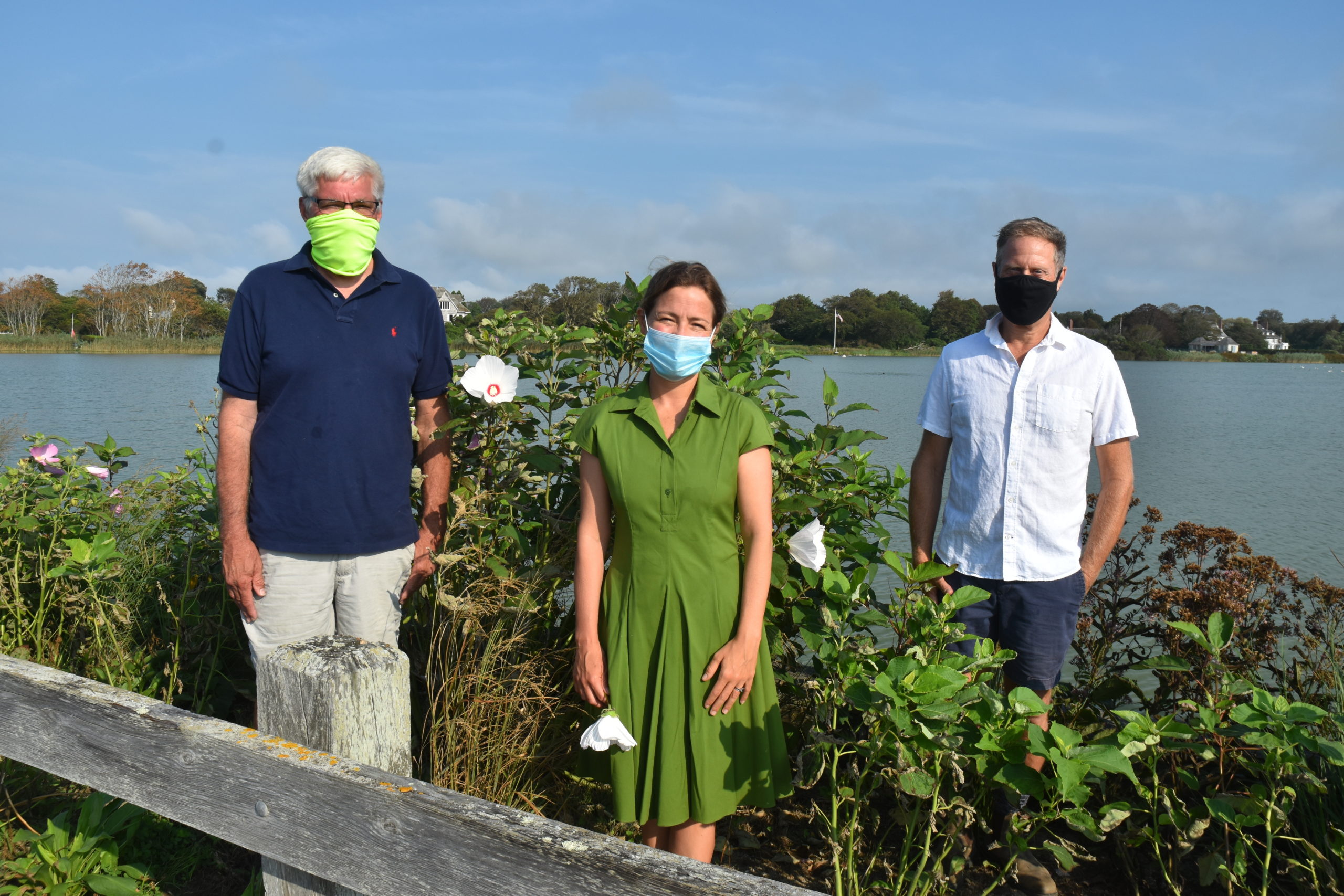
Southampton Town Trustee Bill Pell, Meghan Magyar, a member of the board of the Lake Agawam Conservancy, and horticulturalist Tony Piazza at a bioswale that was planted this year to help filter pollutants from entering Lake Agawam. STEPHEN J, KOTZ
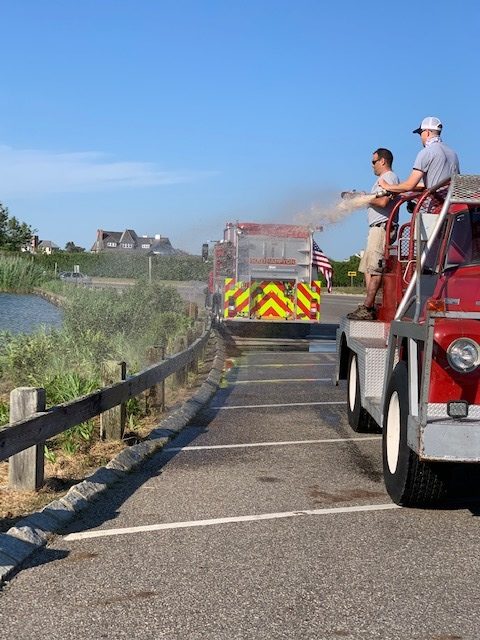
Members of the Southampton Fire Deparment have helped keep a newly planted bioswale at the foot of Lake Agawam moist during the hot, dry summer. COURTESY TONY PIAZZA
Until last June, a thin strip of land that runs between the southern edge of Lake Agawam and the parking lot across from St. Andrew’s Dune Church on Gin Lane in Southampton was just “a weedy tangle,” according to horticulturist Tony Piazza.
But the Lake Agawam Conservancy, which was formed last year with the goal of improving water quality in the beleaguered pond, agreed to underwrite the approximately $31,000 cost of transforming what was just another drainage ditch into a bioswale that will help prevent road runoff pollutants from entering the pond.
Mr. Piazza used a variety of native plants, including swamp rose mallow, which is a type of hibiscus, ruby boneset, swamp milkweed, seaside goldenrod, sweet pepperbush, winterberry, northern bayberry, switchgrass and common rushes to create a garden that will bloom over the course of the summer and early fall and provide winter interest as well. The plants are also good at absorbing the rainwater that runs off the road through spaces in the Belgian block curbing and taking up the excess nutrients and toxins the water carries with it.
It being 2020, a year that will certainly go down in infamy, the planting work along the approximately 8-by-800-foot strip was delayed because of the coronavirus pandemic. By the time it was completed in June, things were already starting to get dry.
“We planted at a time of year that was not the best,” acknowledged Mr. Piazza, “and I thought it would be OK. But then we found ourselves in this unprecedented drought.”
Enter Southampton Town Trustee Bill Pell. The Trustees own the strip of land, and had offered their support for the bioswale project.
“He said, ‘Give me five minutes,’” Mr. Piazza said, “and he called the fire department.” That evening a crew from the Southampton Fire Department brought a tanker and two other trucks to the site, where members soaked the parched garden.
Chief Tony Stevens said volunteers returned a couple of more times to conduct drills at the site — it’s important, he said, that members “exercise the equipment” and keep on top of procedures. But one member, John “Dusty” Kandula went beyond the call of duty, rigging an irrigation pipe to the side of one of the department’s old tankers and stopping by early mornings to water the garden before going to his job with the village’s Department of Public Works.
“It’s all about community. That’s why we volunteer,” the chief said, pointing out that Mr. Kandula is usually up and at it by about 6:30 a.m. “I know because that’s when he signs the truck out,” Chief Stevens said.
Meghan Magyar, a member of the Lake Agawam Conservancy’s board, said since forming last year its members had been looking for projects large and small to help revive the polluted lake. Among its many activities, she said the group held programs to educate people about the valuable role native plant species can play in helping filter polluted water before it reaches the surface water or the groundwater.
“This is the first we hope of what will be many,” she said of the bioswale. “It’s just such a positive, simple way of doing it — by planting plants.”
Ms. Magyar said she was also pleased to see that the project has won the support of so many different communities, from the village and town governments to the congregation of St. Andrew’s Dune Church and members of the Bathing Corporation of Southampton, which have also lent a hand at keeping the garden watered.
Mr. Pell said credit for the idea goes to former Trustee Fred Havemeyer, who worked with Jim Walker of Inter-Science Research Associates Inc., a village environmental consulting firm, about a decade ago on a project to replace an old creosote bulkhead along the south side of the lake, dig out contaminated soil and replace it with fresh sand and plant native species.
“The principal focus was on trying to do something about the water in Lake Agawam, which was inundated with nutrients from all around it,” Mr. Havemeyer said. “It was part of a multipronged effort to put it right when everything was working against it.”
Mr. Havemeyer said he had hoped the rain garden — Mr. Piazza prefers the term bioswale, although they are largely interchangeable — would serve as an example to the village and the town, but it appears he was ahead of the curve. In any event, the work he championed was damaged by storms, including Superstorm Sandy, and eventually allowed to turn to weeds.
Mr. Piazza, Mr. Pell, and Ms. Magyar are betting that won’t be the case this time.
“There is momentum now and funding from the conservancy,” Mr. Piazza said.
Mr. Pell said the project is part of a longer-term vision that would involve removing the median from the parking lot and replacing it with a second bioswale, thus softening the view of the concrete parking lot with a more natural component, while improving water quality at the same time.


 Stephen J. Kotz on Aug 11, 2020