


 1 Photo
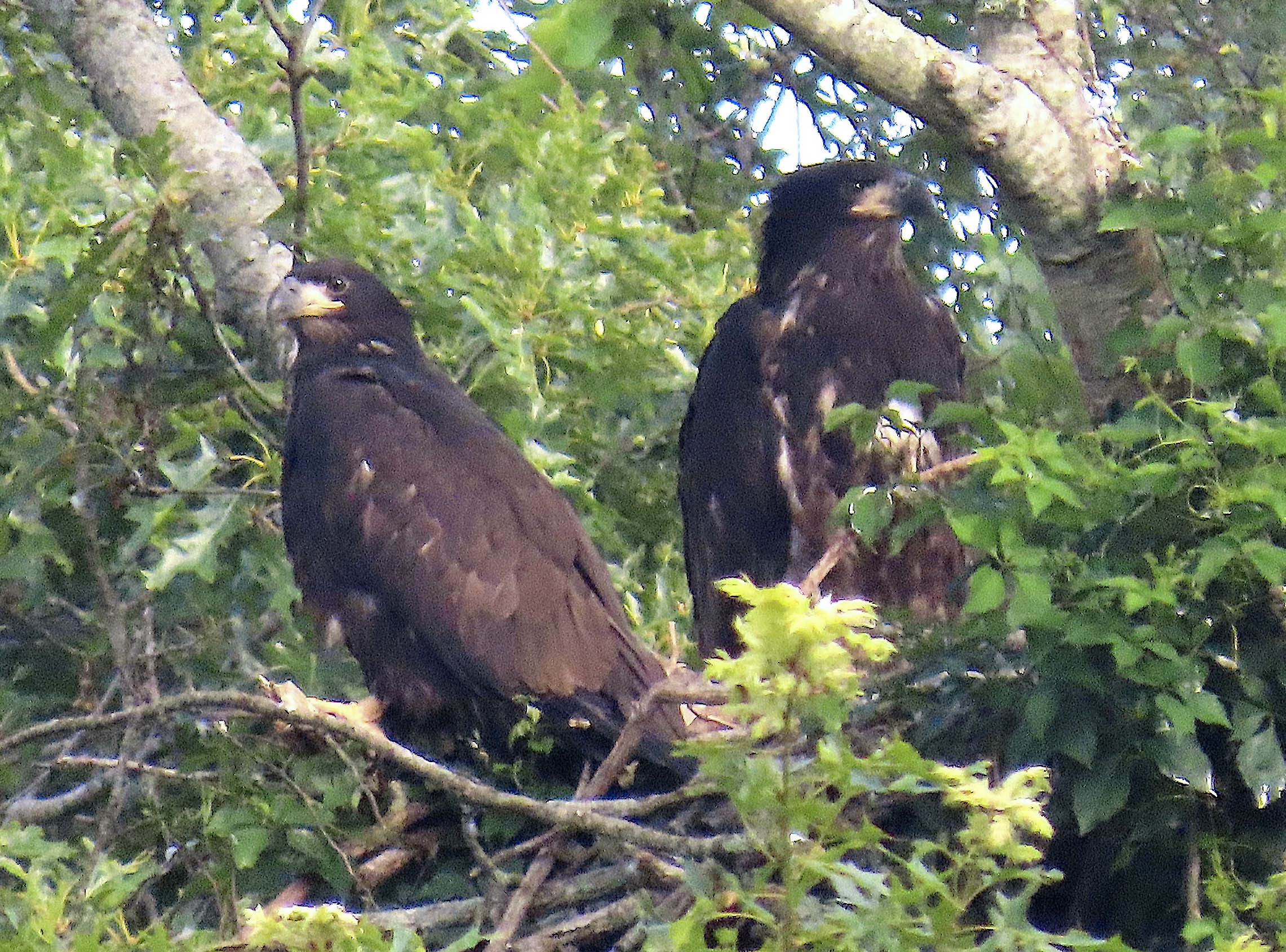
Bald Eagle chicks at a new Amagansett nest just before fledging. MIKE BOTTINI
July’s report from the field has a little bit of everything on the spectrum of good, bad and as-yet-to-be-determined news. We’ll start out with the good stuff.
We went into the winter season with all our swamps, marshes and vernal pools filled to the brim, and that situation remained stable through the spring amphibian breeding season. That bodes well for a number of our salamanders (tiger, spotted and blue-spotted), frogs (wood, spring peeper, gray treefrog), and possibly a very elusive and sporadic breeder: the spadefoot toad.
I received this message on June 13 from Luanne Johnson, a colleague who has helped me with the river otter project and who is the director of biodiversity works on Martha’s Vineyard, doing all sorts of amazing wildlife research:
“Spring deluge triggers spadefoot toad breeding event:
“On May 23, Martha’s Vineyard received 2.8 inches of rain in a spectacular deluge. This type of spring rainfall event, with temperatures above 50 degrees, awakens spadefoot toads slumbering 4 feet underground and triggers breeding.
“The only two breeding basins on Martha’s Vineyard are adjacent to pitch pine/oak woodlands in Edgartown, and spadefoots were heard calling May 23 and 24. Relying on ephemeral pools that are free of fish and salamanders, spadefoot toad eggs and tadpoles are in a race against time to hatch and metamorphose before the basin dries out.
“Eggs hatch in three or four days, and tadpoles metamorphose into toads in three to six weeks, depending on food availability. We found egg masses that were 24 to 48 hours old in both basins two days after the spadefoot toads were heard calling. Adults can be out foraging near their breeding basin on nights with warm temperatures and high humidity.
“Our next visit is scheduled for this week to search for tiny spadefoot toads that may have completed metamorphosis from tadpoles. We hope to find some!”
Looking at the National Weather Service records for the closest station to us (Brookhaven National Lab), we did not experience the deluge that passed over Martha’s Vineyard in May. In fact, the total precipitation here in May was a paltry 1.2 inches, which is 2.5 inches less than the average for May going back as long as records have been kept. June was similar, with a total of 1.5 inches recorded for the month, 2.7 inches below normal.
Most of our swamps, marshes and vernal pools are now completely dry, but the early spring breeding salamanders and frogs should have been able to transition from eggs to larvae to their respective terrestrial forms before the pools went completely dry. And by periodically drying out, these breeding areas are able to remain free of fish predators.
While we are on the topic of vernal pools, the Seatuck Environmental Association has initiated a “Long Island Vernal Pools Working Group” under the leadership of John Turner. The goal is to locate, map and describe all the vernal pools on Long Island and work with local, state and federal governments, scientists, local citizens, land owners, and decision-makers to better protect vernal pool wetland resources and their associated upland habitats.
Another good bit of nature news is that the newest bald eagle nest in East Hampton, and first in Amagansett, fledged two young last week. I suspect, but can’t prove, that this nesting pair was the same as the pair that nested on an osprey pole in Accabonac last year, and also fledged two young.
An early nester, the eagles had a nice set up in Accabonac and were happily incubating eggs until early April 2019, when all the osprey arrived from their wintering grounds.
It took some time for the smaller osprey to get organized, but once they did they used their numerical advantage to continuously harass the eagles every time they flew in with food for their hatchlings. It got so bad that the adults started just dropping food at the nest and beating a hasty retreat to rest elsewhere. For some reason, the osprey did not bother the young, even after they fledged.
Both sets of fledged young, the 2019 and 2020 cohorts, totaling four eagles, provided they survive the next four or five years to reach adulthood, most likely will return to nest somewhere in the vicinity of the East End, further boosting Long Island’s bald eagle population.
Some possible bad news is the dearth of monarch butterfly sightings so far this summer. I use the caveat “possible,” because this is based solely on my observations in the field, including my backyard milkweed patch in Springs and the approximately 30-acre field on the Greentree Foundation property in Manhasset, which is dotted with the beautiful, bright-orange flowers of butterfly weed (Asclepias tuberosa).
And here’s the bad news: Last month, a dead whale was reported floating off the coast of New Jersey, less than 20 miles south of Long Island. It was a male right whale calf, born in December 2019 in the right whale calving grounds off the coast of Florida and Georgia, and was traveling north with its mother for the summer when it was struck by a boat and killed. The necropsy revealed serious injuries from two separate vessel collisions over the course of several weeks.
There are so few North Atlantic right whales remaining — approximately 400 — that researchers at the New England Aquarium have cataloged them all. Only 100 mature females remain in the population. This calf’s mother was born in 2005, and this was her first calf.
North Atlantic right whales range from their calving grounds north to the Gulf of Maine. The population off Europe in the eastern Atlantic was extirpated by commercial whaling. The ban on hunting right whales enacted in 1935 was too late for that population to recover. Basque whalers began hunting the population off Labrador and Newfoundland in the 1500s, and by the 1700s right whales were already rare in those waters.
Right whales were the “right” whale for hunting, because they frequented relatively shallow coastal waters, swam slowly enough to be approached by sail or rowing, floated when killed, and yielded large amounts of oil and long pieces of baleen.
Mothers are very protective of their calves, and one hunting technique was to focus on getting close enough to harpoon the calf, which drew the mother in close enough to also harpoon her.
As with other large whales, the right whales have a very low reproductive rate. “Three to four years is considered a normal or healthy interval between right whale calving events. But now, on average, females are having calves every 6 to 10 years,” according to the National Oceanic and Atmospheric Administration.
Entanglements in fishing gear and vessel strikes are the greatest threats to the endangered right whale, and biologists speculate that females, by going through the energetic stress of reproduction, are more susceptible than males to dying from entanglement or vessel strike injuries.
Since 2017, biologists have documented 31 deaths and 10 serious injuries among right whales, totaling 10 percent of the population. Both threats need to be addressed to prevent this species from going extinct, and both pose a formidable challenge to whale biologists.


 Mike Bottini on Jul 14, 2020