


 3 Photos
A last-minute proposal to resolve the argument over how much tax relief should be given to eligible school districts, using proceeds from Southampton Town’s Community Preservation Fund, has scratched the scab off an old political wound.
Southampton Town Supervisor Linda Kabot introduced a proposal at a special Town Board meeting last week that would establish a reserve fund for the payments in lieu of taxes, or PILOTs, that the town makes to three local school districts: Riverhead, Hampton Bays and Eastport South Manor.
If adopted by the Town Board, the new resolution would create the reserve fund and increase PILOTs for 2009 to around $3.5 million, about $400,000 more than the supervisor originally set aside for the districts in her tentative 2009 operating budget. The three districts received $4.8 million in PILOTs in 2008.
However, Ms. Kabot’s proposal—one of several that have circulated Town Hall in recent weeks—is most likely doomed for failure, as she does not appear to have the support of the majority of the Town Board. If that happens, the PILOT subsidies for 2009 would remain at $4.8 million, the same amount as the three school districts received this year.
The issue must be resolved, and a plan of action adopted, at the special Town Board meeting scheduled for today, November 20, the deadline for filing the town’s 2009 budget.
Ms. Kabot’s plan is to place $256,172 of CPF revenue into a reserve fund and add it to the $3.3 million already set aside for PILOTs in her tentative $82.5 million budget. That $3.3 million is based upon 10 percent of the $33 million in projected CPF revenue for 2009. If Ms. Kabot gets her way, then the total payout for 2009 PILOTs will be $3,537,504.
The supervisor’s initiative comes in response to a plan sponsored by Town Board member Chris Nuzzi that would have changed the formula for how PILOTs are allocated. Initially, Mr. Nuzzi advocated taking 10 percent of the aggregate of the CPF from 2002 instead of 10 percent of the fund’s revenue for a given year. Had that initiative gone through, PILOTs for 2009 would have topped the $6 million mark.
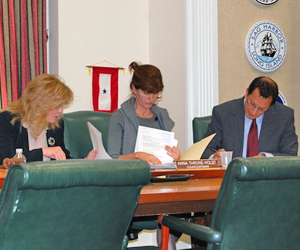
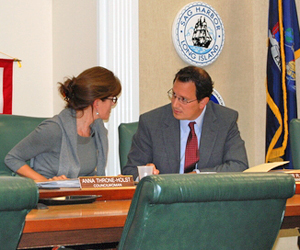
Supported by fellow Town Board members Anna Throne-Holst and Dan Russo, Mr. Nuzzi argued that PILOT relief for 2009 was insufficient in light of the souring economy and the fact that those three school districts had received significantly more money this year. He added that administrators in those districts had planned on receiving larger payouts while crafting their school budgets last spring.
If the town reduces its PILOTs in 2009, the Riverhead School District would be the hardest hit, according to Mr. Nuzzi. That district received $3 million in PILOTs in 2008. In her original budget, Ms. Kabot budgeted slightly less than $1 million to that district.
Mr. Nuzzi and the board members who support him said they are unwilling to add to the financial burden of taxpayers in the hamlets of Flanders, Riverside and Northampton, who send their children to the Riverhead School District.
“These are the least affluent areas in town and will be the hardest hit,” Ms. Throne-Holst said, adding that not providing adequate tax relief to these areas could result in some people losing their homes.
In 2008, with a PILOT payout of $4.8 million, homeowners living on the Southampton Town side of the Riverhead School District, with a home valued at $500,000, received $1,297 in tax relief. If Ms. Kabot’s proposed subsidy of less than $1 million were to be adopted, then that same homeowner would have to pay roughly $932 more in school property taxes.
Mr. Nuzzi has pointed to the 2002 amendment, approved by nearly 80 percent of Southampton Town voters, that allowed for CPF revenue to go to tax relief. “That was the intent of the PILOT program,” Mr. Nuzzi said. “We have the ability to provide significant tax relief to those in most need and we should.”
Under Ms. Kabot’s plan to set aside $3.5 million, a homeowner with a home assessed at $500,000 would save an estimated $649 in school property taxes next year. In Ms. Kabot’s view, this is the best compromise because it does not alter the payout formula while still providing added tax relief to the schools.
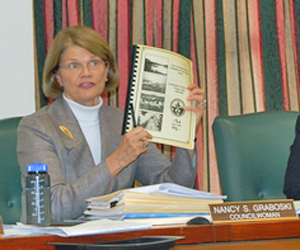
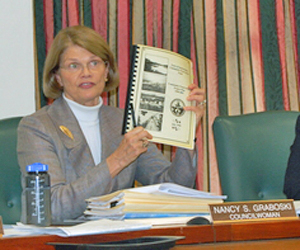
Mr. Nuzzi’s initial plan was not well received by the supervisor and Town Board member Nancy Graboski, who argued that altering the payout formula represented a major policy shift and would harm the integrity of the CPF. Ms. Kabot argued that any such changes to the CPF should be made by voters through a referendum, since the PILOT program was approved by voters in the first place.
The supervisor went as far as to say that the officials who favor Mr. Nuzzi’s proposal to base the payments on the prior year’s revenue—including New York State Assemblyman Fred Thiele Jr. and State Senator Ken LaValle—were advocating “breaking the law.” Mr. Thiele and Mr. LaValle helped to draft the original CPF legislation.
Ms. Kabot made this assertion despite Mr. Nuzzi and Ms. Throne-Holst arguing that they were told by Mr. Thiele that using the aggregate amount was valid.
Though the CPF was established in 1998, Mr. Nuzzi said he wanted to discuss changes made to 2002, the year the CPF was amended to allow for PILOTs. Initially, the 2002 amendment was to compensate school districts that had lost tax revenue from lands within those districts that had been taken off the tax rolls for preservation.
In 2007, Mr. Thiele drafted a subsequent amendment to the PILOT program that allowed districts to receive subsidies defined by a state-based need index. That resulted in Hampton Bays receiving $1.8 million in tax relief, the first PILOT for that district.
Mr. Nuzzi’s initiative to alter the payout equation was scrapped for another plan that sought middle ground. After meeting with Mr. Thiele, Mr. Nuzzi and Ms. Throne-Holst settled on a formula that would base the payouts on 10 percent of last year’s revenue. This solution, the board members argued, would clear up any confusion on how the earmarks were doled out and would provide the districts with an accurate figure before they crafted their school budgets.
This solution, according to Ms. Throne-Holst, is a temporary fix for the upcoming year as Mr. Thiele has proposed legislation that will solve the dilemma once and for all.
“This is a sandwich year,” Ms. Throne-Holst said, adding that basing the PILOTs on last year’s revenue is a “one-shot deal” until Mr. Thiele’s legislation passes in Albany. That legislation would “expressly provide rules for calculating and awarding” PILOT payments, according to Mr. Thiele.
Specifically, Mr. Thiele’s bill requires that a 10 percent limit on PILOTs be calculated each year based on annual revenue, and that the last full year of CPF revenue be used to calculate that percentage. So, according to the assemblyman’s legislation, if the town collected $50 million in CPF revenue in a given year, then the town could allocate up to $5 million in PILOTs for the following year.
Both Mr. Nuzzi and Ms. Throne-Holst favor this plan because they said it clears up any confusion over how the payments are formulated. “Under this plan, school administrators will know exactly how much money they can expect before they craft their budgets,” Ms. Throne-Holst said.
Mr. Thiele’s legislation also specifies which districts are eligible for PILOTs, states the method for assessing the tax value of preserved land, provides for a proportional allotment of PILOT payments based upon tax loss when the PILOT appropriation is less than the maximum PILOT liability, and ratifies all previous town actions with regard to PILOT payments.
“Local governments have utilized their discretion with the PILOT payments more for politics than good policy reasons,” Mr. Thiele said. “This legislation will forever eliminate any such shenanigans with PILOT payments.”
To be codified, Mr. Thiele’s amendments must be approved through a mandatory referendum.


 Brian Bossetta on Nov 18, 2008