


 1 Photo
Homeowners in Flanders and Riverside are upset over the recent installation of a larger trailer to house homeless sex offenders overnight on the Suffolk County Jail property in Riverside.
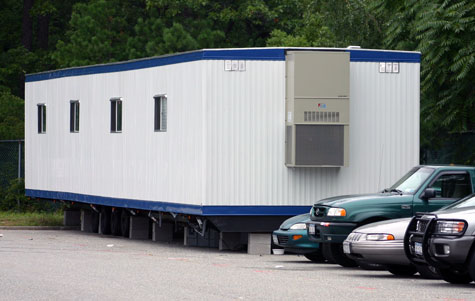
The new trailer, which is managed by the Suffolk County Department of Social Services, was installed around September 11 and increased the living quarters for the homeless sex offenders, from 14 feet by 50 feet to 14 feet by 70 feet, according to Roland Hampson, a spokesman for the department. He noted that the new trailer cost $50,000 and can accommodate about 20 sex offenders, though it can be configured to hold more. The original smaller trailer could hold up to eight people.
“It seems like we’re the dumping grounds for everything, all the time,” said Michael Brewer, the president of the Flanders, Riverside and Northampton Community Association, who fought against the placement of the trailer at the Riverside jail last spring. “It doesn’t surprise me that the county is using us as a dumping ground again.”
Southampton Town residents have been upset since learning last year that the Department of Social Services had placed both of its trailers that provide temporary housing for homeless sex offenders in the municipality. A second trailer that temporarily houses the sex offenders was placed early last year near the Suffolk County Police Academy shooting range, located off Old Country Road in Westhampton.
Mr. Hampson explained that the Westhampton trailer is utilized only as an overflow facility for the one in Riverside. The trailer in Westhampton measures 14 feet by 50 feet and can accommodate up to eight people. The county has no plans to increase its size, according to Mr. Hampson.
According to the New York State Sex Offender Registry, there are some 18 sex offenders who currently list the trailer at the county jail in Riverside as their permanent home—even though the shelter is only meant to provide temporary shelter. Pictures of the sex offenders, as well as some of the details of the crimes they committed, are available for review on a state website.
At 7:30 a.m. each day, taxis hired by the county transport the sex offenders to the homes of relatives or the offenders’ places of employment. Mr. Hampson said the county pays for the cab service and receives partial reimbursement from the state.
Mr. Hampson said many people falsely believe that the trailer occupants can freely roam the neighborhoods of Flanders and Riverside. He explained that those calling the trailer home cannot check in until 8 p.m. each night and cannot leave until 7:30 a.m. the next morning. No one stays in the trailer between 7:30 a.m. and 8 p.m., and there are no showers or cooking facilities inside the trailer, according to Mr. Hampson.
He also noted that there is no time limit on how long a homeless sex offender can stay at the trailers: “The state mandates that we house the homeless. There’s nothing that limits how long they can stay.” However, Mr. Hampson noted that, on average, the sex offenders stay for only a few days.
The county is forbidden by law to release the names of those that are receiving financial aid, according to Mr. Hampson. “As it pertains to Social Services, the state protects their confidentiality because they’re recipients of Social Services,” he said. “However, they are personally responsible to report their whereabouts to county police.”
He explained that homeless sex offenders receiving financial aid from the county must still register with local police—a sticking point in the past, because not all of the residents in the past have registered with the Southampton Town Police Department. Convicted sex offenders are required by the state to provide their home addresses to local authorities, such as the Southampton Town and Riverhead Town police departments, once they are released from prison. Other conditions stipulate that sex offenders cannot live near schools, playgrounds or other places that children usually congregate.
There were 16 homeless sex offenders housed at the trailer at the jail in Riverside as of last Thursday, September 18. Mr. Hampson noted that the last time the Westhampton facility was used was the night of September 10.
The homeless sex offenders residing in the Riverside trailer represent only between 1 and 2 percent of the entire sex offender population in Suffolk County, Mr. Hampson noted. There are more than 1,000 registered sex offenders living in Suffolk.
Mr. Hampson explained that the county installed a larger trailer at the Riverside property because of laws that restrict where sex offenders can live. A county law, passed in 2006, mandates that sex offenders cannot live within one quarter of a mile of a school, licensed day care center or playground. Those kinds of restrictions tend to increase the number of homeless sex offenders seeking assistance from the county, Mr. Hampson said.
“We’re planning in advance for homeless sex offenders,” he said, referring to the larger trailer. “It allows us flexibility should the numbers increase.”
Suffolk County employs security guards from a private firm to oversee the occupants of the trailer, Mr. Hampson explained. With the increase in the trailer size, the county hired a third guard, he said. Members of the Suffolk County Sheriff’s Department also provide back-up if their assistance is needed.
“The sheriff’s office have enforcement rights on jail property and tell our security what to do,” Mr. Hampson said. “They’re not in there, pacing the trailer—that’s what the security does.”
He added that sheriff’s department patrols the perimeter of the prison, a fact that should allow area residents to feel safer. “They’re responsible for the entire jail facility, they control ... who comes and leaves,” Mr. Hampson said.
Michael Sharkey, the chief of staff of the sheriff’s department, emphasized that no one is allowed to wander the grounds near the jail and trailer. Though his deputies would assist trailer security guards during emergencies, Mr. Sharkey noted that the sex offenders can come and go as they please because they are no longer prisoners.
“If their behavior goes beyond what’s legal, we have jurisdiction,” Mr. Sharkey said, speaking about the role of the sheriff’s department, “but if they’re simply walking off the grounds, we have no reason to stop them.”
When sex offenders opt to leave the trailer, whether to look for permanent housing or to find employment, the Department of Social Services is responsible for providing them with transportation to their destination, according to Mr. Hampson. He noted that sex offenders “absolutely” cannot leave the trailer property on their own.
But Suffolk County Legislator Ed Romaine of Center Moriches, whose legislative district falls just north of the county jail in Riverside, does not think that the county is keeping close enough tabs on the sex offenders.
“I’m skeptical of the fact that they’re taxied back to where they came from,” Mr. Romaine said this week. He suggested that corrections officers who are on duty should monitor the trailer.
Mr. Hampson said the trailers are needed to prevent homeless sex offenders from wandering from neighborhood to neighborhood, and to keep them away from other shelters that are open to families who might have children.
“This protects the integrity of our shelter system and ensures that the neighborhoods are safe,” Mr. Hampson said. “It’s a program that should make people feel safer, not more nervous.”


