


 2 Photos
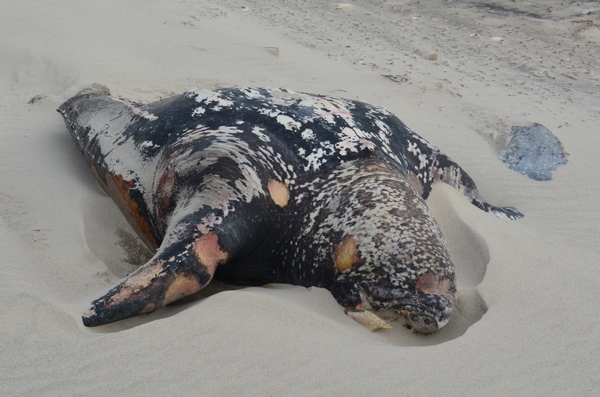
A leatherback turtle washed up in East Quogue after Sandy. ERIN MCKINLEY
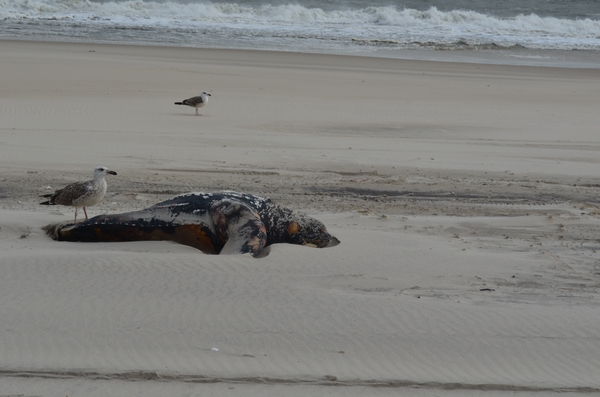
A leatherback turtle washed up in East Quogue after Sandy. ERIN MCKINLEY
Sunk in the sand in East Quogue, the decaying, mammoth-sized carcass of a leatherback sea turtle remains visible, months after Hurricane Sandy’s massive surge carried it ashore.
Kim Durham, the rescue program director and biologist for the Riverhead Foundation for Marine Research and Preservation in Riverhead, said Monday that when healthy, the reptile, whose shell measures 7 feet long, probably weighed as much as 800 pounds.
Responding to calls from the public, Southampton Town officials usually contact biologists from the foundation to assist in breaking down such a carcass while performing a necropsy, which makes burial easier, Ms. Durham said. But without such a request from the town, and without the heavy equipment or manpower needed to bury it themselves, the foundation has had little choice but to let the carcass be.
The first report of the animal came on October 31, just after the storm hit. Biologists inspected it a few weeks later, once Dune Road was reopened to traffic. There was no evidence of sharp-force trauma, such as slices in the shell or flesh from boat propellers, Ms. Durham said.
Unless the biologists have a plan for disposing of the reptile, she added, they do not typically perform an internal examination, which is needed to determine its age and sex. The town, she explained, was busy with storm cleanup, and biologists were preoccupied with caring for living animals that could be rehabilitated.
Sometimes, a turtle’s age can be determined by the length of its tail, she said, but this particular carcass did not have such soft tissue by the time they inspected it. Ms. Durham did note that it was safe to assume the leatherback was an adult.
An internal examination could determine a cause of death if, for example, biologists find that the animal had ingested plastic or a hook. Leatherback turtles are usually seen in East End waters during the warmer summer months and later into the fall. They tend to migrate with jellyfish, which they feed on, Ms. Durham explained.
“They’re big animals,” she said. “They typically don’t come into rehabilitation facilities because of their size.”
Leatherback turtles, an endangered species named after the black, leathery skin that covers them, are the largest turtles in the world, according to the foundation. Adults can weigh up to 1,300 pounds.
During the month of December, the foundation brought in a total of 14 live sea turtles of different species, most of which were stunned by the cold water temperatures. “Everybody is doing really well now, so that’s good,” Ms. Durham said.
But she said the carcass that washed ashore in East Quogue was by far the largest turtle. There is still a chance that the town and foundation will revisit the option of disposing of the animal, though she said it’s still up in the air.
Chris Bean, the superintendent of the Southampton Town Parks and Recreation Department, was out of the office and could not be reached for comment.


