



 2 Photos
Environmentalist Richard Amper at the February public hearing on the Lewis Road development. KITTY MERRILL
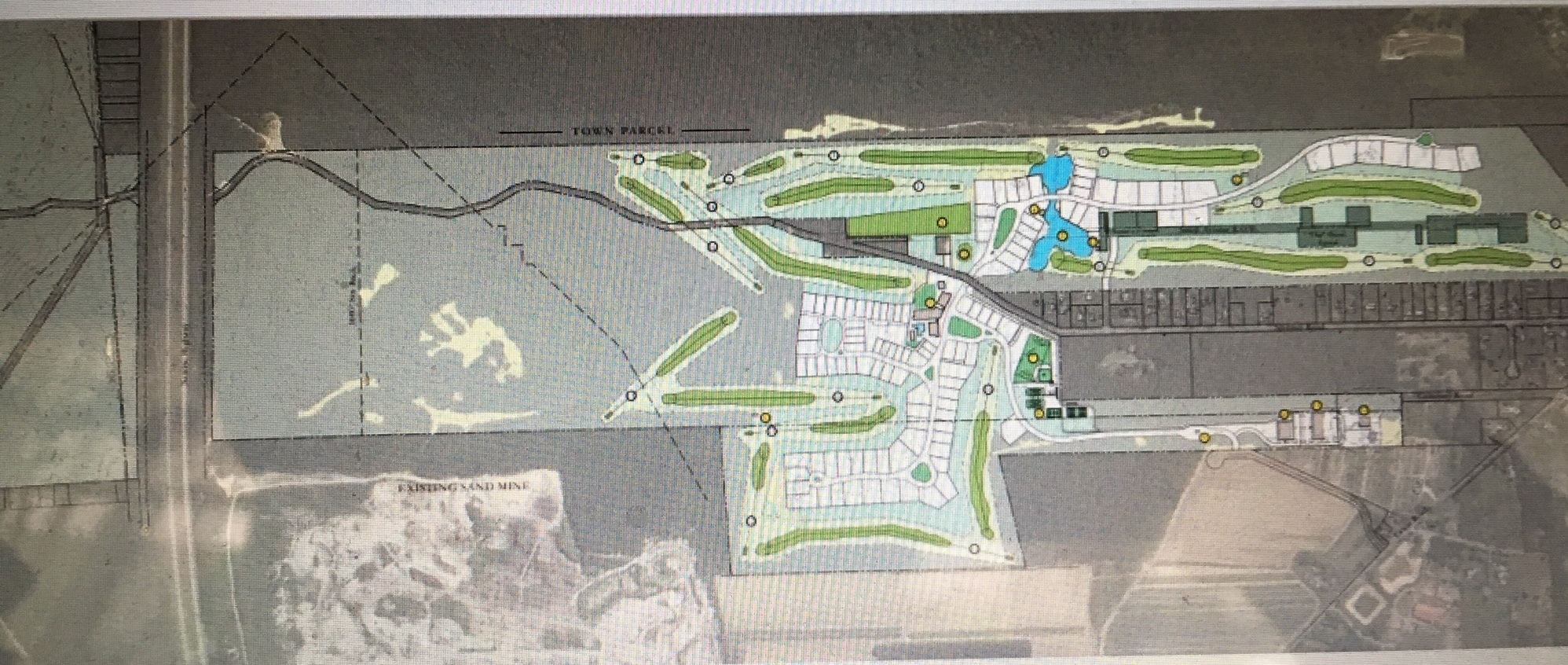
A revised map of the Lewis Road Planned Residential Development.
With a slew of questions still unanswered, and environmentalists calling for a do-over, the Central Pine Barrens Joint Planning and Policy Commission on June 17 moved the Lewis Road Planned Residential Development proposal in East Quogue along, tentatively scheduling, depending on the COVID-19 guidance in place, a public hearing for its July meeting and extending the decision deadline to August.
The proposal was subject to a public hearing in February that saw a standing-room-only audience crowd Riverhead Town Hall.
The proposal under consideration then, if approved, would include 118 housing units, an 18-hole private golf course and other private recreational facilities on 588 acres of land, 65 percent of which would be preserved as open space, in the Central Pine Barrens Overlay District and Aquifer Protection Overlay District in East Quogue. The site is north and east of Lewis Road near Spinney Road, extending north to, then beyond, Sunrise Highway.
But the proposal has changed.
Responding to questions raised by staff on June 3, contractors Nelson, Pope & Voorhis submitted a 173-page response on behalf of the developer Discovery Land Company. Commission members voted last week to send a response letter to the applicant, asking more questions, dozens of them, and making note of changes to the plan.
The site has increased by 20 acres, to a total of 608.45, through the purchase of an 11.11-acre parcel, known as the Timperman property, and through an additional 8.89 acres of road abandonments.
The revised master plan for the development depicts greater unfragmented open space at the northerly portion of the site, and connects with public open space to the east. It clusters development in a tighter fashion, and includes a conservation easement on the private open space held by the homeowners. There will be no construction of 17 density incentive units, no mining permits, dewatering, or off-site exportations of soil needed.
Principal environmental planner Julie Hargrave made clear, in her letter to the applicant, that the dozens of questions seeking clarification, additional submissions to demonstrate conformance with the Central Pine Barrens Comprehensive Land Use Plan Standards and guidelines.
Questions arose about sewage discharge and nitrogen effluent volume. When deemed practical, sewage treatment plant discharge should occur outside and downgradient of the central Pine Barrens, Ms. Hargrave reminded. A sewage treatment plant with tertiary treatment is proposed, even though the project density is well below the county health department standard, she noted.
Clearing limits prompted a variety of questions from the planners. It appears over 171-acres will be cleared, but the numbers of cleared area and open space don’t add up to the total acreage, nor has the applicant provided information about existing clearing, the planners said. An earlier report asked if existing clearing comprised 28 or 44 acres, and the information was not provided.
The revised pan demonstrates a greater amount of unfragmented open space and improves connectivity with adjacent public open space. To better demonstrate conformance with open space standards, more information and explanations are needed. For example, Ms. Hargrave noted, about 200 acres of the open space proposed is located between the golf course and housing units, dispersed among 171 acres of physical development. Extensive areas of isolated islands of open space are scattered throughout the development, she said.
The impact to steep slopes on the property was also a cause for query, and, while the revision called for tighter clustering, Ms. Hargrave said it could be tighter still.
The project site is adjacent to public trails and lands on its easterly side. For a distance of about 5,600 feet, development that includes the removal of natural buffers is proposed along the boundary. Revised grading plans should confirm adjoining public lands will remain undisturbed.
Ms. Hargrave concluded the report with a proviso. She emphasized the questions and comments were derived after a “preliminary review” of the June 3 submission and more may be forthcoming at the continuation of the public hearing.
Veteran environmentalists don’t believe the project’s public hearing should continue. They believe, given the volume of new information and revisions, that an entirely new application should be submitted and reviewed.
At the opening of the commission meeting, held via Zoom conference, Executive Director John Pavacic was called upon to read public comment. Richard Amper, executive director of the Long Island Pine Barrens Society, sent two missives to the body.
“What in Sam Hill is going on?” Mr. Amper wrote. “‘The Hills’ submits documents to the Commission in support of their project, days before the deadline. It seems to be providing information on a Pine Barrens development that is entirely different from what was provided to the Southampton Town Board and the Southampton Planning Board. This is an outrage. The applicant has been consistently changing its project, without providing supporting information.”
The veteran environmentalist said he was additionally irked to discover the review of the revised project without time to undertake his own review. “There is no way that the Commission could respond to this massive input,” Mr. Amper wrote. “I know, because the environmental community is trying to do so.”
Robert DeLuca of the Group for the East End, agreed. “Though we have just begun working our way through this extensive resubmission, it appears clear that the environmental review undertaken by the Town, clearly failed to adequately consider the requirements of the Pine Barrens Review Commission, as was long recommended by the public, but rejected by the town.” Southampton Town was the original body that reviewed the application, first dubbed “The Hills.”
“Staff and the environmental community deserve appropriate time to review the applicant’s massive new application for a project different from the earlier submission. This is the biggest and baddest proposal ever presented to the Commission,” Mr. Amper continued, adding “… that the Commission should respond to the applicant’s June 3rd submission, 24 hours before the Commission’s June 17th meeting, suggests the greatest shortcoming in review of a project in the history of the Pine Barrens Protection Act.”
Like Mr. DeLuca, Mr. Amper believes the current application differs significantly from the previous proposal. “Once we get through this set of revisions, we are going to have to consider whether the differences are so different as to render the proposal a new application, and how to proceed from there,” Mr. DeLuca said.


