


 1 Photo
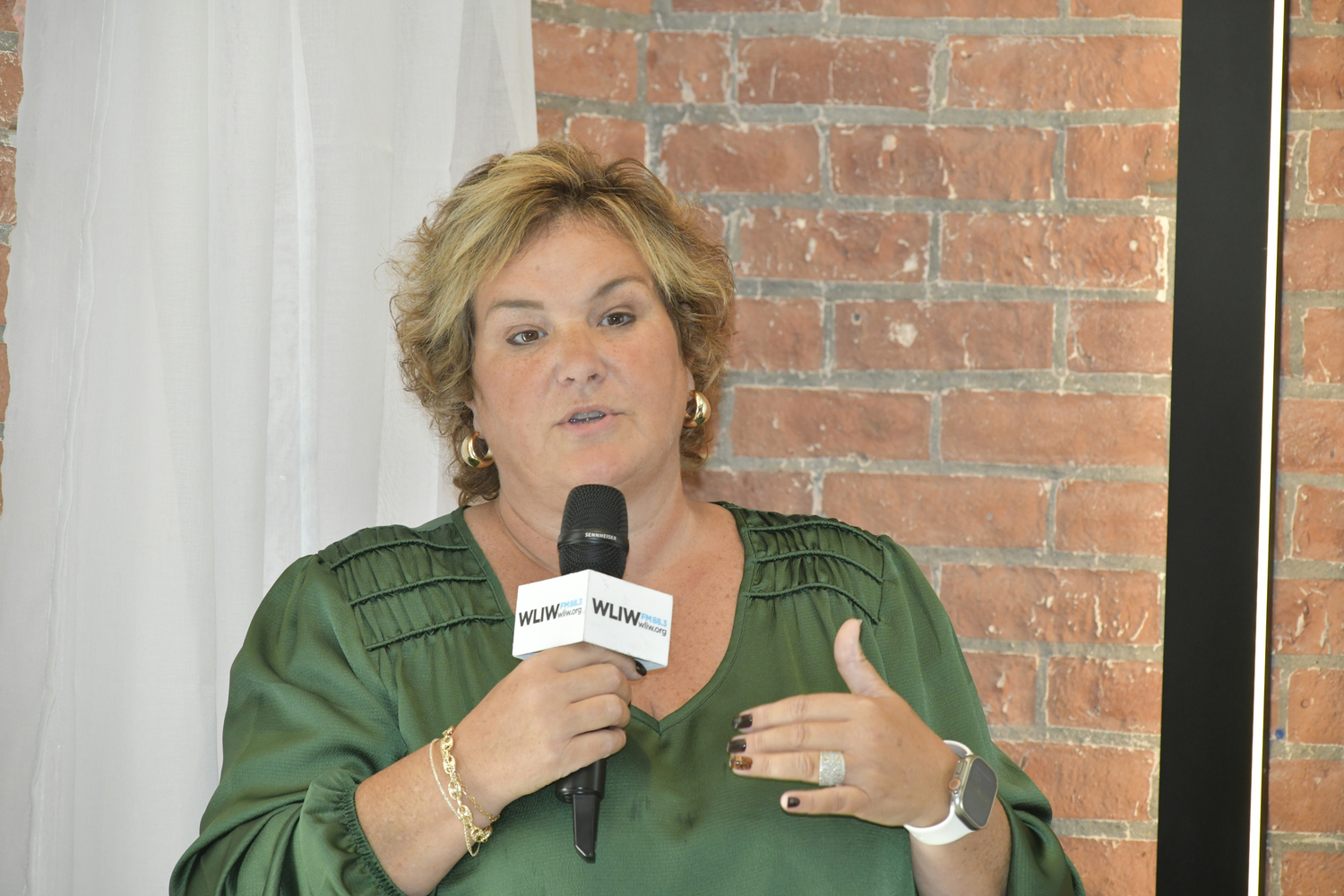
Kym Laube at the Express Session on October 17 in Southampton. DANA SHAW
The opportunities and challenges of New York’s legal cannabis industry were the focus of the most recent Express Sessions, “Cannabis and Its Economic Role” — but Kym Laube, the executive director of HUGS Inc., urged panelists and participants at the event on Thursday, October 24, to not discount the problems cannabis use could cause among vulnerable segments of the population.
Laube said among the unintended consequences of the state’s rollout of legalized cannabis is the very real threat that access to the legalized drug could make it easy for vulnerable teens to obtain and abuse it.
HUGS, which stands for Human Understanding and Growth Services, encourages healthy behavior among young people to help them avoid falling into the trap of substance abuse and other problems.
Laube jokingly described herself as “the buzzkill” at the Sessions event because of her warnings. She said the state began its legalization push during the COVID-19 pandemic and that municipalities were forced to move too quickly to opt in or out of allowing cannabis dispensaries in their jurisdiction. In the meantime, she said, the state was slow in rolling out regulations for how those facilities should be run and how preventing abuse should be factored into the equation.
All this at a time when there is a mental health crisis among teens and an ongoing substance abuse epidemic. “When the focus should be on providing youth with positive behavior models, we’ve just made another substance incredibly easy for them to get their hands on,” she said.
Dr. Jeffrey Reynolds, the president and executive director of the Family and Children’s Association, which operates Thrive East End, a recovery center in Riverhead, agreed with her assessment.
Reynolds said today there are high levels of anxiety, depression, and suicidal thoughts among teenagers, while at the same time there is a “documented lack of services for those kids.”
The problem, he continued, is “for some of those kids, weed will be a way of self-medicating away the anxiety and depression that has become really common.”
The state’s commercialization plan “has been botched almost from day one,” he continued, pointing out that there are more illegal pot shops than licensed stores, while the state has not taken the necessary steps to create a comprehensive effort to prevent abuse.
Reynolds said he had more faith in cannabis entrepreneurs than the state when it came to putting in guard rails to ensure that legal cannabis does not find its way to underaged users.
“Because of the lack of prevention messages, it gives young people the impression that if it is legal, it must be safe,” he said.
Both Laube and Reynolds conceded that not every teen who smokes or ingests pot would develop a problem, but that adolescents, whose brains are still developing, are more prone to being adversely affected by any type of drug use.
“The person who uses cannabis occasionally is not a problem,” said Reynolds. “It’s the person who uses cannabis for the first time and who says, ‘I don’t feel anxious for the first time or I can go to school now and not feel depressed.’ That’s the problem.”
“Legalization doesn’t mean there aren’t risks,” added Lars Clemensen, the superintendent of schools of the Hampton Bays School District.
Clemensen said when the Southampton Town Board debated whether or not to opt in to allowing cannabis shops that he and Laube “were the two sole voices raising concern. It felt like we were yelling into the wind.”
He added that town officials saw the possibility of earning revenue from pot sales without taking into account the hidden costs for things like preventative programs in the schools. Today, he said the Southampton Town Police Department has only one school resource officer who works on drug prevention programs, but has to cover nine different school districts and 12 different buildings. That program will likely need to be expanded in the future.
Reynolds added that government officials have been blinded by the revenue cannabis sales can generate while overlooking the resultant costs, from problems in schools to emergency room visits by those who have bad reactions to drugs.
Clemensen said he was disappointed that the town allowed cannabis dispensaries to open in areas zoned for highway business. In Hampton Bays, one is a proposed dispensary near St. Rosalie Catholic Church and Our Lady of the Hamptons preschool, he said. Noting that the hamlet was “a patchwork of zoning,” he said it was difficult to find a safe place to site a dispensary away from children. It’s not like different zones are separated by the Grand Canyon, he said.
Laube said the potential for trouble was immense with home delivery, with the chance that young people might sample gummies belonging to their parents without knowing how potent they are.
“We love our substances,” she said of American society. “We continue to chase the drug of the day without thinking of the consequences.”


 Stephen J. Kotz on Oct 29, 2024