


 1 Photo
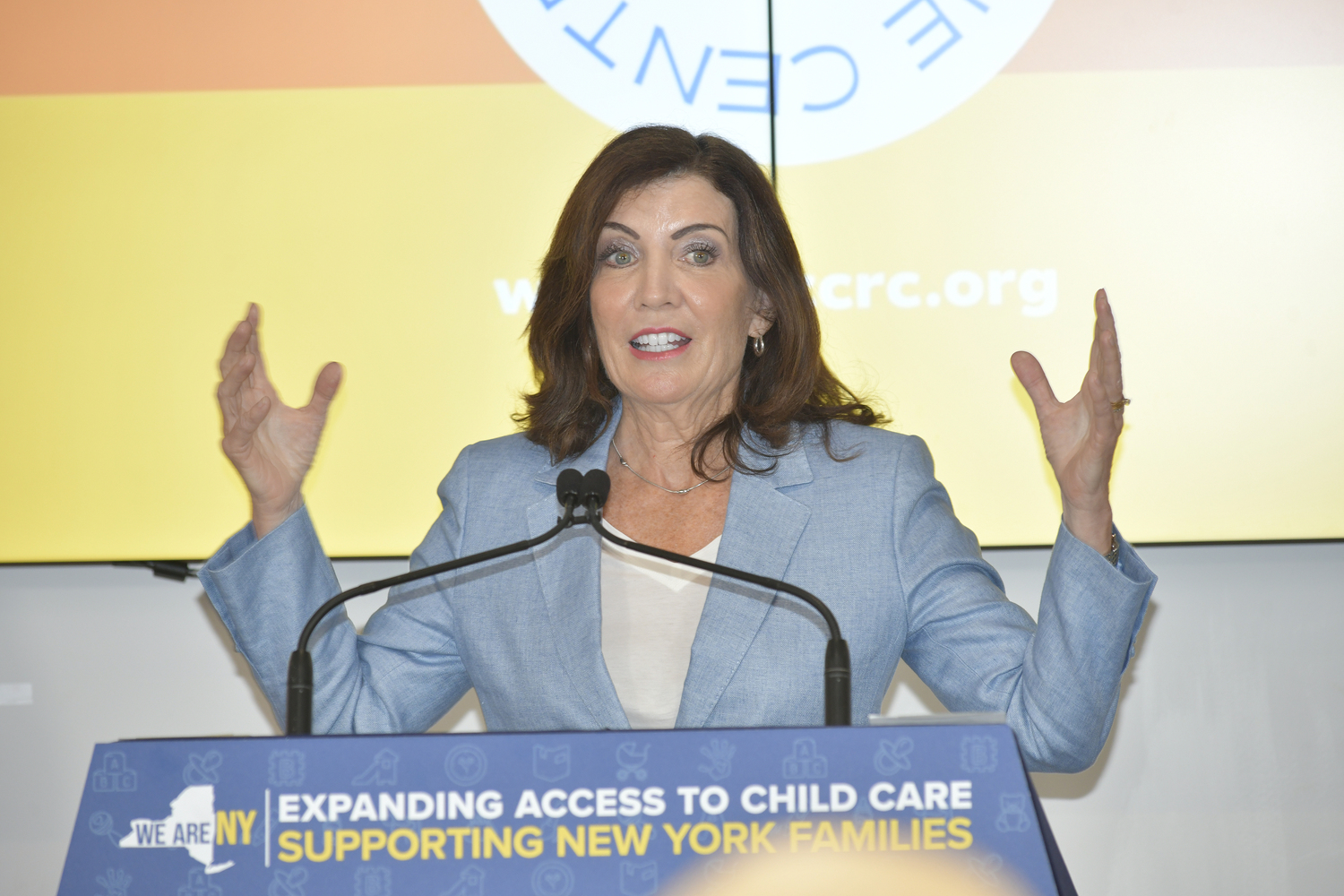
New York Governor Kathy Hochul
Governor Kathy Hochul’s executive budget proposal would force East End school districts to make significant cuts to balance next year’s financial plans.
According to calculations unveiled last week, local districts might face a more than 20 percent decrease in state aid.
Southampton Superintendent of Schools Nicholas Dyno said he was in shock to see a forecasted 27 percent, or $485,000, decline in support for his district. The move comes after three years of large appropriations to fully fund foundation aid.
“No one discussed it for the past year or so. This wasn’t on anyone’s radar,” he said. “We received $1,770,000 in foundation aid this current year, and it’s already a tough year, where we’re still under the pressure of the 2 percent tax cap and have health care costs going up around the 15 percent mark — over $1 million from this year to next.
“In layman’s terms, it gives us this impossible task to build a budget where either we cut personnel or we cut programs, because that’s where the bulk of our resources go.”
Sag Harbor School Business Administrator Jennifer Buscemi said her district’s 21.5 percent, or $428,681, deficit in light of health insurance and retirement system increases would be destructive.
“We have never had to address such a large reduction in year-to-year state aid and hope our legislators can work with the governor to keep our aid in line with last year’s allocation,” Buscemi said.
“It is too early to see how this will affect the overall budget, but we will most certainly have to do a combination of things to close the gap. That means tightening our belts wherever we can, possibly finding additional revenue sources, applying some of our savings and possibly having to raise taxes.”
The state’s foundation aid formula includes factors such as enrollment and local community wealth, but Springs Superintendent Debra Winter said her drop from 682 students in the 2013-14 school year to the current 656 in her K-8 school is not significant enough to warrant her 12.43 percent, or $200,000, slash.
“Any reduction in aid is significant for Springs — devastating — and will impact our students, who deserve so much more than we currently provide, not less,” she said. “I’m not going to lose a teacher because my enrollment went down four kids. We’ve already been uncompetitive with our neighbors. We dug ourselves into a hole, and it’s going to be hard to get out unless something drastically changes.”
Dyno also said a deficit, especially coupled with inflation, would create a much more complex issue for his district than just balancing a budget.
“We’re trying to attract teachers,” he said. “To get people to travel out to the East End we need to provide a fair wage and in these fiscal times, it gets really difficult to be able to meet all the demands that we have in each of the areas to have the best staff possible, to provide all the programming we want to provide and to maintain fiscal responsibility.”
Foundation aid is actually the only new aid, while all other figures, like Eastern Suffolk BOCES gains, are actually reimbursements based on purchases made the year prior.
Winter said her aid adjustment is also more than what numbers in the budget proposal might suggest, because universal pre-K, coming in at over $600,000, is listed as aid, but is grant-funded. The district applies based on the number of students served.
“If it wasn’t for the increase in BOCES aid, our actual reduction in foundation aid is 28 percent,” the superintendent said, adding she has been steering her district toward purchasing anything possible through BOCES-vetted vendors.
The projected decreases would also be a result of the governor’s pitch to end what has been called a “hold harmless” policy, which has been a part of how foundation aid has been applied since it was established in 2007. The provision has meant school districts could depend on receiving at least as much school aid as it did the previous year.
“With the governor removing hold harmless that now means my aid will definitely be impacted every year and be unpredictable and volatile, which she intended not to do, and then all of the sudden decided to,” Winter said. “Even if she went back to hold us harmless, it would be better than a cut.”
East Hampton Superintendent of Schools Adam Fine, whose district could lose 20.17 percent, or $774,241, said he remains hopeful that the State Legislature will help reestablish support.
“We are hoping to speak with our local New York State leaders to plead our case,” Fine said. “We consider New York State to be our partner in the education of our students, and I am hopeful for a positive resolution.”
Winter said her first phone call was to State Assemblyman Fred W. Thiele Jr., who she said assured her he is fighting to restore aid.
“Fred has been a champion of Springs School and is amazed at what we have accomplished with our low per-pupil expenses,” she said.
The assemblyman said while the governor is attempting to reduce spending to close a state deficit, he believes her effort at the expense of education is the wrong priority, and vowed he would not vote for any budget that reduces foundation aid to a single school district. Thiele also cited his disapproval of the governor’s decision to renege her commitment just one year after the three-year phase-in plan to fully fund it was complete.
“It would violate the pact between the state and local school districts to provide a quality education to every child. The losers would be both the local taxpayer and our children,” he said. “That initiative was heralded by educators across the state as a demonstration of our commitment to public education. There must be certainty and stability in funding state education. Historic increases cannot now be followed by a substantial cut.”
The Express News Group reached out to State Budget Director Blake Washington for comment, but did not hear back by press time.
Washington told Newsday that after increasing school aid statewide by $7 billion over the last three years, with an additional $13 billion increase in federal aid during the same period, it’s time for the state to provide a more sustainable level of funding. The change is needed to ensure high-needs schools get vital funding, he said.
Thiele said he has already joined forces with other state legislators and school officials across his assembly district to reject the cuts and request the full restoration of foundation aid. The state Senate and Assembly will present alternatives during one-house budget plans in March. A final budget is due by April 1.
“I must emphasize that this executive budget is only a proposal,” Thiele said. “It is the start of the state budget process. The state budget must be approved by both the Senate and Assembly before being signed by the governor. It definitely could and will change. I expect strong opposition to the governor’s proposal in the legislature.”
Quogue could see a 27.71 percent, or $121,303, setback; while Amagansett could lose 16.78 percent, or $73,875 in funding. Tuckahoe’s aid under the proposed plan would drop 16.44 percent, or $183,786; Montauk’s 13.22 percent, or $151,171; Remsenburg’s 10.9 percent, or $85,445; Westhampton Beach’s 6.88 percent, or $193,520; Bridgehampton’s 4.85 percent, or $44,145; and East Quogue’s 3.3 percent, or $67,101.
Decreases for other districts across Long Island, like Three Village, might have austere effects. It would be expected to make up for a 17.86 percent, or $8,923,875 shortfall. Suffolk County, under the present proposal, would lose $33 million in foundation aid.
“I can’t imagine an $8 million cut — and they have commercial property,” Winter said. “We have nothing here. The $200,000 deficit for us is like the $700,000 cut that East Hampton is projected, based on our total wealth.”
Riverhead, Hampton Bays and Greenport are the only East End school districts that would see increases under the governor’s current proposal. Hampton Bays Superintendent of Schools Lars Clemensen said despite his district’s estimated 3.9 percent, or $588,031 rise in aid, he’s worried that the governor’s record achievement is at risk.
“Tremendous gains have been made through her commitment to fully funding the foundation aid formula,” Clemensen said. “Our enrollment over 10 years has shown a slight increase, and foundation aid is the support we have needed for both programming and mitigation of property taxes. I am hopeful that the Legislature and governor will work together on this topic so that the significant number of districts with proposed cuts see relief in the final budget.”


