



 3 Photos
Empty storefronts on Main Street in Southampton Village. DANA SHAW
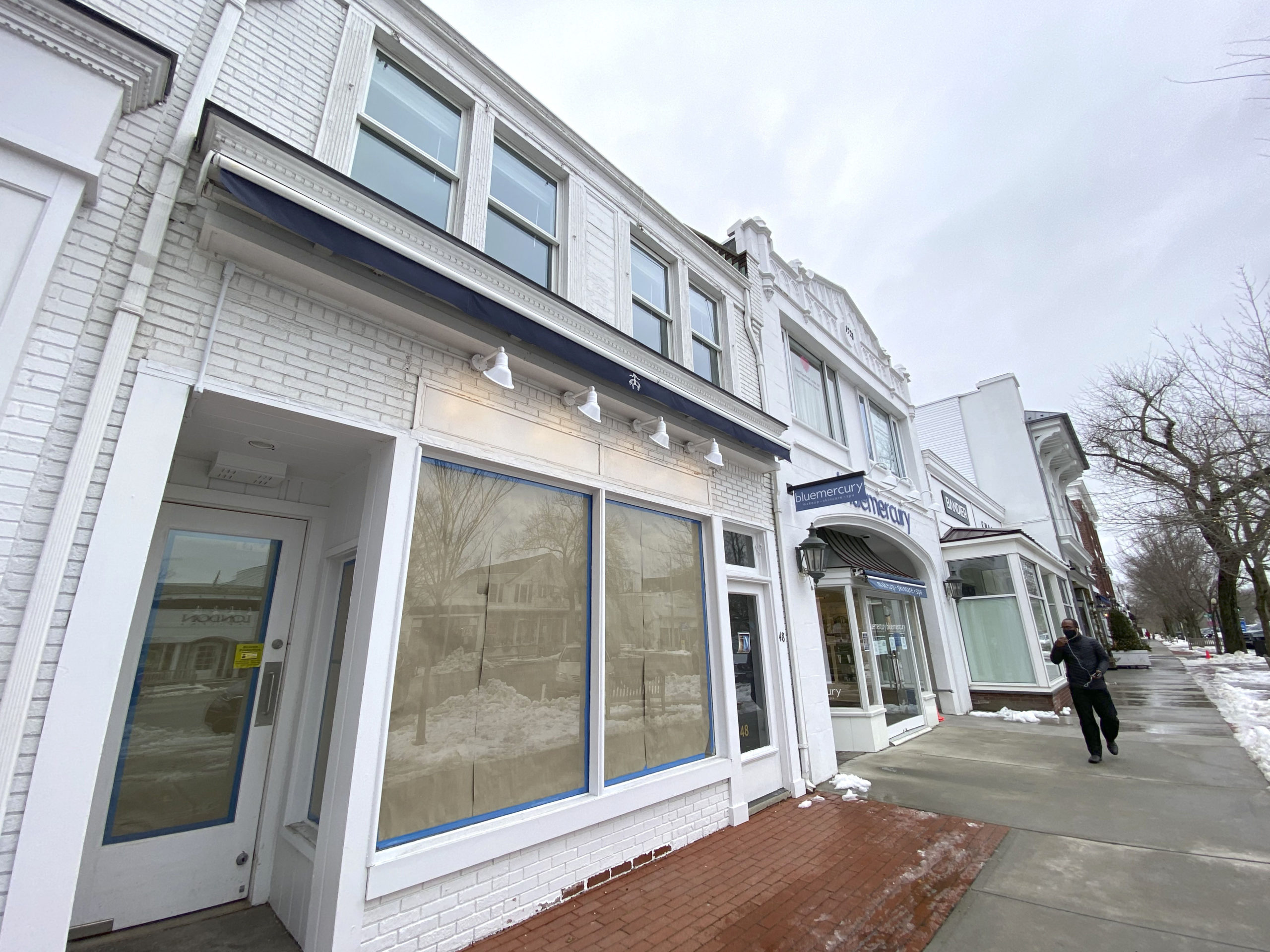
Empty storefronts on Main Street in Southampton Village. DANA SHAW

Alice Hope's installation, "Priceless." is featured in the windows of the former Chico's on Jobs Lane. DANA SHAW
Window displays underscore and enhance the vitality of a downtown business district. They can connect the interiors of shops with pedestrians on the street. By contrast, empty storefronts, their windows covered with ubiquitous brown paper, denote a disconnect between the building and passersby.
Last summer, after nearly a year of consideration, the Southampton Village Board passed legislation designed to strengthen a connection that annually weakens as seasonal shops shutter for the winter by requiring that empty stores display art installations in their windows.
The law has been in effect for months, but there’s plenty of brown paper still on display. Prior to February 2, no landlords had been cited with violating the new ordinance, and while a creative and free opportunity to remedy the blight is readily available, few choose to take advantage of it.
The Southampton Arts Center has stepped up to assist store owners. The center will curate an art installation for the empty window for free, indemnify the building owner and use its own staff to install the artwork while giving the artist a modest honorarium.
“It’s a win-win,” said SAC Executive Director Tom Dunn. He was hard pressed to explain why no more than three shop owners had decided to give the idea a try.
The SAC Storefront Art Project pairs local artists with downtown spaces, Amy Kirwin, SAC’s outgoing artistic director, explained last week. The center has a lineup of artists who proposed installations. “The amount of windows there are versus the amount of inquiries do not match up,” she said, noting the volume of interested artists compared to the dearth of willing landlords and available spaces.
Are the property owners hard to find or do they simply balk at participating? “I think it’s a little of both,” Ms. Kirwin said, pointing out that beyond working to create vibrant and welcoming village streetscapes, the program helps landlords comply with local law.
Approved last summer, the village’s code amendment relating to vacant storefronts comes with a fine of no less than $1,000 and no more than $2,500 per offense for stores that do not comply. The code has a provision that allows for separate offenses to be charged every day the windows go unadorned. After The Express Group questioned the dearth of enforcement, 12 property owners — on Main Street, Jobs Lane, Pond Lane, Hampton Road and Nugent Street — were cited for violating the ordinance, on February 2 and February 3.
That inertia irked community member Mackie Finnerty. She sent a memo to Mayor Jesse Warren and the Village Police last month demanding action. The long-standing problem of paper-covered vacant store windows gives the village a very unattractive appearance, she wrote, providing officials with the addresses of 20 vacant properties in violation on Main Street, Hampton Road and Jobs Lane. Frustrated by the dismal look, she said this week, “You only see that in towns that are falling apart.”
According to Village Police Lieutenant Chris Wetter, solving the problem of a vacant store’s empty windows isn’t an endeavor for those looking for instant gratification. “There are a lot of moving parts,” he said. In many cases, he noted, the landlords aren’t local and have to be tracked down. From there, they are given a 30-day opportunity to resolve the issue. The resolution could involve a plan for decor that must fit simple criteria laid out in the law and be approved by Village Administrator Charlene Kagel-Betts.
On February 2, Ms. Kagel-Betts said that she had not received a single inquiry from a landlord looking to make use of the free program. Working with village ordinance enforcement officer Angel Perez, she’s conceiving an outreach effort to notify landlords of the law and their options. Like Mr. Dunn, she couldn’t speculate as to why more landlords aren’t participating in the program. How the effort would roll out was still in the conceptual stages, but Ms. Kagel-Betts said it would include providing landlords with photos of different pieces of art that could be installed.
That landlords are hard to track down, strained credulity for Ms. Finnerty, who noted the village has no problem figuring out where to send their tax bills. Management companies, which many absentee landlords use, could be alerted to violation of the new ordinance and tell their clients. “This shouldn’t be that hard,” she said. “These places are all for rent.”
“We had a grace period,” Mr. Warren said. “Stepped up enforcement is the next logical step.”
Describing the system set up between both the Southampton Arts Center and the local artists alliance as “seamless,” the mayor acknowledged there are a handful of property owners who simply do not want to comply no matter how easy it is.
“These landlords are sitting in Florida collecting tax write-offs, and they have no interest in interacting,” he said.


