


 1 Photo
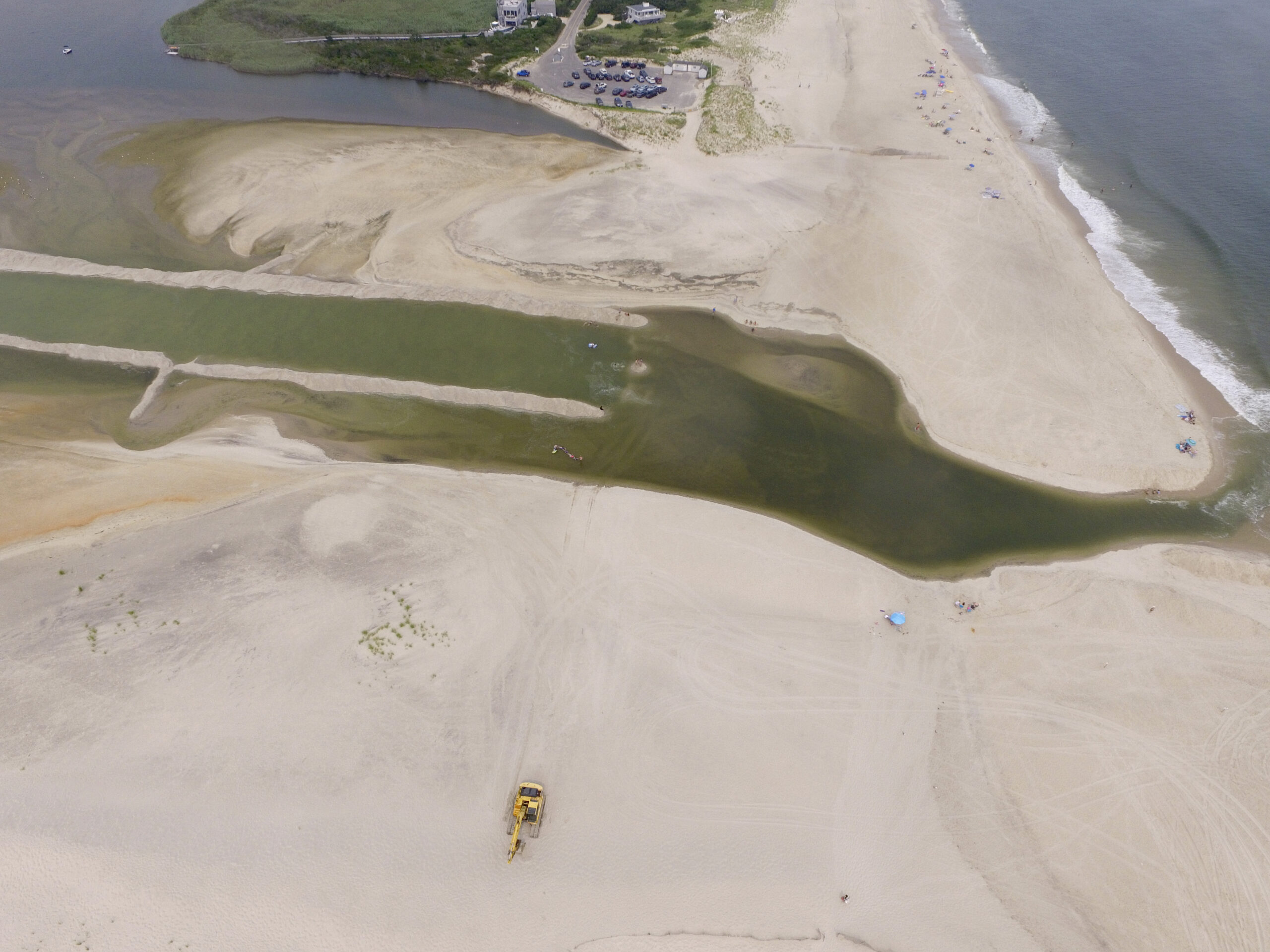
Endangered piping plovers have nested where the cut, seen underway in a previous effort, is usually made to relieve flooding in Mecox Bay.
The flooding of Mecox Bay in Water Mill has become so severe that, if it rains in the next few days, Supervisor Jay Schneiderman may be compelled to declare a state of emergency.
“People can’t flush their toilets,” he said Tuesday night, June 14.
But something stands in the way of making the cut that will allow water to flow from the swollen bay into the Atlantic: A pair of endangered piping plovers have nested right where the cut would be made, and federal and state agencies charged with protecting their welfare won’t allow anything that might disturb their habitat.
The birds are due to fledge by the end of July, but, said the supervisor, “We won’t make it until the end of July.
“We’re trying to develop a work-around,” he continued. Along with Trustee President Scott Horowitz and town engineers, officials are devising a pumping operation to decrease the flood levels of the bay.
So far, one suggestion has been to craft a device using four pumps and flat tubes. The tubes would run about 100 feet out into the bay and have an outflow onto the beach above the mean high water mark. Set up could be close to the parking area at Scott Cameron Beach, away from where the cut is traditionally made and the plovers are nesting now.
“We’re working on a dispersion method so we don’t have erosion,” Schneiderman said.
While myriad agencies — U.S. Fish and Wildlife, the U.S. Army Corps of Engineers, the State Department of Environmental Conservation — are involved, none of the outside agencies has stepped up to help fund the pipe and pump work around. “The town may have to go it alone,” Schneiderman said.
At the Town Board meeting Tuesday, the supervisor put forth a resolution adding $350,000 to the budget line that the Trustees use to manage Mecox Bay. “I don’t know how much money will be needed, if any,” he said. The money would come from the Community Preservation Fund, which allows up to 20 percent to be used for water quality improvement projects.
“This is the second time we’re going to this fountain with CPF money,” Councilman John Bouvier pointed out. How the money is spent will require meticulous accounting, “crisis or not,” he said. “I just want to be very careful how we’re spending that 20 percent.”
Bouvier worried that the town has spent a lot of money on the issue without implementing a permanent solution. “We keep going through this and there are solutions,” he said.
While the pumping method will lower the flood levels in the bay, it’s a one-way movement of water as opposed to the transference between the bay and ocean that occurs with a cut. So, the project won’t increase salinity or oxygen or cool the water’s temperature, all factors in the health of the water body and its marine life and shellfish.
It will relieve the flooding, Schneiderman reiterated, and could bring levels down 5 or 6 inches. As the flood persists, causing septic systems to fail, there’s the potential for an intrusion of fecal coliform bacteria into Mecox Bay. The flooding problem is an environmental problem, the supervisor stressed.
“This could soon be a public health emergency,” he added.
The problem is not a new one: The creation of a manmade cut from the bay to the ocean dates back to precolonial times. The modern-day approach revolves around getting all the involved agencies to sign off. In recent years, the Trustees have pushed for and received emergency permits to open the cut.
Last year, the attenuated process took so long, Schneiderman threatened to issue an executive order to open the cut without a permit in order to prevent an ecological disaster. This year, Horowitz was successful in getting the permitting agencies to allow for the cut to be made on an as needed basis, with a proviso: that it doesn’t interfere with piping plovers.
According to the town’s management plan for the bay, Mecox Bay is “a coastal estuarine pond with an ephemeral inlet to the Atlantic Ocean.” Nearly 1,100 acres, the bay and its tributaries rank as the largest of the backbarrier ponds on the South Fork.


