


 4 Photos
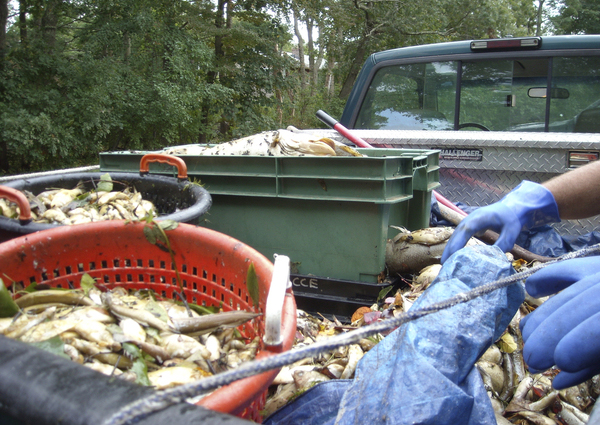
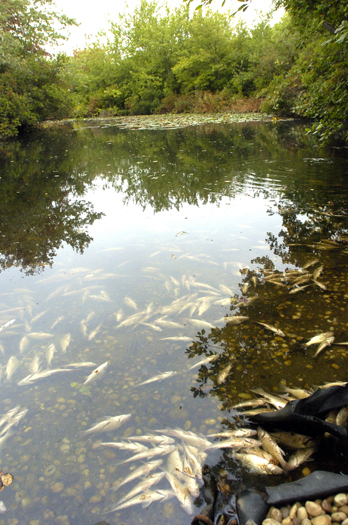
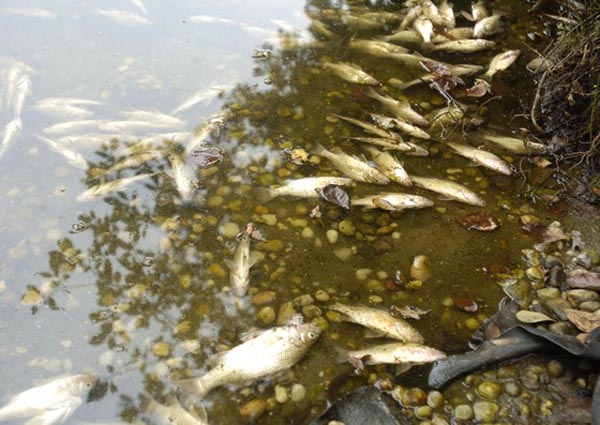
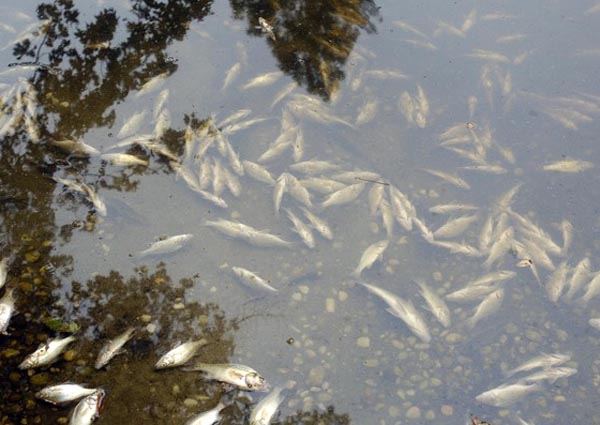
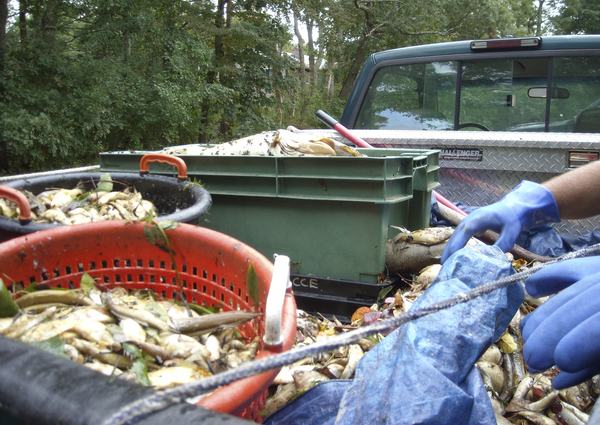
Mill Pond in Water Mill suffers from nitrogen and phosphorus pollution, but the cause of a massive fish kill in the pond in 2008 was likely not contaminated runoff from nearby farm fields or lawns or leaking septic systems, according to the marine scientist who has been investigating the incident for the Southampton Town Trustees.
Christopher Gobler, Ph.D., an associate professor at Stony Brook University’s School of Marine and Atmospheric Sciences, told the Trustees and a crowd of Water Mill residents on Monday afternoon that it appears the fish kill was the product of a confluence of ecological and climatological conditions and human impact that conspired to vacuum oxygen from the lake on the evening of September 21, 2008, killing more than 4,000 pounds of fish.
The fish kill came on the heels of a two-week dry spell, so speculation that it had been caused by an influx of runoff contaminated by fertilizers from farms and lawns seems unfounded, Dr. Gobler said. And groundwater levels at the time were the lowest they had been in many months, so the likelihood that it was directly tied to contamination from the septic systems of waterfront houses was also unlikely, he said.
But for most of the 20th century, tiny Mill Pond was entirely surrounded by hundreds of acres of farm fields, which, though now largely replaced by houses, have left groundwater tables in the region high in nitrogen and phosphorus. Those water tables feed into Mill Pond, where the nitrogen and phosphorus provide the perfect fuel to feed blooms of blue-green algae each summer.
“With the high levels of nutrients and the high temperatures in the summer and the low amount of flushing, all the right ingredients are there for blue-green algal blooms,” Dr. Gobler said. “For those of you who live around the pond, I’m not telling you anything you don’t already know.”
The soupy green carpet of algae that covers the surface of Mill Pond each summer has been a focus of concern for residents around the pond for years. In 2008, the algae was particularly thick and as the huge algae bloom blossomed, the mercury took a sudden dip on September 21, dropping to just 41 degrees. The bloom collapsed that night and the next day. Not surprisingly, the fish kill happened simultaneously.
When algae blooms collapse they gobble up dissolved oxygen in the water as the individual algae cells die and decay. In the case of large blooms and shallow, poorly flushed water bodies, this commonly creates a condition called hypoxia, in which there is no oxygen left in the water. It’s also possible that the dying algae could have released some toxins, though Dr. Gobler said there is no way to tell if they had. Fish would also have been somewhat stressed by the sudden drop in temperature.
While the coincidences added up to an unfortunate mess, there was one very fortunate coincidence: the fact that Dr. Gobler and a group of his graduate students had been watching Mill Pond closely for years. They had reams of data about the conditions in the water right before the fish kill and right after and were able to scoop up fish as they were dying to be examined for foreign substances that might have caused the die-off.
No chemicals or other more serious contaminants were found, in the fish or in the lake, Dr. Gobler said. Rather, the conditions that caused the fish kill had more likely been present for years, and remain present.
Dr. Gobler’s scientific team had focused on Mill Pond as early as 2005 because of the thick blooms of blue-green algae, a particularly destructive phylum of bacteria because the thick carpets they form on water surfaces can starve other species of sunlight.
A wide variety of factors could be contributing to the high nitrogen levels in the pond—runoff, leaking septic tanks, even wildfowl feces—but the bulk of the contaminants that are making it into the lake are coming in through the groundwater and from decaying sediments in the bottom of the pond.
“There’s a big nitrogen problem with the groundwater in the area,” he said. “This should not be a surprise, it’s a legacy of fertilizer use from active and former farms.”
Dr. Gobler told residents at the meeting—including Tom Halsey, whose family has farmed the fields surrounding the pond for more than a dozen generations—that even though many of the farms are now gone, it will take many years for the residues of fertilizers to naturally flow out of the area in groundwater.
Residents peppered the scientist with questions about ways that the pond’s problems might be addressed—from upgrades to septic systems to mowing lily pads at the end of summer to keep them settling into the lake bottom, to wholesale dredging of the sediment at the bottom of the pond. Septic upgrades wouldn’t hurt but probably wouldn’t have a substantial impact, Dr. Gobler said, and large-scale dredging is probably not feasible, members of the Trustees said.
Dr. Gobler said it was unlikely that four SolarBees, solar-powered water mixers placed in the pond in 2007 by a group of residents in hopes of keeping the algae blooms in check, had contributed to the fish kill or the conditions that led to it, but he also said they probably were not helping improve the water quality either.
Improving the flushing of the pond would probably help, as would reducing the amount of nitrogen that gets into the pond, the scientist added, though he did not have any quick suggestions on how exactly that could be accomplished. He said that a proposal the Trustees have been considering to sprinkle the bottom of the pond with flakes of alum, a compound used in making aluminum, that would bond with phosphorous and keep it from being released into the water column, might offer some benefits. So would finding a way to improve the flushing of the pond through its lone outlet, under Montauk Highway into Mecox Bay, though increasing the outflow of pond water might pose other environmental concerns.
Removing vegetation eating fish like carp and goldfish might also help bring the pond back into ecological balance, consultant Jim Walker said, a step that has worked in other ponds in the area.
Trustee Eric Shultz said the Trustees plan to hold a forum with the public and a pond management expert they hired to develop a plan for Mill Pond in the near future.
“We have to take some time,” he said to the anxious crowd of residents this week. “Over in Silver Brook we put in some bubblers and some crayfish and other predator fish, and now it’s beautiful. The water turned right around. But each place has a lot of different parameters.”


 on Aug 18, 2010