


 2 Photos
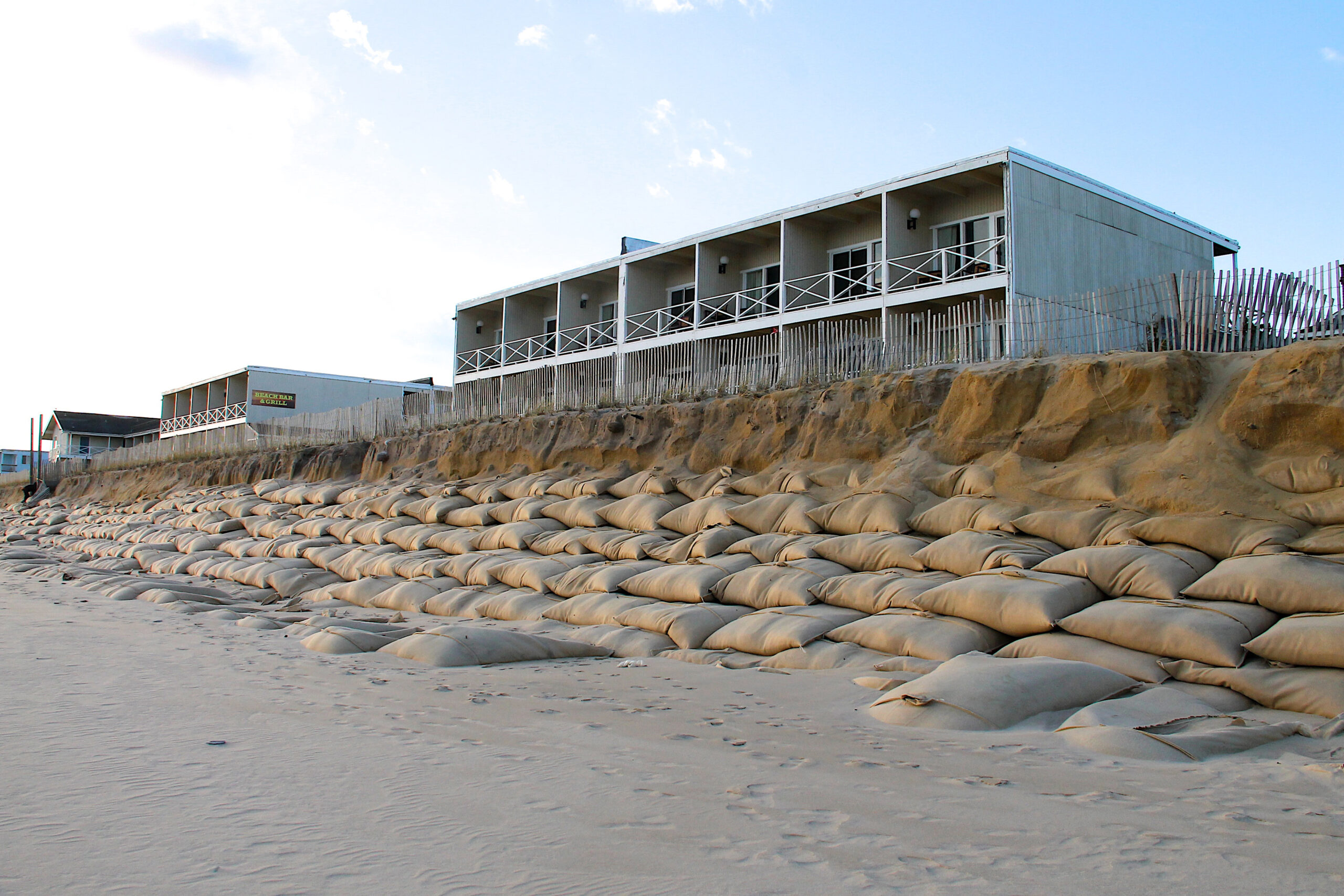
With Montauk facing the threat of coastal erosion and other problems, motel operators say the hamlet should receive a larger portion of the money collected by the county motel and hotel tax. The County Legislature is expected to increase the tax from 3 percent to 5.5 percent of the daily cost of a room. KYRIL BROMLEY

Leo Daunt, an owner of Daunt's Albatross Inn, in Montauk, stands at Atlantic Ocean beach access that has been closed because of heavy erosion. STEPHEN J. KOTZ
A proposal to nearly double the Suffolk County hotel and motel tax has Montauk motel owners up in arms. They say the hamlet’s motels would bear the brunt of collecting the tax for the benefit of the rest of the county — while their own community gets little in return.
The measure, to increase the tax from 3 percent to 5.5 percent, was aired at a public hearing before the Suffolk County Legislature on March 7. The legislature referred the matter to committee and is expected to adopt it when it meets on April 4 in Hauppauge.
Leo Daunt, owner of Daunt’s Albatross Inn and president of the Montauk Chamber of Commerce, said about a half dozen Montauk business owners attended last week’s hearing in Riverhead to voice their objection.
“We don’t mind paying a tax, as long as some of that tax comes back to the community,” Daunt said. “But this is just extraction tax — an extraction that goes from Montauk to a convention center on the other side of the county.”
Montauk businesses collect about 25 percent of the total raised in the county by the tax each year, and East Hampton and Southampton towns collect about 43 percent of it combined. But Daunt and other Montaukers say the county returns next to nothing to the hamlet despite pressing needs to combat erosion, treat wastewater, and improve roads and other infrastructure.
The county estimates that the hotel and motel tax, which is added on to the general sales tax of 8.625 percent, currently brings in about $11 million per year. It would bring in an estimated $20 million if it is increased to 5.5 percent.
Under the new measure, after a series of specific allocations are met, the balance of the money collected by the tax would go to a special county infrastructure fund to help pay for the construction of a new convention center in Ronkonkoma that is part of the multibillion-dollar Midway Crossing development proposal.
Another $6 million collected from the tax would be given to Discover Long Island, which promotes tourism to the region, including Montauk.
An allocation of $3.25 million would go to the county’s general fund and be earmarked for parks, $2.25 million would be earmarked for county historic sites, and $1.25 million would go to help support the Vanderbilt Museum and Planetarium in Centerport.
The East End would benefit most directly from a $2.25 million allocation to promote cultural programs. Of that total, $1 million would be dedicated to the five East End towns.
But of that $1 million, only $12,000 in funding for the Montauk Historical Society would come directly to Montauk, said Jennifer Iacono, a board member of the Montauk Community Playhouse, who also spoke against the hike at last week’s hearing.
“It’s a short bill. I read it three times and thought I was missing something,” said George Filopoulos, an owner and managing partner of Gurney’s Inn. “There’s no chance Montauk is going to contribute $6.3 million in perpetuity when there are only pennies coming back.”
But the Montauk contingent received some pushback from legislators, who support the tax hike.
After Jennifer Fowkes, the Montauk Chamber of Commerce’s executive director, said she feared some people would rethink a weekend stay in a Montauk motel if they were forced to pay the extra tax, Kevin McCaffrey, the legislature’s presiding officer, asked her if she had ever traveled and stayed in motels. “I’ve never paid less than 5 percent anywhere,” McCaffrey said, arguing that the county tax was modest compared to many other places.
And Legislator Nick Caracappa of Selden chided Filopoulos for complaining about the tax hike when rooms at Gurney’s Inn can go for as much as $1,600 a night on the Fourth of July weekend. “If you are going to tell me you are upset about a 2 percent increase in taxes, maybe you should lower your rates,” Carapacca said.
“My complaint is, this money is not going where it should go,” responded Filopoulos.
Bryan DeLuca, the executive director of the Long Island Aquarium in Riverhead and head of the East End Tourism Alliance, said that both the chamber and Gurney’s had earlier supported the tax hike.
David Ceva, owner of Sole East Resort and the chamber’s vice president, contradicted DeLuca’s account. “We do not, at the Montauk Chamber of Commerce, support this increase,” he said. “Mr. DeLuca put it as this was going to pass and we were joining or were against it with the result that it would jeopardize future funding.”
Mitch Pally, the former CEO of the Long Island Building Institute who now leads the fundraising wing of the Midway Crossing project, said the convention center was as worthy of the funding as any project in Montauk. “I don’t think it’s fair to say that any one set of infrastructure needs is more important than another,” he said.
Deputy Presiding Officer Steven Flotteron said residents in western Suffolk County had readily anted up for farmland preservation and other East End priorities and that it was only fair for the hotel tax to help fund the convention center.
Daunt praised Suffolk County Legislator Bridget Fleming for being “a warrior” in the effort to fight the tax increase, but she said this week that she simply did not have the votes to prevent the legislature from increasing it.
“Obviously, it’s unfortunate — and it has been since the tax was first enacted — that the East End towns contribute far more in the tax than we receive back from it,” Fleming said. “Representatives from East End businesses, particularly Montauk, did a really good job of spelling out what the inequities are.”
Fleming discussed the matter with McCaffrey and its counsel, William M. Duffy, late in the hearing “in the hope that the distribution can be adjusted so Montauk and the rest of the East End benefit more from it,” she said.
Filopoulos said the $6.3 million Montauk will be collecting could be bonded to provide about $100 million worth of infrastructure projects, ranging from coastal resiliency and wastewater treatment to road construction. He said he understood that Montauk could not expect to get all the money back, but that a more equitable split needed to be made.
With the hamlet facing serious threats from problems like erosion, Filopoulos said it would make good sense for the county to redirect more of the tax money to protecting the very businesses that are responsible for collecting the lion’s share of the tax.
“They should feed the golden goose,” he said, “so it keeps laying gold eggs.”


 Stephen J. Kotz on Mar 10, 2023