


 2 Photos
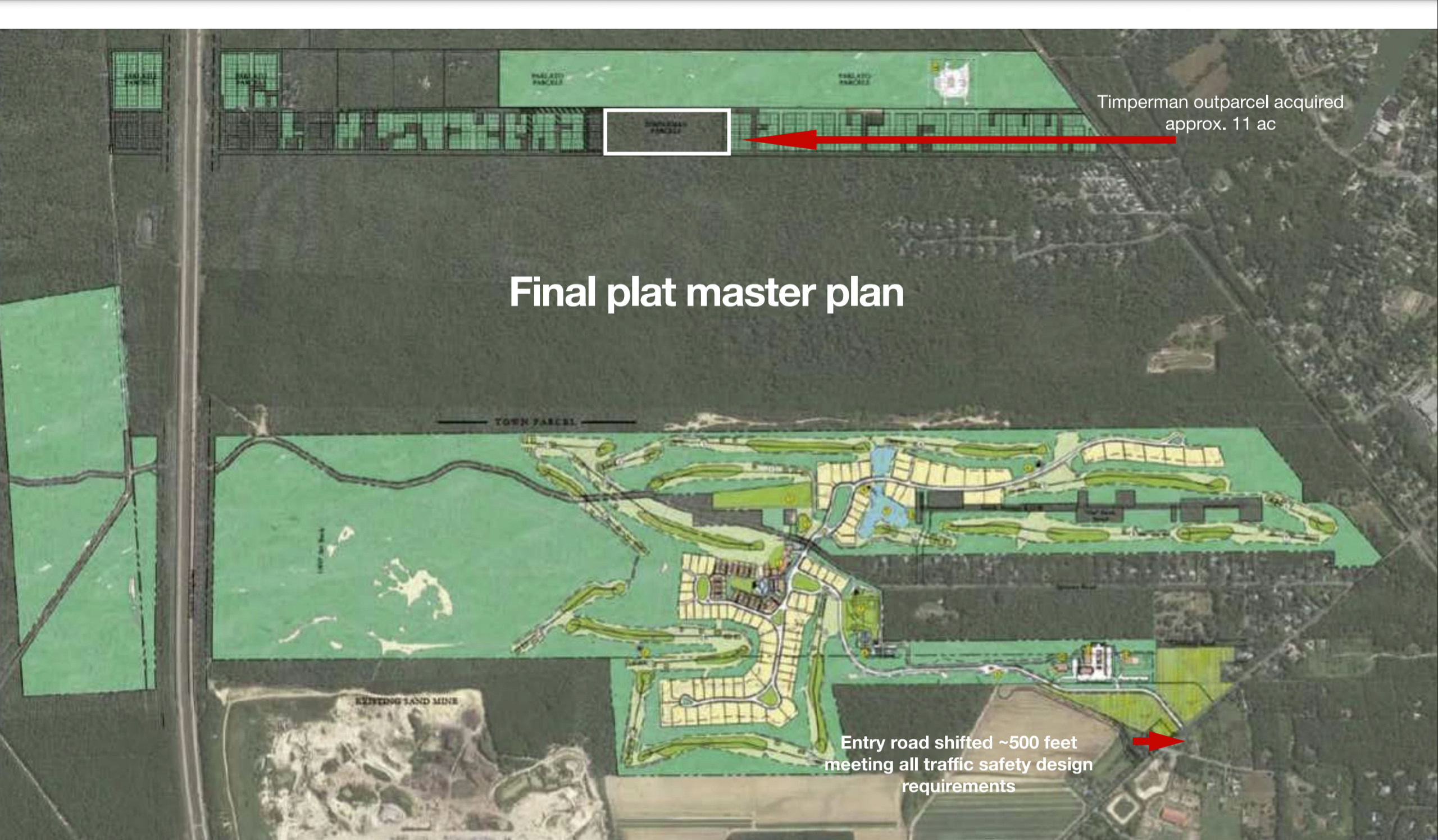
The final master plan for the Lewis Road golf resort in East Quogue.
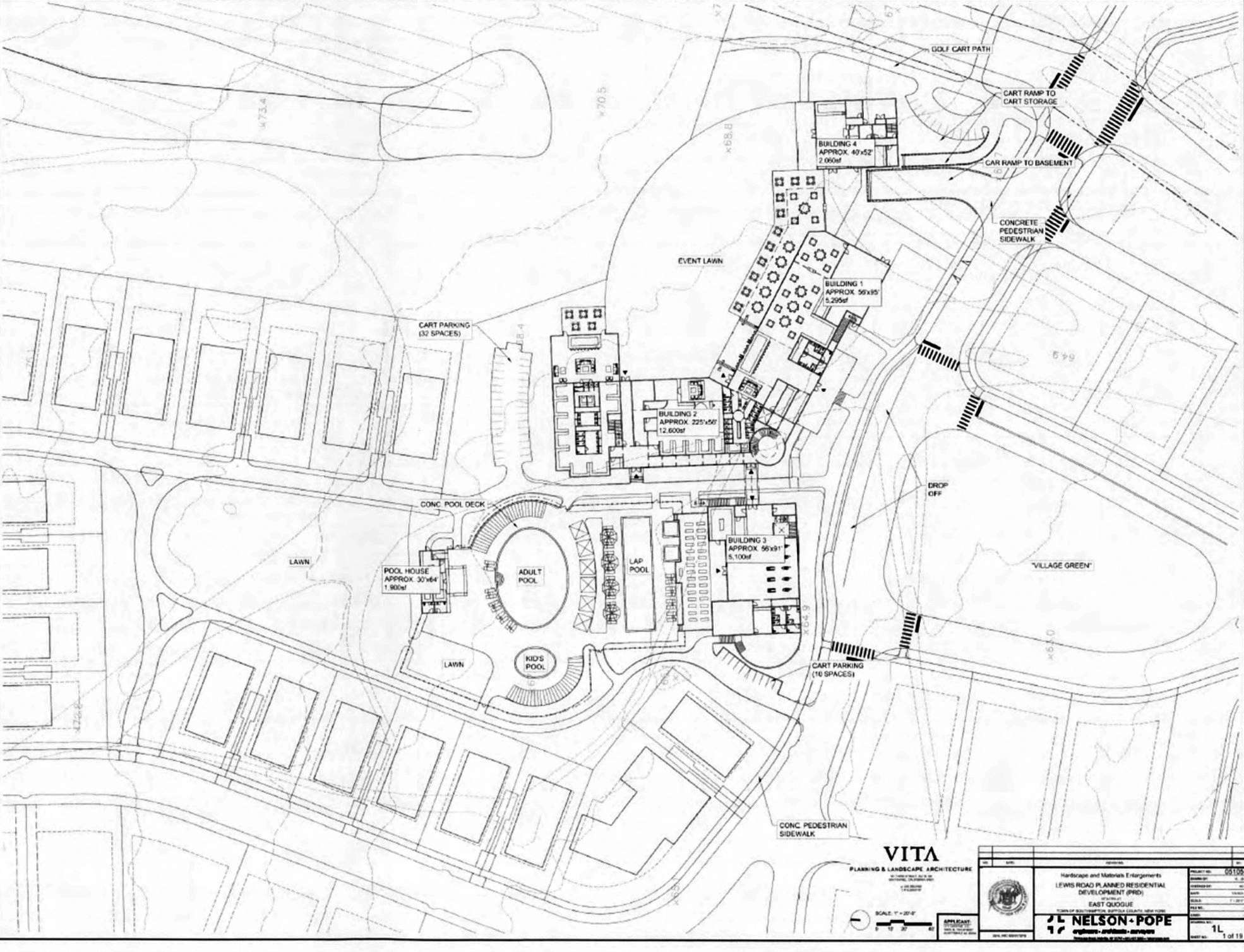
The schematic design of the Lewis Road golf resort site plan.
Opponents of a planned East Quogue luxury golf course development have filed suit looking to overturn the Southampton Town Planning Board’s approval of the Lewis Road Planned Residential Development.
Petitioners — including neighbors of the site, the East Quogue Civic Association, the Long Island Pine Barrens Society and the Group for the East End — launched what’s known as an Article 78 proceeding targeting the Planning Board and the developer, Arizona-based Discovery Land Company, in Suffolk County Supreme Court. Article 78 proceedings seek to nullify decisions made by municipal bodies.
The litigation was anticipated after a decade-long, often convoluted and always controversial process came to an end on December 8, when the majority of the members of the Southampton Town Planning Board gave the green light for the development of 118 units plus 12 workforce housing units, an 18-hole private golf course, and other private recreational facilities on nearly 608 acres of land in the Central Pine Barrens Overlay District and Aquifer Protection Overlay District.
It’s located on about 600 acres off Spinney Road described by opponents as the largest privately held undeveloped tract of Pine Barrens land within the Town of Southampton. Dick Amper, executive director of the Pine Barrens Society, repeatedly criticized it as “the biggest and baddest” development ever proposed in the Pine Barrens.
In a release announcing the Article 78 suit this week, Amper doubled down: “Southampton is the only town looking to undo protection of the Pine Barrens environment — shame on them. Environmentalists everywhere agree that local friends of developers are promoting their pals’ projects, and protection of East End land and water cannot be compromised by a local politician who is a friend of a developer.”
The battle to stop the development dates back to when it first appeared — in 2015, as a mixed use planned development district (MUPDD), dubbed “The Hills.” In 2017, the Town Board voted against the needed zone change, prompting a $100 million lawsuit from Discovery. The Town Board subsequently repealed legislation that allowed the PDD zoning tool.
The plan resurfaced, this time called the Lewis Road planned residential development, putting the Planning Board in charge of the review. In a split vote in 2019, the Planning Board approved the preliminary subdivision and site plan applications, prompting the first spate of lawsuits. One, challenging the preliminary approval, was dismissed in court; a second, looking to annul a Zoning Board of Appeals determination that a golf course could be an accessory use to a residential development, is still in the appeals process. Acting Suffolk Supreme Court Judge Carmen Victoria St. George had dismissed the actions, determining the petitioners lacked “standing,” because they wouldn’t be directly harmed by the proposal.
“It’s a sad irony that New York State law specifically provides the opportunity to challenge questionable government decisions in a timely fashion — but if the public can never secure the standing it needs to be heard in court, the law is hardly worth the paper it’s written on,” Group for the East End President Bob DeLuca said in a release announcing the new litigation.
Pointing out that several of the petitioners in the current and previous lawsuits live nearby or immediately adjacent to the proposed development, he continued, “If you look at the lower court’s standing decision, it appears the only person with sufficient standing to challenge an arbitrary government development approval would be the developer themselves. That is not what the law intended, and that is why we have appealed that decision. The public needs to be heard on this matter, and we will fight to secure that right, as well as the responsible protection of our precious Pine Barrens ecosystem.”
This latest legal action rehashes the array of opponents’ arguments against the project — arguments voiced at public hearings before the Pine Barrens Commission, which voted in favor of the project, and the Planning Board during last year’s public hearing.
Opponents charged town officials failed to conduct a proper assessment required by the State Environmental Quality Review Act. The Town Board underwent SEQRA review for The Hills, then planners used the same review for Lewis Road. SEQRA requires a new review when a project has changed, but supporters, including Southampton Town Supervisor Jay Schneiderman, asserted the project hadn’t changed that much. In fact, supporters felt the new iteration provided better protection of the environment.
It doesn’t, however, provide a variety of community benefits that were a required part of the Hills plan under PDD rules.
“It is unreasonable, and arbitrary and capricious, to conclude that SEQRA review of The Hills at Southampton MUPDD proposal by the Town Board, pursuant to a different local law, suffices for the Planning Board’s SEQRA review of the Lewis Road Project proposal that almost entirely eliminates the multimillion-dollar environmental mitigation and community benefits package that came with The Hills at Southampton MUPDD,” the suit states.
As mitigation measures, The Hills proposed building an on-site sewage treatment plant for the East Quogue School, the purchase of a 33-acre property in the Weesuck Creek watershed, to offset the intensity of development, a $1 million fund for sanitary system upgrades within the watershed, a $300,000 shellfish restoration project, plus $250,000 funding for Shinnecock Bay restoration efforts and $50,000 for an eel grass restoration project. Community golf outings, a land purchase for the East Quogue Fire Department, and a $100,000 revitalization project for the hamlet also went away with The Hills, the lawsuit points out.
By not embarking on a new SEQRA review for the new project — an application that both changed and was submitted under a different zoning category — the Planning Board “failed to undertake the most basic steps of a lawful SEQRA review,” the suit asserts.
Said Claudia Braymer, attorney for the petitioners, “I have never seen an environmental review so totally derailed from the SEQRA procedures enacted to protect the public good.
“I also don’t understand how this commercial resort development complex was ever approved for an area where the local zoning prohibits resorts and virtually any commercial uses except agricultural-related businesses,” she continued, adding, “We are hopeful that the court will grant the petition and annul the approvals that have been granted in violation of SEQRA and the local zoning code.”
Representing Discovery Land, attorney Steven Barshov of the firm Sive, Paget and Riesel offered a statement via email.
“The lack of merit to this new lawsuit and the hypocrisy of the organizations suing is truly astounding,” he said. “They hold annual huge fundraisers at local golf clubs, yet claim this state-of-the-art golf course will destroy Southampton. They continue to ignore the two environmental impact statements which conclude that the golf course will not generate a single significant adverse environmental impact. They attack Justice St. George for denying their standing to sue, but they conveniently ignore that they submitted no evidence to the court to establish their standing and, after appealing her dismissal of their case, they abandoned their appeal. They claim horrors to the Pine Barrens, but ignore that the Central Pine Barrens Commission has approved this project not once but twice.
“For these and many other reasons, this litigation is not merely meritless, it is frivolous.”


