


 1 Photo

Commuters will be able to ride new weekday commuter trains and shuttle buses to most villages and hamlets between Speonk and Montauk starting this winter for $8.50 per day, round trip.
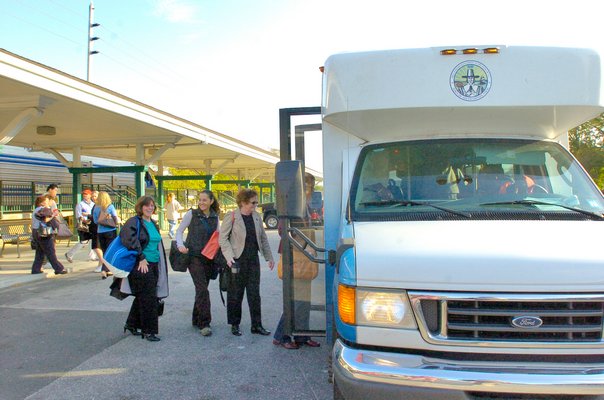
The Long Island Rail Road will add four new commuter trains, two eastbound in the mornings and two westbound in the afternoons, between Speonk and Montauk on weekdays starting in February. The trains will connect with shuttle buses run by Southampton and East Hampton towns from between each hamlet’s train station and nearby into downtowns and to major centers of employment.
Fares for the trains will be $3.25 each way and $1 for the connecting bus, paid as a single fare, or $8.50 round trip per day, and $42.50 per week, the system’s planners told East Hampton Town officials this week. Schedules and stops have not yet been established, but the two morning trains are expected to arrive in East Hampton Village at 7 and 9 a.m.
For comparison’s sake, East Hampton Town Assistant Planning Director Joanna Pahwul told members of the East Hampton Town Board on Tuesday, driving the 22 miles from Hampton Bays to East Hampton in an average car would cost about $30 a week in gas at current prices, without calculating for wear-and-tear on a car, or time spent sitting behind the wheel in stalled traffic.
The experimental commuter system was spearheaded by State Assemblyman Fred W. Thiele Jr. and State Senator Kenneth P. LaValle, who also secured $500,000 in state funding for the two towns to split and put toward the “last mile” bus services, designed to deliver commuters from train stations to final destinations. Each town will be expected to match the state’s contribution with $250,000 of its own to meet the anticipated costs of the bus contracts for one year.
“The idea here is to increase use of public transportation during the rush hour periods,” Mr. Thiele said in East Hampton on Tuesday. “It’s not going to replace automobiles as a means to get to the East End, but we’re trying to mitigate some of the issues.”
The system is modeled on a 2007 program set up when County Road 39 in Southampton was being widened. The trains that year carried an average of about 400 riders per day, even though the limited schedule meant that the trains often left the eastern hamlets too early in the afternoon to be of much use to 9-to-5 workers.
Ms. Pahwul noted that some employers may need to be a little flexible with workers hours depending on when train schedules for arriving and departing in the easternmost hamlets.
The towns will be in charge of work with bus contractors to lay out specific routes and stops for shuttles to follow through the hamlets. Planners said they expect routes and the sizes of buses used to have to be adjusted as the system is implemented to meet the demands of riders.
Requests for proposals from bus companies will be sent out by the towns in mid-August and agreements would need to be inked by December to get the system in place by February.
Mr. Thiele said that if the program is seen as a success, he has already discussed with the LIRR the addition of new double-tracks in some spots to allow trains to pass each other.
Tom Neely, Southampton Town’s director of transportation, said the committee that has overseen the organizing of the pilot program also may ask that the LIRR re-open long shuttered stations at the Stony Brook University Southampton campus and in Water Mill and create a new station in Wainscott.
Mr. Neely also said that in conjunction with the commuter program, the state has dedicated funding to pay for the expansion of the parking areas at the Hampton Bays train station. As many as 30 new spaces will be created, depending on the final design, he said. The state contributed $125,000 toward the project.


 on Jul 17, 2018