


 1 Photo
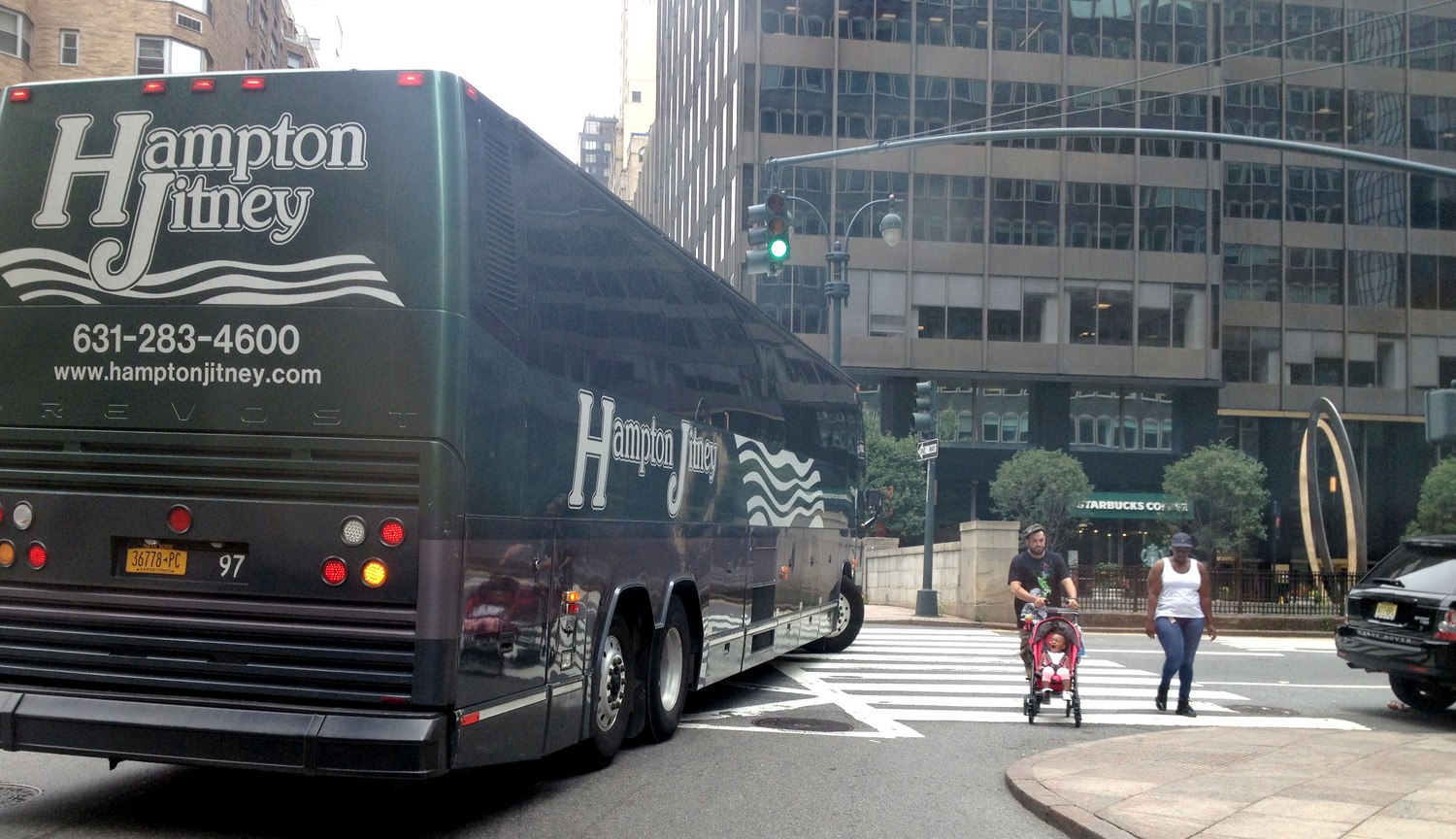
The Hampton Jitney in New York City. DANA SHAW
Hampton Jitney is getting the word out to its riders that potential fare increases could be on the horizon because of a congestion pricing proposal in the New York metro area, which would force the bus company to pay significantly more in tolls when it enters the city’s central business district.
The business district tolling program includes vehicles using the Queens Midtown Tunnel, which the Jitney entered roughly 20,000 times in 2023.
“It’s certainly something that’s coming to metro New York,” Hampton Jitney President Geoffrey Lynch said last week. “It’s just a question of what the pricing will be and who, if anybody, will be exempted.”
Lynch said he is hoping that Hampton Jitney will be offered an exemption from the congestion pricing, because the company and the service its provides is “part of the solution” to the traffic congestion issue in Manhattan. But he said that, thus far, in discussions with the MTA, an exemption looks like a long shot.
He said the problem is that the MTA considers the Hampton Jitney to be an “inter-city bus service” and not a commuter bus, putting the Jitney in the same category as bus services that ferry passengers between major cities, rather than those that operate exclusively in one metro area, primarily serving commuters.
Lynch said the Jitney is trying to make the case that it is unfair to be lumped in with the inter-city bus services.
“We have thousands of passengers who ride Hampton Jitney a few days a week for work, and who commute regularly with us, making the same trips every week,” he said, adding that in the summer Hampton Jitney serves a significant number of “weekend commuters.” He acknowledged they are not commuters in the traditional sense, but they are what sets Hampton Jitney apart, putting it in a kind of middle ground between the inter-city bus services and standard commuter bus services.
Lynch said the congestion pricing would add “hundreds of thousands” of dollars to Hampton Jitney’s annual toll expense, potentially doubling the cost of what it spends on tolls, and added that last year, Jitney spent half a million dollars on E-Z Pass tolls. He said he can’t speculate on what the actual figure would be when the new pricing goes into effect, but offered more insight into what it could look like for the company.
“Our fare structure includes four lines, Montauk, Westhampton, North Fork and Ambassador, each with prepaid, pay onboard, and value pack prices,” he explained. “And there are other cost inputs besides just tolls to consider. Trying to state what passengers will pay right now if Hampton Jitney is not exempted would require a whole new fare table, which we do not have yet. It’s safe to say that if we are subjected to the congestion price toll, it would add 25 cents to 75 cents to the cost of a fare.”
Lynch’s frustrations with the program are not strictly related to the cost.
“The issue is not the actual cost to our passengers,” he said. “The issue is that the MTA is promoting the congestion price program as a means of incentivizing people to get out of their automobiles and use transit instead. But for people who want to travel between New York City and the East End of Long Island on Hampton Jitney, which is transit, the MTA is saying you will be taxed. It goes against the principle of the congestion toll program and is another example of the MTA ignoring eastern Suffolk County.”
Hampton Jitney sent a letter out to its riders who buy yearly pass books, imploring them to make their voices heard during an open comment period with the MTA, in which anyone can comment about the proposal and what services should be exempt. Riders can submit written comments or even show up in person at the meetings. The MTA will vote on the plan either later this month or in April, and the new pricing would go into effect this spring.
The MTA has opened the congestion pricing toll recommendations for public comment until March 11. Those who want to comment can visit contact.mta.info/s/forms/CBDTP.


 Cailin Riley on Mar 6, 2024