


 1 Photo
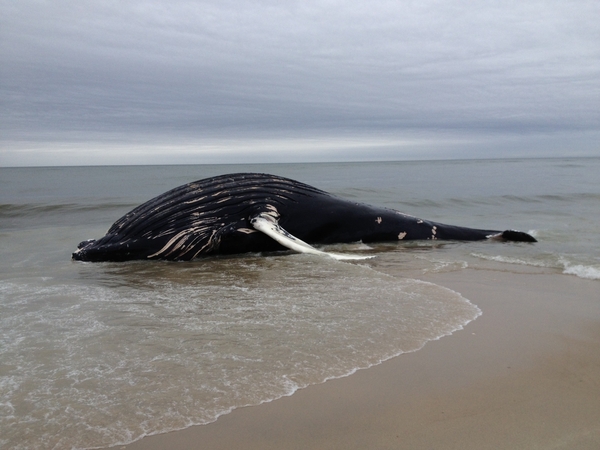
The whale that died in the Moriches Bay last month. COURTESY OF NOAA
An official with the National Oceanic and Atmospheric Administration—the federal agency that many critics blamed for dragging its feet last month when trying to free a beached humpback whale from Moriches Bay that eventually had to be euthanized—this week apologized for failing to take advantage of resources that could have possibly helped free the 15-ton leviathan.
John Bullard, the regional administrator of the NOAA Fisheries Greater Atlantic Region, in a prepared statement this week, apologized for the lack of communication between his organization and the community—members of which had repeatedly offered help and equipment, including a dredge that could have been used to help free the mammal, over three days, only to be repeatedly turned away and, in some instances, threatened with arrest if they came too close to the female stranded on a sandbar.
“Although there were generous offers of help and equipment from the public, unfortunately we were not aware of these resources until after midday [November 22], more than 48 hours after the whale beached itself and after local experts and residents reported a clear decline in the whale’s condition,” Mr. Bullard said in the statement.
Mr. Bullard, who was not available for comment this week as he was attending a conference, also apologizes in his statement for what he describes as the lack of dialogue between his agency and other responding groups, including the Riverhead Foundation for Marine Research and Preservation.
“We’re sorry there wasn’t more explanation and discussion with the community about the dialogue among experts and decisions being made,” Mr. Bullard said in his statement. “Would outcomes have been different if local knowledge, equipment, and resources were known and in place on day one? Governor [Andrew] Cuomo called me personally on [November 22] to offer any equipment and personnel we needed to free the whale.”
He later added: “We all regret that we did not have this conversation with the state on the first day that the whale stranded. We’ll never know for sure, but within the first 36 hours, an expert-directed response with the resources of the state and local community may have been worth a try.”
NOAA has been repeatedly criticized by locals—including dozens who attended a shoreline vigil for the whale after it was euthanized—for the way it handled the stranding, insisting that more could have been done immediately after the whale became beached on Monday, November 21, about a week after it was first spotted in Moriches Bay while chasing bait fish. Authorities euthanized the mammal two days later, the day before Thanksgiving, after it became clear to them that she would not be able to free herself and had grown too weak.
Many locals, including Tim Dahlen of Westhampton Beach, said they cannot understand why NOAA repeatedly refused to accept any assistance from locals, including those who had managed to transport a dredge near the whale the day before it died. Many boaters resorted to dumping seawater on the humpback while it was stranded and before they were threatened with arrest by responding U.S. Coast Guard officials.
“I don’t understand how they say how it’s too late,” Mr. Dahlen said on Tuesday. “They were saying this whale had damage to its internal organs … ”
An necropsy completed on the whale, which was later buried in the sand at Cupsogue Beach, revealed that the whale had bruising that could have been suffered before it became stranded on the sandbar, Jennifer Goebel, a NOAA spokeswoman, recently explained. Officials are still awaiting the results of tests done on tissue samples taken from the whale during the necropsy.
Officials with the Riverhead Foundation for Marine Research and Preservation, who were among the first to begin tracking the whale before it beached itself, have also been criticized for their handling of the situation, though they have pointed out that NOAA automatically becomes the lead agency in such circumstances.


 Amanda Bernocco on Dec 14, 2016