


 1 Photo

When Emil Norsic opened his sanitation business, now Norsic & Son Sanitation, on Sandy Hollow Road in Southampton 78 years ago, he did not have any neighbors.
But in 1978, Edward Broidy purchased just over 17 acres across the street from Mr. Norsic. Mr. Broidy then built his own home and subdivided the remaining land into 11 lots, on which houses were eventually built.
Though well aware of the nearby garbage transfer station, Mr. Broidy said he was under the impression that the business would never grow. He was wrong.
In addition to collecting garbage that is hauled to the Brookhaven Town landfill in Yaphank, the family-run business now also processes construction and demolition debris, offers a cesspool cleaning service and rents portable toilets. And the family is now seeking permission from Southampton Town to expand its operations—neighbors contend that the business has already grown, and its owners are now simply trying to legalize their operation—to neighboring properties that the family also owns.
Today, January 6, Emil “Skip” Norsic III, the company’s current owner and grandson of the company’s founder, will appear before the Southampton Town Zoning Board of Appeals—but not for the reason he originally thought. He will not find out if the zoning board will grant him a variance, a ruling that could help Mr. Norsic in his quest to eventually secure Town Planning Board approval to legalize the expansion of his business.
The reason for the delay: As of Tuesday evening, Suffolk County’s Planning Department had not yet submitted a referral to the zoning board, a document that’s required before a variance can be granted, because Sandy Hollow Road is owned by Suffolk County. “We have to receive comments from the county before rendering a decision,” said Kandice Cowell, a secretary for the zoning board. “A decision won’t happen on January 6.”
The lot line modification application itself remains stalled in the town’s Planning Department, because it was deemed incomplete last April, said Jacqueline Fenlon, a town planner. It is missing several mapping requirements that have not been submitted, she said.
Norsic & Son Sanitation’s operations are based on a 119,300-square-foot property—just shy of 3 acres—off Sandy Hollow Road. The land stores the company’s fleet of trucks that picks up and transports residential and commercial garbage, as well as construction waste that is processed and packaged on-site, to the Brookhaven Town Landfill and a transfer station on Old Dock Road in Brookhaven, Mr. Norsic said. The business also cleans cesspools and rents portable toilets; the sewage is transported to transfer stations in Riverhead and East Hampton, he said.
The company, however, also utilizes portions of three residential properties on Henry Road that abut the business and belong to Mr. Norsic and his family. Mr. Norsic is claiming that because his company predates the town’s zoning in 1957, it should be considered a business with a pre-existing, non-conforming use. He explained that the three adjoining lots have been used by his company since before zoning.
Only one of those three adjoining properties—the northern-most lot, which currently houses a garage—has a certificate of occupancy that proves pre-existing use. The other two properties are still zoned residential, according to Ms. Fenlon. Mr. Norsic’s uncle and aunt, Peter and Barbara Nikolich, live on the southern-most lot, and Emil and Anna Norsic, Mr. Norsic’s parents, live on the middle lot. A renter also lives on the northern lot.
Mr. Norsic said he is looking to expand the official boundaries of his business so that all of the industrial land is grouped together, a request that could be accelerated with the securing of a variance, Ms. Fenlon said. The variance would permit different uses on the residentially zoned properties without changing their actual zoning, which would require Town Board approval.
If the lot line modification application is eventually approved, the northern-most parcel would be reduced to about 27,500 square feet, according to the site plan. The middle lot, which currently measures around 50,000 square feet, would be decreased to 36,700 square feet, and the southern lot—which includes a garage that the sanitation company utilizes as a repair shop—would be reduced to about 26,700 square feet, down from about 42,900 square feet.
If its application is approved, Norsic & Son Sanitation would be operating from nearly 4 acres, or a single lot that measures almost 170,000 square feet, according to documents.
Mr. Norsic is contending that the change shouldn’t require a variance in the first place because he does not consider the move to be an expansion, but rather a formalization of how the property has been used for more than half a century.
“The question is, have we been operating on that property pre-1957? Yes, we have,” Mr. Norsic said during a recent interview. “There was activity taking place there in conjunction with the business, and there still is. This is just a small step toward officially putting the business there on one piece of land.”
Town Planning Board Chairman Dennis Finnerty, and several neighbors who live near the business, disagree with that take. In a referral to the town zoning board last summer, Mr. Finnerty wrote, “The current use of the 42 Sandy Road parcel did not exist as it does today … the Zoning Board of Appeals should consider this a gross expansion of the use.”
Mr. Finnerty cited the creation of a construction and demolition debris processing area on the main property—as well as storage space and land clearing—as uses that cannot be considered pre-existing.
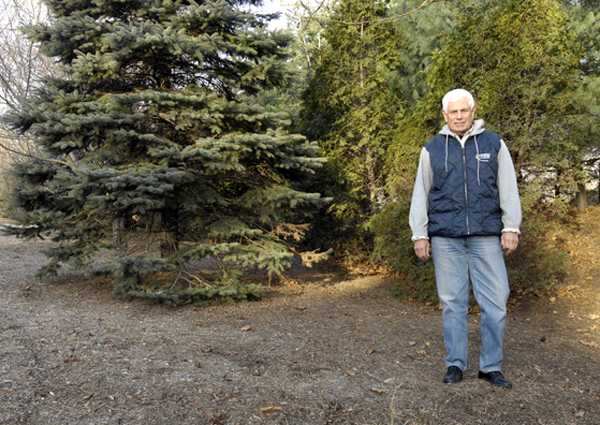
As for Mr. Broidy, who now lives on a portion of the land that he purchased from Mr. Norsic’s grandfather 32 years ago, he said he never believed that the business would grow to what it is today. “I didn’t buy the property knowing that there would be this kind of noise and odor,” the 75-year-old said during a recent interview at his Broidy Lane home. “I don’t want my quality of life ruined. I wanted to buy this pristine area, knowing what it was. It’s no longer that.”
Mr. Broidy’s neighbor, Sharon Carr, said she couldn’t agree more. “The gist of the application is that they’re trying to legalize an illegal use,” she said. “What they describe as a simple lot line modification takes the property and makes it industrial. To claim otherwise is an atrocity and an absolute lie.”
Mr. Broidy pointed out that Mr. Norsic is a familiar face in Town Hall. Just five years ago, Mr. Norsic applied for a planned development district, or PDD, that would have allowed the construction of four new buildings on his company’s property. That application, which was eventually rejected, would have required a hardship permit, Ms. Fenlon said.
“The process just got to be too expensive and it wasn’t worth the aggravation,” Mr. Norsic said about the effort to secure a PDD.
Mr. Broidy is accusing Mr. Norsic of using a “back-door approach” to legalize his expanding business. Mr. Broidy said he has witnessed a gradual clearing of nearby trees over the last 25 years. “It’s not like I moved next to an airport and am complaining about the airplanes,” he said. “We were here first. If the zoning is changed, they can put industrial buildings up there. It’s not just going to ruin the area, but a 3- to 4-mile radius.
“They think they’re going to get away with this,” he continued, “but they shouldn’t. It’s not right.”
Mr. Norsic explained that in order to stay viable in today’s sanitation industry, certain changes are necessary, like the addition of new trucks and buildings. In 2006, Mr. Norsic said he purchased a building in Southampton for his administrative headquarters and a warehouse in Calverton.
“Just so there are no surprises, Skip would like to put a smaller building up,” said Brian Gilbride, one of the company’s managers and also the mayor of the Village of Sag Harbor. “To do that, he has to give up some of the buildings already on the property and take them down—which he is willing to do.”
Mr. Norsic’s grandfather, who moved to the United States from Croatia in 1914, began the business after working at an estate in Sag Harbor. “Back then, it was the wild west,” Mr. Norsic said. “The garbage guy was unreliable, had one truck and there was really no organization. My grandfather thought he could do it better.”
Mr. Norsic said his grandfather borrowed money from his teenage son, Emil Norsic II, who had saved his earnings from working as a golf caddy, and purchased the area’s lone garbage company, called Bill Nichols. From just a handful of customers, the company has grown to serve more than 3,000 residents and hundreds of businesses throughout the town.
The third-generation business owner said he’s been working at the company since he could jump inside the cab of a garbage truck. Today, a fourth generation of family members—Mr. Norsic’s nephew and three cousins—are also employees of the company.
“It’s really an American story,” Mr. Gilbride said.


 Michelle Trauring on Jan 5, 2011