


 2 Photos
Rebecca Young. PRESS FILE

Rebecca Young. ANISAH ABDULLAH
Ticks and tick-borne illnesses have long been a problem on the East End. There may not be a solution to ridding the region of the parasite, but there are ways to prevent getting a tick bite — or a subsequent disease.
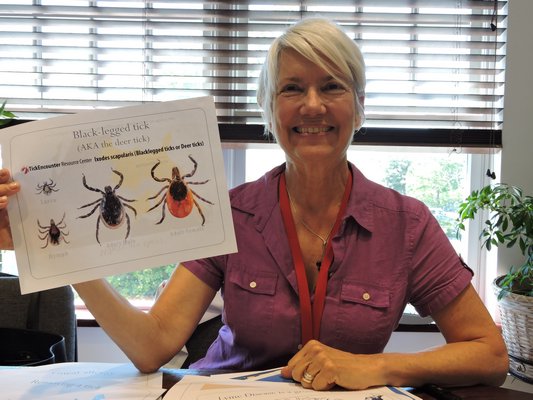
Rebecca Young is the Help Line nurse for the Stony Brook Southampton Hospital’s Regional Tick-Borne Disease Resource Center, and fields hundreds of calls a year from those wanting to know more about ticks. Here, she answers some of the questions she regularly is asked:
Q: If I see a tick on me, what should I do?
One of the most important things to do initially is to identify the tick … Sometimes it’s good to take a picture of the tick if you have your phone with you before you pull it out. Because, a lot of times, people mush the tick up, and then the picture afterward is too hard to identify. So if you can do that, it’s so important to identify.
That being said, it’s very important to have that tick taken out as soon as possible. Every extra hour that it’s on you, it’s more likely that you’re going to get a disease. The reason for identifying the tick is, then you know what diseases you are at risk for.
So then the next thing you do is make sure you get it off. And we have all sorts of information about how you pull a tick off. You grab it close to the skin with very, very sharp tweezers, and you pull with an upward, slow and steady motion until it pulls out … Then you clean the area with alcohol and antibiotic.
So you pulled your tick out — save the tick. The tick is a medical record. A lot of doctors don’t know how or don’t care to be bothered with identifying ticks, or it may be very hard for them to identify. So you preserve the tick, either in a Ziploc bag, or you can tape it to a card, or you can put it in a little vial of alcohol … You write the date on it, when you were bitten — and that’s going to help you down the line should you get sick.
Q: What if I don’t have tweezers at the time that I discover a tick? Is it okay to pull it out with my fingers?
Bottom line, you get that tick out as soon as you can. Even if you’re going to have to dig with your fingernails.
I had a patient who waited, like, eight hours to go to the emergency room to have a professional take the tick out. They just added eight hours to the possibility of getting a disease.
It’s not the actual tick bite that’s the problem — it’s the bacteria getting into your system. And many sources say it takes 24 hours for the bacteria to migrate from the [tick’s] abdomen up into the salivary glands. So you have that time to get the tick out.
Q: Out here on the East End, what types of ticks are found?
We worry about three different types of ticks. The first one, of course, is the deer tick, or black-legged tick, and that carries Lyme disease. It carries other diseases, too. We get 10 cases of Lyme for every case of another disease. So, it’s prevalent. It’s a big public health crisis problem. That’s our main concern.
The second tick that we worry about is the lone star tick. A newcomer, came here from the South. It was usually in seven states in the South. I think it came here on birds or fowl, or whatever — they’re not really sure — but we have more lone star ticks out there now than deer ticks, which is interesting … There’s more of them, they’re more hardy, they can live in different temperatures, they’re very aggressive. It’s sort of a different kind of a tick.
The female adult is very easily recognized: She’s got that white spot on it. And they’re the ones that usually bite you … The main disease is ehrlichiosis, very similar to anaplasmosis of the deer tick.
The dog tick is the third one. They used to be much more prevalent. They get their disease, Rocky Mountain spotted fever, from the meadow vole, and there’s not that many of them anymore, because of habitat disruption. Whereas the deer tick gets Lyme disease from the white-footed mouse and other small animals, which, there’s a proliferation of them all over.
Q: What types of diseases do they carry?
The deer tick carries Lyme — that’s our biggest disease, 10-to-1 to other co-infections … You’ve got three to 30 days for the first symptoms of tick disease to hit. One of them, of course, the notorious EM rash, bull’s-eye rash, 50 percent or less get it, so you can’t count on getting that to let you know you have Lyme. However, if you do get it, then you are lucky, because you have a definitive diagnosis of Lyme disease.
If you see the rash, or if you get any of the other signs and symptoms, such as flu symptoms, headache, nausea, fever … you go to the doctor. They’ll probably diagnose you clinically and put you on three weeks of doxycycline.
If you have no symptoms in that first period then you do have the option of going to get a test … You’re not testing for the actual bacteria; you’re testing for your body’s reaction to that bacteria, which is an antibody. And so that, just by definition, is not very definitive, because the antibodies can be cross-reacting with something else, or maybe they just don’t appear yet — it’s very time sensitive.
So that’s pretty much Lyme disease. The other infections have a lot of the same symptoms. They usually come out a little earlier. Like anaplasmosis, ehrlichiosis, you’ll see symptoms in one to two weeks, whereas with Lyme it could be longer. And babesiosis is another one. There’s many infections; they all have their own thing. Their initial symptoms are similar.
Q: If I’m outside, is there anything I can do to avoid getting a tick on me? What type of prevention strategies are there?
If you’re going to hike, you want to go on well-traveled paths, walk in the middle of the path, and you need to wear light clothing … You tuck your pants into your socks. An interesting thing you can do is put duct tape, sticky side out, around where your socks and pants meet, and then the ticks, they crawl from the bottom up, pretty much. They get caught in the duct tape. And then you could see what’s around your yard.
One of the No. 1 preventative things to do is to spray your shoes with permethrin. Permethrin is a pesticide repellent that is the best on ticks. And you spray your shoes. It binds to the material of your clothing and your shoes — it wouldn’t work on rubber boots — and then it stays there for, like, a month.
Q: Is spraying the yard with permethrin the best solution to prevent ticks around the house?
It’s going to help a lot. And what also helps: short grass that is mowed very short, because the ticks, they die by desiccation. They don’t really like being out in the sunny, hot grass. They like to be in the leaf litter. So you want to rake all that leaf litter up, mow the lawn really short. Having said that, the lone star ticks do a little better in the hot grass than the deer ticks.
Q: Can I get bitten by a tick in the winter?
Yes. Because of global warming, anytime it gets above 40 degrees in the winter, the ticks wake up, and they might be looking for their blood meal, and we have seen that. I talk to a lot of patients and callers, and they call through the winter and they’ll say they got a tick on them. And we get, sometimes, those warm, balmy days. So you have to be really careful. Not as much, of course, but absolutely.
We talk to a lot of the landscapers about protecting themselves, especially in the fall and the spring, when they think winter is over but it’s not summer yet, and they think there are no ticks out there. You got to be really, really careful in the spring.
Q: What is the biggest misconception about ticks or tick-borne diseases?
I think the biggest thing is that people think, when they get bitten or they have a sign and symptom, they think that the test is the definitive way to diagnose a disease — and it’s not. You can’t just go get a test and find out if you have Lyme. You might find out you have Lyme from a test, but it is a clinical diagnosis, which is supported by the test. … We worry about a lot of false negatives …
The misconception I’m talking about has to do with Lyme. You can test for some of the other tick diseases without this problem a little bit more definitively.


 Staff Writer on Aug 6, 2019