



 18 Photos
Stacey Reister speaks with the press outside of the courtroom.
Stacey Reister speaks with the press outside of the courtroom.
Stacey Reister speaks with the press outside of the courtroom.
Stacey Reister speaks with the press outside of the courtroom.

Stacey Reister speaks with the press outside of the courtroom.
Stacey Reister speaks with the press outside of the courtroom.
Stacey Reister speaks with the press outside of the courtroom.
Stacey Reister speaks with the press outside of the courtroom.

Stacey Reister
Stacey Reister
Stacey Reister
Stacey Reister
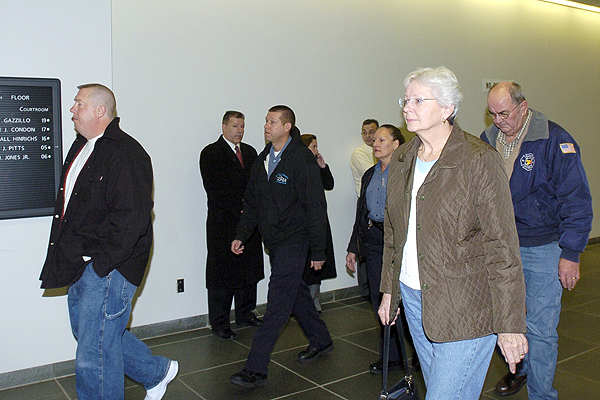
Friends and family of Andrew Reister leave the courtroom.
Friends and family of Andrew Reister leave the courtroom.
Friends and family of Andrew Reister leave the courtroom.
Friends and family of Andrew Reister leave the courtroom.

Assistant District Attorney Denise Merrifield gives a statement.

Assistant District Attorney Denise Merrifield gives a statement.
A
Suffolk County Criminal Court jury found Anthony Oddone guilty of first-degree manslaughter on Monday, after nine tense and tumultuous days of deliberation following a seven-week trial. He was acquitted on the more serious charge, murder in the second degree, on which he had been indicted in August 2008.
Mr. Oddone, 27, of Farmingville now faces a minimum sentence of six years in prison and a maximum of 25 years. He will be sentenced by County Court Judge C. Randall Hinrichs on February 9.
The verdict was announced in the Riverhead courtroom on Monday at about 5:15 p.m. His attorney, Sarita Kedia, said afterward that she would appeal the conviction. Assistant District Attorney Denise Merrifield said she will ask the judge to sentence Mr. Oddone to the maximum.
Following the verdict, and before being led away, the defendant turned to Stacey Reister, the widow of victim Andrew Reister, and mouthed the words, “I’m sorry.”
With tears welling in his eyes, he also mouthed “Thank you” toward his mother, Laura, and the crowd of his friends and supporters—including two members of the Bridgehampton golf course where he had worked during college who are thought to have paid for his defense—seated in the courtroom as New York State Courts officers handcuffed him. Some of Mr. Oddone’s friends broke into tears following the verdict. One stormed angrily out of the courtroom.
Mr. Reister, who was 40 when he died, has two children. He had been a Suffolk County Department of Correction officer and was moonlighting as a bouncer at the Southampton Publick House on August 7, 2008, when he clashed with Mr. Oddone after telling the younger man to stop dancing on a table. Mr. Oddone wrapped an arm around Mr. Reister’s neck and choked him for what some witnesses testified was as long as three minutes. Mr. Reister never regained consciousness and was declared dead two days later.
To find Mr. Oddone guilty of manslaughter in the first degree, the law states that the jury had to conclude that Mr. Oddone had intended to cause “serious physical injury” to Mr. Reister when he began choking him and in doing so caused his death. To be found guilty of murder, the jury would have had to conclude that he intended to cause Mr. Reister’s death.
Outside the courtroom following the verdict, Ms. Reister said she was happy with the conviction, even though it was on a lesser charge.
“It’s got a 25 in it—it’s fine,” she said, referring to the years in prison Mr. Oddone faces.
“I don’t want to celebrate his loss or [his mother’s] loss, but I am thankful,” she told to reporters in the hallway where she and her family and Mr. Oddone’s supporters all had awaited the verdict since the jury began deliberating on December 3. “Nobody wins here. He was crying. I was crying. Nobody wins.”
She acknowledged Mr. Oddone’s silent apology and said that the tears in his eyes told her he was remorseful.
“Do I forgive him? That’s a big word,” she said when asked by a reporter. “He took the biggest part of my life.”
Ms. Reister said she was relieved that the ordeal of the two-month trial and the long deliberations was finally over.
“I can be a mom again,” she said. “Tomorrow, I’m letting the kids skip school ... and we’re going to make Christmas cookies.”
“I’m probably going to come here tomorrow, because I’m on auto pilot,” she joked with a fleeting smile.
The verdict brought an end to one of the longest criminal trial deliberations many in the courthouse could remember by a Suffolk County jury. The jury had asked to have the charges read back to them five times, had spent more than eight hours in the courtroom listening to testimony read back to them, and apparently waged some very heated battles in the jury room. On both Thursday and Friday of last week, Ms. Kedia had demanded that separate jurors be dismissed from the case because they had violated the secrecy of their deliberations, apparently in exasperation at the difficulty of reaching consensus.
One of the jurors, Stephen Garvey, said following the announcement of the verdict on Monday that the jury members had set aside the most serious charge, murder in the second degree, early in their deliberations and had battled over the manslaughter charge for more than a week. He said it was the “not guilty” vote of a single juror that held up the verdict for most of their nine-day struggle, and that they had been close to declaring themselves deadlocked.
“It was 11-1 on that Friday afternoon ... and then it was just a matter of convincing the other juror,” Mr. Garvey, a 61-year-old retired Long Island Rail Road employee from Northport, said in the lobby of the courthouse on Monday evening; he was the only juror who agreed to talk to the media. “We went over all the evidence, and we just had to convince her that his actions showed his intentions ... We re-lived the crime over and over and over.”
The hold-out juror, a middle-aged woman who would not give her name, declined to speak with a reporter after the verdict.
On Monday morning, the jury had listened to more than four hours of testimony describing the struggle reread to them by a court reporter. The verdict came down just over three hours later.
The jury consisted of 10 original members plus two alternates who were swapped in to replace two jurors who were dismissed by Judge Hinrichs on separate occasions.
Mr. Garvey said that just four jurors, himself included, had initially voted guilty on the murder charge, but that they changed their votes after realizing the other eight jurors were not going to be convinced Mr. Oddone had intended to kill Mr. Reister. He called the events leading up to the trial a “tragedy” for both the Reister and Oddone families.
Before they left the Arthur M. Cromarty Criminal Court building, prosecuting attorney Denise Merrifield spoke to the jury in the lobby, telling them several details about Mr. Oddone that had not been mentioned during the trial, particularly about Mr. Oddone’s criminal record. Mr. Oddone never took the stand during the trial, which would have given the prosecutor the opportunity to bring up his record.
“There were several things about his criminal history, which he has, that I couldn’t tell you about during the trial,” she told the seven men and five women. “He has a history of violence, he has a history in bars, he worked as a bouncer ... There is more to this guy than just a guy in a tie sitting at a table, if that helps you sleep better tonight.”
Outside the courtroom after the verdict was read, Ms. Merrifield said that she was satisfied with the manslaughter conviction.
“My hat’s off to the jury,” she said, acknowledging that the case had taken nearly a month longer than originally anticipated during the jury selection. “They were obviously a very hardworking jury.”
The veteran prosecutor said that she had guessed from the jury’s repeated requests to have the charges read back to them with a particular focus on the legal explanation of intent that they were still considering one of the two most serious charges. Mr. Oddone could have been found guilty of manslaughter in the second degree or criminally negligent homicide had the jury found him not guilty of first-degree manslaughter.
Ms. Kedia had tears in her eyes when she left the small office adjacent the courtroom she has used for the last two months, a small group of Mr. Oddone’s friends behind her. She declined to comment on the verdict except to say sternly: “We will most certainly be appealing.”
Ms. Kedia’s defense had focused on the fact that Mr. Reister had initiated the physical confrontation when he pushed Mr. Oddone off the table he was dancing atop. She argued that Mr. Oddone was defending himself against the larger Mr. Reister—who was 6 feet 4 inches tall, compared to Mr. Oddone’s 6-foot-1-inch frame, and outweighed the younger man by at least 60 pounds—and that the chaos of the bar and the assaults from other patrons trying to get him to release his grip on the bouncer clouded his thought process.
After the verdict was read, Ms. Kedia asked that sentencing be held in February rather than January, as the judge initially indicated.


