


 2 Photos
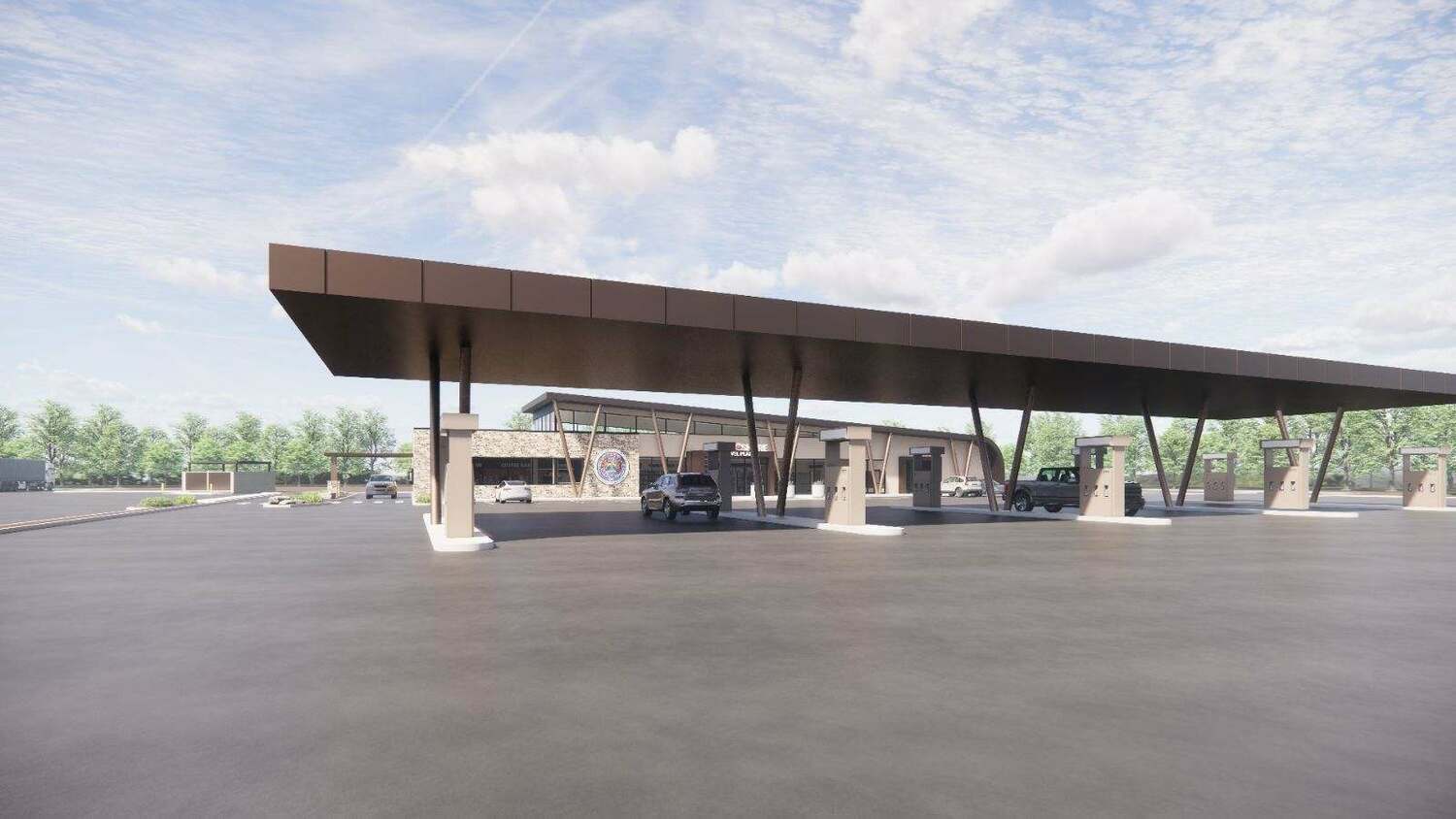
Initial renderings of the planned gas station and travel plaza that will be constructed on 10 acres of land owned by the Shinnecock Nation in Hampton Bays. COURTESY EASTERN WOODLAND PETROLEUM
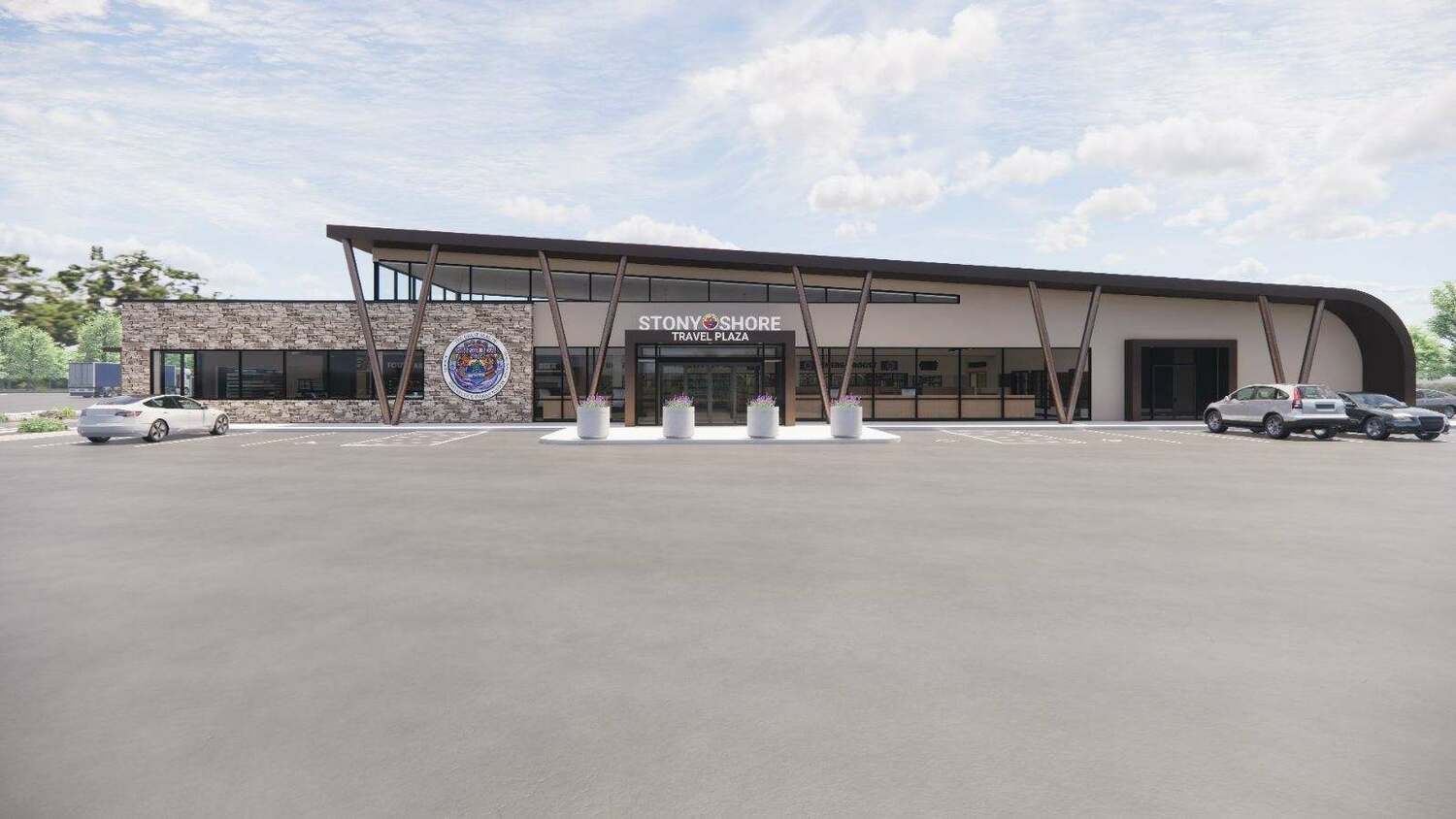
Initial renderings of the planned gas station and travel plaza that will be constructed on 10 acres of land owned by the Shinnecock Nation in Hampton Bays. COURTESY EASTERN WOODLAND PETROLEUM
After the Shinnecock Nation last week began clearing 10 acres of tribe-owned land on its Westwoods property in Hampton Bays, off the northern side of Sunrise Highway, as the first step in construction of a gas station and travel plaza, questions continue to swirl about the details of the economic development project, and the degree of involvement it will entail from both the state and Southampton Town.
A primary curiosity is whether the tribe will seek to create entrances and exits from Sunrise Highway to the gas station, which Tribal Council Chairman Bryan Polite said has a tentative opening date of spring 2025.
Earlier this week, Polite said that the nation definitely wants to create access to the gas station from the highway, but the tribe will not forge ahead with construction on those access points without cooperation from the State Department of Transportation. So far, he said, there has been little or no dialogue between the tribe and the state DOT, but not for lack of trying on the tribe’s end.
“It’s been almost a year of getting support to ask the DOT to work with us on an off-ramp. We hired an engineering firm that’s worked with the DOT and knows the ins and outs of that, and we’ve presented five different options, including a passover, but it’s fallen on deaf ears.
“They’re not responding,” Polite continued. “What they’re telling us, and I think our last communication was about two years ago, is that they’re reviewing it and they plan on meeting with us.”
Stephen Canzoneri is the public information officer for the Long Island region of the State DOT. When reached earlier this week to provide comment on the gas station plans, he said, “Due to the agency’s existing litigation with the nation, we have no comment.”
The litigation he’s referring to is the suit the DOT brought against the tribe when it constructed the pair of 62-foot-tall electronic billboards on tribal land on each side of Sunrise Highway, another economic development project that has brought revenue to the tribe.
State Assemblyman Fred W. Thiele Jr., who recently announced that he will retire at the end of his term, has been a supporter of the tribe’s plan to build a gas station. He said earlier this week that the DOT uses the litigation as a basis to not talk with the Shinnecock or the public about access to Sunrise Highway.
While Thiele said he supports the gas station as a viable economic development project — a feeling he does not share about the tribe’s plans to build a casino on their Montauk Highway territory — he said there are several important questions that need to be answered and a “multitude of issues” that need to be resolved before the project can be carried out.
He pointed out that in 2020 the tribe reached out to state, county and local officials with a concept plan for the gas station, but there had not at that time been any environmental review. He said that important issues like environmental impacts, impacts on neighbors, to groundwater and more all need to be carefully considered.
“As I expressed then, and now, unlike a casino, which I strongly oppose, I have no opposition to the concept of the gas station and retail proposal,” he said. “High South Fork gas prices and the current lack of services on the LIE and Sunrise are factors which would favor this project. But site-specific issues need to be addressed.
“I had not further heard details on this project since the summer of 2020 until the bulldozers showed up on the site about a week ago,” he added. “Obviously, a lot of issues are presented by this project as I outlined above. The details matter. Beginning land clearing without notice to the town or surrounding community is not the best way to address those issues.”
Thiele said that Polite has since reached out to him about the project, and the tribe was scheduled to meet with Southampton Town Supervisor Maria Moore, Town Councilman Michael Iasilli and Town Attorney James Burke on Wednesday afternoon, February 14, to discuss the Westwoods property.
Figuring out how to proceed when it comes to coordination between the tribe and state and local officials will likely be complicated, as it typically is when the tribe embarks on an economic development project.
Thiele said the state’s involvement will relate only to the tribe’s efforts to create access points to the gas station from Sunrise Highway, while coordination with the town could be trickier and more involved. The fact that the Westwoods property — which extends from the land proposed for the gas station just off Sunrise at the south end, to the bluffs overlooking the Great Peconic Bay on the northern end — is Shinnecock-owned land but not “reservation” property raises a gray area category of questions related to whether town zoning codes apply, Thiele said.
He dug into what some of those questions, and perhaps battles, could relate to.
“Would the town have to grant site plan approval?” Thiele asked. “Would the county have jurisdiction over fuel tank installation? What about SEQRA or NEPA?”
He also pointed out that there was a 2003 court case regarding land clearing for a proposed casino at the Westwoods property, where the court ruled that the town had zoning jurisdiction. The case was ultimately removed to another court, and then the casino effort was abandoned. Thiele added that this all went down before the tribe had earned federal recognition.
He also added that, in the 1950s, the state had acquired an interest in the land that was part of Westwoods, to build the extension to Sunrise Highway, which has created a complicated legacy for that piece of land.
“Typically, DOT must grant a permit to access a state highway,” Thiele said. “Whether or not such a permit is needed here is an open question. The Shinnecock have said the highway is on their land and no state permit is needed, or at least that they retained the right of access. The DOT has been silent on this matter.”
Polite pointed out that the 2003 court case was ultimately vacated and maintained that the Westwoods property is reservation property, essentially no different from the tribe’s territory just a few miles to the east.
“[Westwoods] has never been zoned or taxed, and is on the Southampton Town map as ‘Shinnecock Reservation,’” he said. “It says ‘Shinnecock Reservation’ — and those aren’t our maps, those are the town maps.”
He also pointed out the historical significance of the Westwoods property, and in particular the area known as Canoe Place, which earned that name because, dating back hundreds of years, long before the Shinnecock Canal was built, it was the smallest area of land where the Shinnecock could carry their canoes after paddling between the Peconic and Shinnecock bays. “It’s not only our territory, but it’s culturally significant,” he said.
The further along the project progresses, the more necessary it will be for all sides to come together to reach a solution. How quickly and efficiently they will be able to do so remains an open question.
Polite said he remains hopeful that the project can proceed with good cooperation between all sides, and said early discussions with the town have given him reason for that hope thus far.
“Hopefully,” he said, “this will be one of those times where Shinnecock isn’t being persecuted for trying to better the lives of our own people on our own tribal territory.”


 Cailin Riley on Feb 14, 2024