


 4 Photos
Passengers arrived on the eastbound train in East Hampton on Tuesday morning. KYRIL BROMLEY

Passengers arrived on the eastbound train in East Hampton on Tuesday morning. KYRIL BROMLEY

Passengers arrived on the eastbound train in East Hampton on Tuesday morning. KYRIL BROMLEY
Passengers arrived on the eastbound train in East Hampton on Tuesday morning. KYRIL BROMLEY
Two months after the Long Island Rail Road launched a combination shuttle and rail service for commuters called the South Fork Commuter Connection, ridership has steadily increased—and soared in some instances—from March to the end of April.
Only two riders took the train to Amagansett in the month of March; in April, that number had jumped to 23 riders, the biggest gain. Although that may seem like a small number of riders, other train stations are seeing a much higher number of passengers.
In March, 100 riders were reported to have taken the train to Southampton—for the month of April, that number had risen to 333 passengers.
Some areas had a smaller increase. For example, in East Hampton Town, 102 riders were reported to have taken the train during the month of March, and 163 took it during the month of April.
The Bridgehampton train station saw a 135-percent increase, with 60 passengers riding the rails in March and 141 in April.
Overall, the commuter train saw an increase over the same period from 264 riders to 644, a 143 percent increase, month-to-month.
“I’m encouraged,” Southampton Town Supervisor Jay Schneiderman said on Tuesday. “People’s travel patterns don’t change overnight. It takes a while. It’s not going to work for everyone.”
East Hampton Town Supervisor Peter Van Scoyoc said in an email on Tuesday that he has seen a steady increase in ridership since the service began in March, and he expects it to continue to increase.
“We have received high praise from many who are taking advantage of the new train schedule,” he said. “Most point out the benefits of less stress, shorter commute times and the ability to work or read on the train, instead of driving in bumper-to-bumper traffic.”
The South Fork Commuter Connection is a new service that was started in March that allows commuters to take the train to any of the South Fork train stations, depending on the schedule, for $3.25 each way. For an additional $1, commuters can ride one of the shuttle buses to get to points near their work.
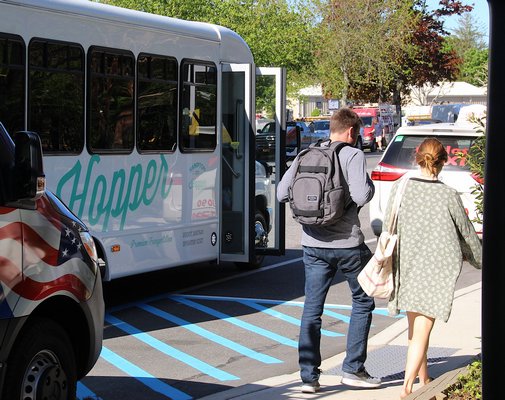
The numbers being reported include only people who transferred from the train to the last-mile shuttle service that is being provided by the towns of Southampton and East Hampton, by way of the Hampton Jitney and the Hampton Hopper. Riders who walked or took alternative transportation to their final destination from the train stations were not included in the count—so the actual number of train passengers likely is even higher.
Mr. Schneiderman rode the second morning train on Tuesday, which departed Hampton Bays at 8:26 a.m. and arrived in Southampton Village at 8:36 a.m., and said there were only about 20 riders on the single-car train being pulled by a locomotive.
But the earlier train, which left the Speonk train station at 6:16 a.m., and made stops in Westhampton, Hampton Bays, Southampton, Bridgehampton, East Hampton and Amagansett, had “more than 80 people riding,” said Mr. Schneiderman, attributing the numbers to the conductor who took the tickets.
He continued to say that Tom Neely, the director of public transportation for the Town of Southampton, is working with numbers from the shuttle services. Mr. Neely’s numbers show more riders are taking the train to Southampton and getting on the shuttle than at any other location
“The more important numbers are from the worker,” Mr. Schneiderman said of the conductor.
Of the 80 people Mr. Schneiderman said was reported to him, a lot of people got on at the Hampton Bays train station.
The conductor also said a lot more people were actually riding the train to East Hampton, according to Mr. Schneiderman.
John C. Jilnicki, the acting town attorney in East Hampton, said in an email that he takes the train whenever his day will allow him to do so, and he has seen the train packed on both the top and bottom levels.
“While it may start in Speonk with only about 5 to 15 people, it fills further at eastern stations, probably doubling at Westhampton, and it is pretty well packed once it leaves Hampton Bays,” he said in an email. “This week, it’s pretty close to full on every train I have been on so far, unlike most of the regularly scheduled trains run outside the SFCC program.
“It is true that the last/first mile buses aren’t that full, because many people walk and get rides … but the trains have been quite full and bus ridership doesn’t reflect train ridership,” he added.
Beginning this week, the train schedule changed and the commuter rail dropped service on Fridays to allow more trains from Manhattan. The modification opens a gap in what the town has been trying to do, which is get more people to take the train to work.
“At least you have relief for four days of the week,” Mr. Schneiderman said. “The schedule is different on Friday … they have the ‘Cannonball.’” The Cannonball is an afternoon train from New York City that is typically filled with weekend visitors.
State Assemblyman Fred W. Thiele Jr., who worked to get the South Fork Commuter Connection to become a reality for the East End, announced in April that legislation to install mechanisms that will allow trains to pass, is gaining traction in Albany.
Mr. Schneiderman said this week that he plans to meet with MTA officials soon to discuss locations where the mechanisms can be installed.


 Greg Wehner on May 21, 2019