


 1 Photo
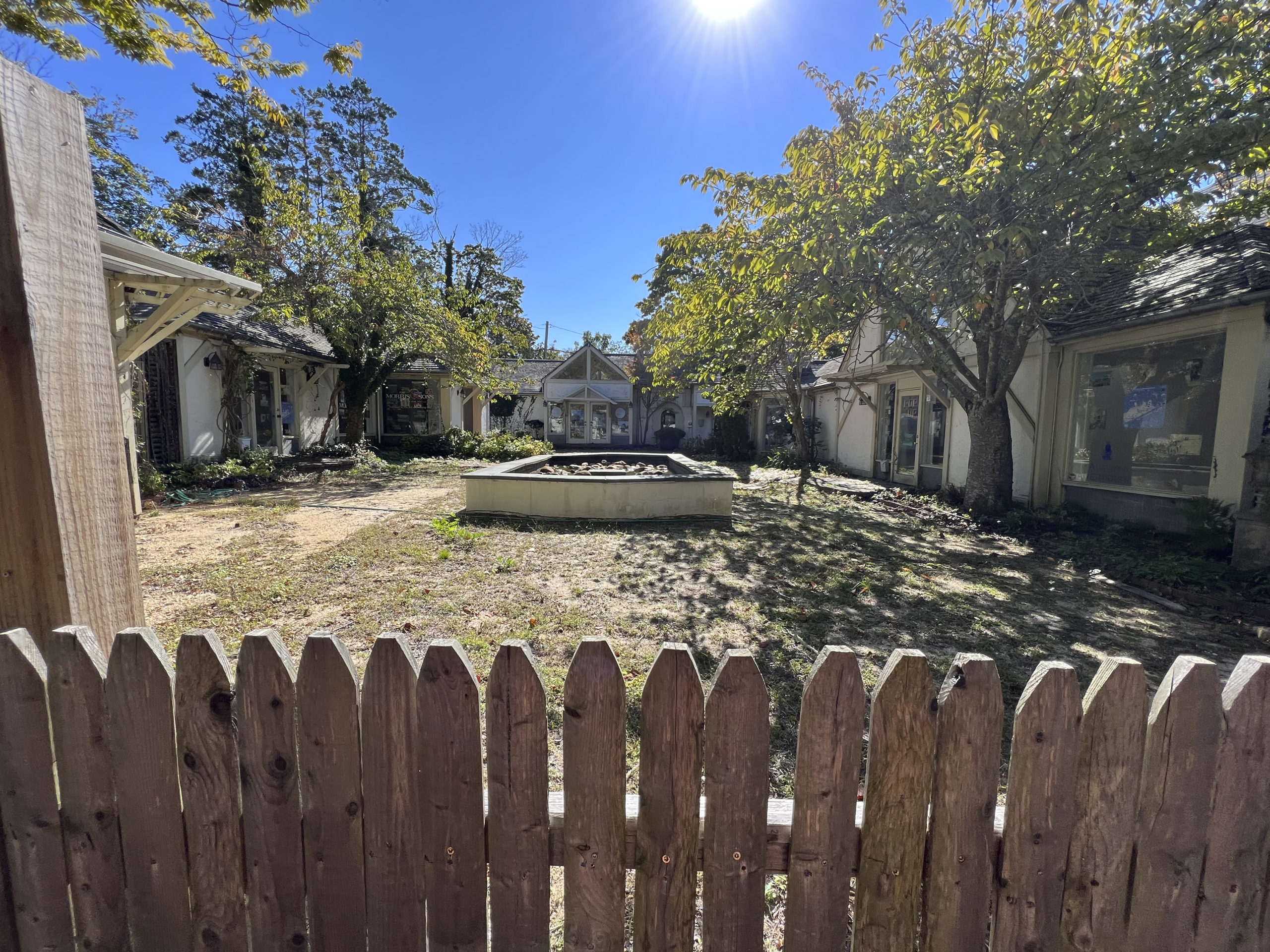
The abandoned courtyard on Jobs Lane in Southampton Village. DANA SHAW
The owner of a Jobs Lane courtyard and the empty storefronts that surround it has sued Southampton Village in state court in an attempt to invalidate an October 26 Village Board determination that the property, which is located in a historic district, has fallen into disrepair.
The lawsuit filed on November 24 argues that the Village Board had no authority to pass a resolution making that determination, because the courtyard is behind a fence and not within public view. The filing acknowledges that bricks were removed from the courtyard but says that act triggers neither the local law nor state regulatory provisions. State property maintenance code on vacant structures preempts any attempts by the village to regulate the premises, the lawsuit states.
Located at 38-42 Jobs Lane, the courtyard with three one-story buildings was built in the 1970s. In 2017, the owner, John Vigna, sought to redevelop the 0.22-acre property with a pair of two-story buildings, but he withdrew the application a year and a half later after resistance from residents who sought to save the courtyard. In the summer of 2019, bricks in the courtyard were torn up and scattered, and plastic flamingos were installed; the loose bricks and the flamingos have since been removed.
The lawsuit notes that on August 12 this year, the Village Board adopted a law giving it the authority to make a judgment that a property has fallen into a state of disrepair and is causing a detrimental effect on the character of a landmark or historic district. The authority to make such a determination was previously only granted to the Board of Architectural Review and Historic Preservation.
At the October 26 Village Board meeting, the chairman of the Board of Architectural Review and Historic Preservation, Jeff Brodlieb, gave a presentation in which he detailed the village code on protecting historic districts and spoke to the condition of the courtyard specifically. “It’s apparent to the eye that it is a detriment to the historic district,” he told the board.
Vigna’s attorney argues in the lawsuit that the evidence was “a mere opinion” and accuses the chairman of presenting “misleading photographs of the premises.” The lawsuit also notes that the owner was not given notice that a presentation would be made and that a vote concerning his property would be taken that day.
The owner has been issued numerous citations for altering the courtyard without a certificate of appropriateness. The determination that a property has fallen into disrepair is designed to open up even more enforcement opportunities for the village. An attorney for Vigna was in Southampton Village Justice Court on November 9 to answer the citations, and Justice Michael Solomon told the attorney to sit down with the village prosecutor and come to a resolution.
On Tuesday, Mayor Jesse Warren questioned the value of a lawsuit to overturn the Village Board’s determination. “It seems like it’s a lot of work to do that instead of just fixing the courtyard,” he said. He suggested it would be hard to argue that the state of the courtyard is not a detriment to the historic district: “All you need to do is look at the photos.”
In addition to the village code, state property maintenance code requires that the property be kept in order, Warren said.
The mayor, lamenting that a space in the downtown historic district is sitting unrented and unused, said he met with Vigna’s attorneys, Michael Walsh and Gil Flanagan, and offered an easement on village property so Vigna could install a septic system, which would enable him to open a restaurant, coffee shop or wine bar at the courtyard. The attorneys told him that Vigna would be open to selling the property to the Southampton Town Community Preservation Fund, but that Vigna would only accept a “big number.” Warren said both ideas were rejected.


