



 12 Photos
Pine Barrens Society Execuitve Director Dick Amper. VALERIE GORDON
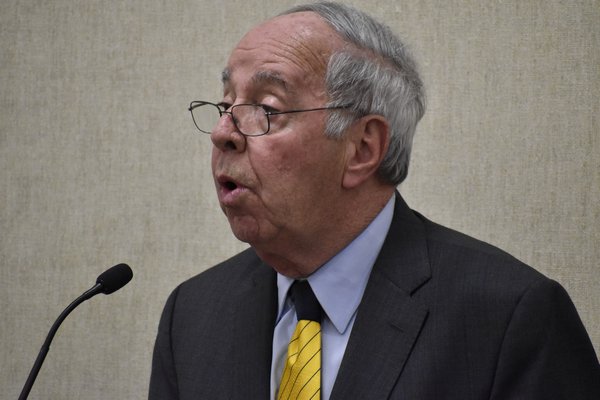
Pine Barrens Society Execuitve Director Dick Amper. VALERIE GORDON
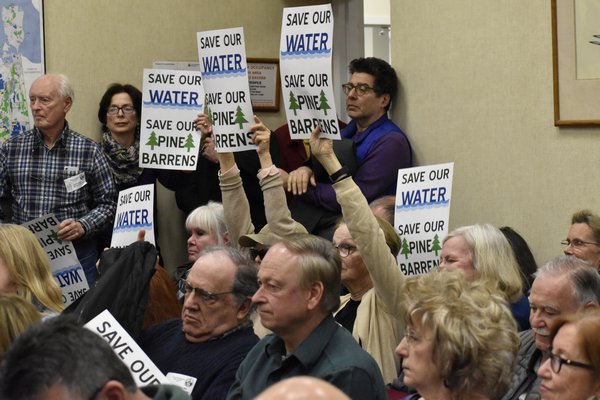
Community members held signs reading: "SAVE OUR WATER SAVE OUR PINE BARRENS." VALERIE GORDON
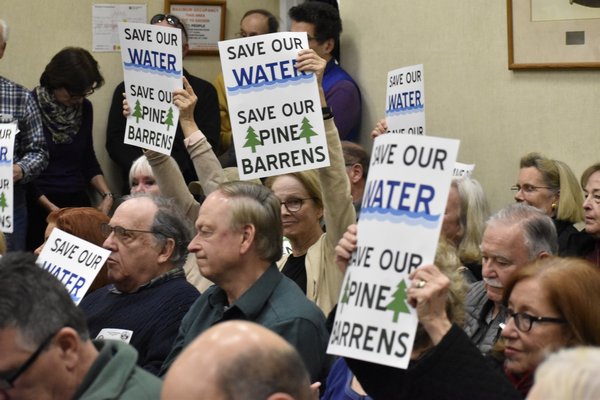
Community members held signs reading: "SAVE OUR WATER SAVE OUR PINE BARRENS." VALERIE GORDON

Al Algieri, president of the East Quogue Civic Association. VALERIE GORDON
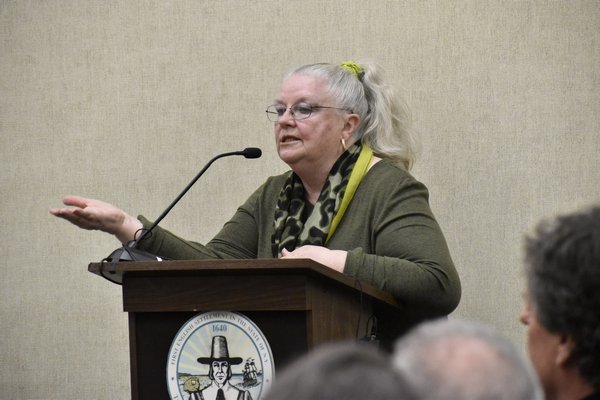
MaryAnn Johnston, president of Affiliated Brookhaven Civic Organization. VALERIE GORDON
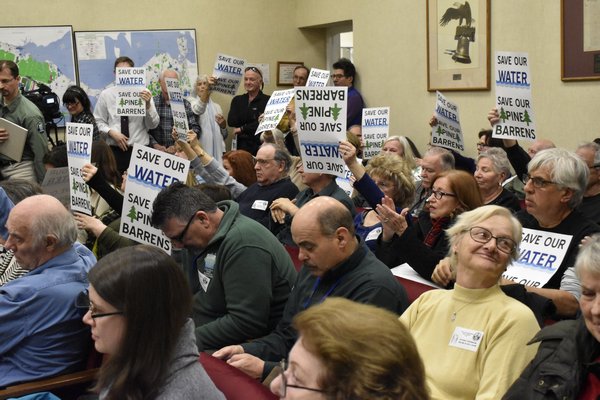
There wasn't a seat to be had at the Pine Barrens Commission meeting on Wednesday. VALERIE GORDON
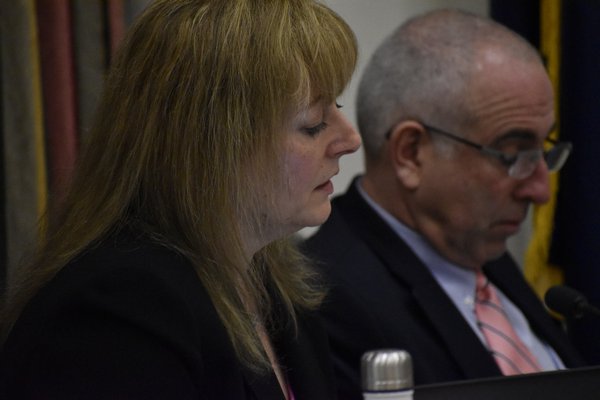
Pine Barrens Commission Chairwoman Carrie Meek Gallagher and Southampton Town Supervisor Jay Schneiderman. VALERIE GORDON
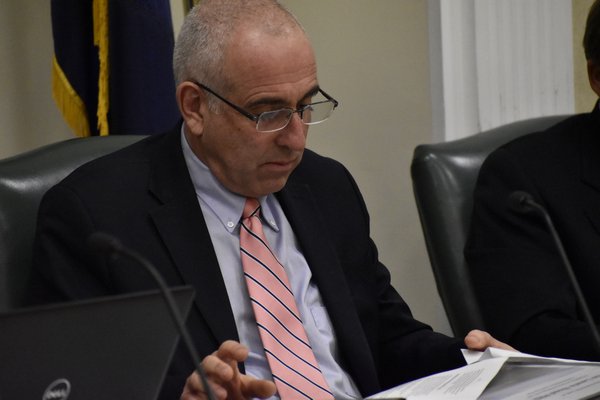
Southampton Town Supervisor Jay Schneiderman. VALERIE GORDON
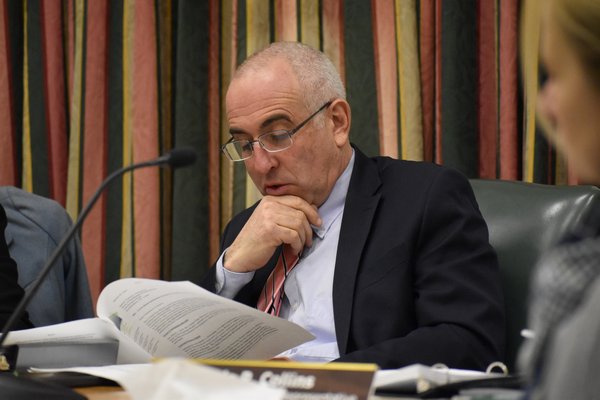
Southampton Town Supervisor Jay Schneiderman. VALERIE GORDON

Pine Barrens Commission Special Councilman John Milazzo. VALERIE GORDON

Southampton Town Planning Director Kyle Collins. VALERIE GORDON
The Central Pine Barrens Commission last week unanimously voted to resend a letter to the Southampton Town Planning Department—identical to one that was sent to the regulatory board a year ago—seeking information regarding details of a proposed luxury golf course resort in East Quogue.
The commission’s meeting on Wednesday, March 20, held at Southampton Town Hall, drew community members from throughout the East End, the majority of whom held signs reading: “Save Our Water, Save Our Pine Barrens.”
Among them were Dick Amper, executive director of the Long Island Pine Barrens Society, and Robert DeLuca, president and CEO of the Group for the East End, who both implored the Pine Barrens Commission to assert jurisdiction over the 591-acre project.
The two environmentalists noted that since 2013 the commission has sent a total of 10 letters to the project’s developers, Arizona-based Discovery Land Company, as well as to the Town Planning Department—but received responses to none of them.
Pine Barrens Commission Chairwoman Carrie Meek Gallagher, who also serves as regional director of the State Department of Environmental Conservation, said last week that she is optimistic the letter to the Planning Department would bring a response this time around.
Originally, Ms. Gallagher had intended that the board vote on sending a new letter, drafted by the commission’s principal environmental planner, Julie Hargrave. However, Southampton Town Supervisor Jay Schneiderman, who serves as a member of the commission, as well as Town Planning and Development Administrator Kyle Collins, were hesitant to send the newly written letter, having received a copy of it only just prior to the 2 p.m. meeting.
After a lengthy discussion, the commission decided to resend the previous letter—dated March 1, 2018—to the Town Planning Board, along with an attached cover letter requesting that the regulatory board submit detailed information about Discovery Land’s plans and its adherence to the Pine Barrens Protection Act.
The act was enacted by the State Legislature in 1993 as a way to protect the environmentally sensitive Central Pine Barrens through strict regulations, including restrictions involving site clearing and fertilization limitations.
Both Mr. Amper and Mr. DeLuca referred to the developer’s previous application, known as The Hills at Southampton, which failed to win the necessary support of the Town Board for a required zone change last year. They argued that Discovery Land is likely aware that aspects of the development—especially the 18-hole golf course—do not conform to the Pine Barrens site restrictions.
After failing to obtain the necessary change of zone, Discovery Land revised the project, limiting the use of the proposed golf course solely to the subdivision residents and their guests as an amenity, and argued that it met existing town zoning restrictions for residential subdivisions. The town’s Zoning Board of Appeals agreed.
That plan is currently in front of the Southampton Town Planning Board, which hired a consultant last month to review whether an environmental impact statement, prepared as part of the State Environmental Quality Review Act, which was approved by the Town Board under the zone change application, is substantively similar to the developer’s revised plan. The consultant, B. Laing Associates, is expected to deliver a recommendation on April 11 as to whether a supplemental study is necessary to move forward with the application.
At last week’s Pine Barrens Commission meeting, Mr. Collins argued that the commission should wait to take any action on the proposed project until the town’s Planning Board has deemed the SEQRA study sufficient or not. After that, he said the Pine Barrens Commission would have time to review the project—and Mr. Schneiderman agreed.
“Once we deem it complete, there will be a referral to this board,” Mr. Collins said.
However, this garnered strong opposition from the community members who crammed into the Southampton Town Board meeting room. Following the meeting, Mr. DeLuca called the town officials’ suggested course of action “a huge mistake.”
“SEQRA was designed to get the input of all involved agencies at the earliest possible stage of review,” he said. “If the Pine Barrens Commission has something to offer, they should offer it now—not after a determination has been made that’s very difficult to undo later on.”
Of Mr. Collins’s and Mr. Schneiderman’s hesitance, Mr. DeLuca said, “The funny thing is, this diatribe gets people to be more suspicious about what’s going on. This should have been a simple, ‘Let’s take a look, and why haven’t they sent something back in five years?’ You just get that feeling sometimes that something’s not right, and that’s how it felt.”
Mr. DeLuca and Mr. Amper also criticized the Pine Barrens Commission for not asserting jurisdiction over the project earlier, or at last week’s meeting, noting that the ideal outcome of the meeting was to break what they called the “circular cycle” of sending letters with no responses.
“You’ve sent letters and they have not responded because they know that the project doesn’t meet the Pine Barrens Protection Act,” Mr. Amper argued.
“Just assert jurisdiction and get the application—if it’s fine, it’s fine. If it’s not fine, it’s not fine,” Mr. DeLuca added. “This is not as difficult as it is being made to appear.”
According to John Milazzo, who serves as special counsel to the Central Pine Barrens Commission, the board asserted jurisdiction over the developer’s previous project, The Hills at Southampton, several years ago. However, the details of that were not immediately clear.
Mr. Milazzo declined to comment on whether the commission’s assertion of jurisdiction would still apply to the developer’s new application if the Southampton Town Planning Board deems the previous environmental impact statement sufficient.
Al Algieri, president of the East Quogue Civic Association, as well as several East End residents—including Andrea Spilka, president of the Southampton Town Civic Coalition, and MaryAnn Johnston, president of Affiliated Brookhaven Civic Organization—addressed the Pine Barrens Commission last Wednesday, pointing to the onslaught of water issues plaguing the East End.
In 2016, the Francis S. Gabreski Airport in Westhampton, and, more recently, the Hampton Bays Fire Department property were added to the New York State registry of Superfund sites—any land in the state that has been contaminated by hazardous waste and poses risks to human health or the environment. The former landfill on Damascus Road in East Quogue, though not a designated Superfund site, has also been identified by the town as a site contaminated by perfluorinated compounds known as perfluorooctanesulfonic acid, or PFOS, and perfluorooctanoic acid, or PFOA.
“Developers will pretend there isn’t a water issue,” Ms. Johnston said, pointing to the Hampton Bays Water District’s solution of blending water from different wells to dilute the chemicals. “Giving everyone a little bit of the poison doesn’t work.”
While the majority of those present at the meeting were opposed to Discovery Land’s plan, Cyndi McNamara, chairwoman of the East Quogue Citizens Advisory Committee, was not. She said that she was speaking on behalf of her organization and argued that the project’s opponents have tried every which way to influence and intimidate decision-makers at the town level to deny the project.
“The opposition has struck out with every other regulatory board, so, congratulations, you’re next,” she said. “Welcome to the circus—I hope you’ve got popcorn.”


 Valerie Gordon on Mar 21, 2019