



 4 Photos
Pine Barrens Society President Dick Amper. PRESS FILE

Pine Barrens Society President Dick Amper. PRESS FILE

Dick Amper and Robert DeLuca met last week to disucss the potential lawsuit. VALERIE GORDON
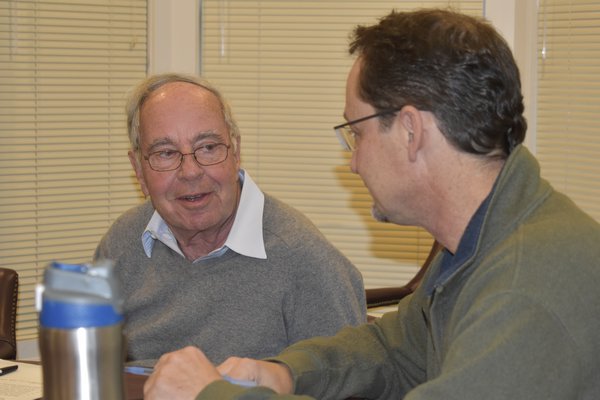
Dick Amper and Robert DeLuca met last week to disucss the potential lawsuit. VALERIE GORDON
The Long Island Pine Barrens Society may go to court seeking to overturn a recent decision by the Southampton Town Zoning Board of Appeals, which cleared the way for a private 18-hole golf course on a luxury housing development in East Quogue.
The organization’s president, Dick Amper, said on Thursday, December 6, that he will be meeting with the nonprofit’s board of directors this week to discuss filing an Article 78 lawsuit—which, rather than seeking monetary damages, simply asks the court to overturn municipality and regulatory board decisions.
He said the potential suit would focus mainly on what he said is the ZBA’s blatant disregard for the language in the town code, which he said precludes a golf course as an accessory use. He added that the lawsuit, if filed, likely would list multiple petitioners, including the Pine Barrens Society, the Group for the East End, local residents and, potentially, civic groups.
“Everybody hates it,” Mr. Amper said of the ZBA decision, “so I think there will be a long line of people willing to come forward.”
The deadline to file a challenge is Saturday, December 15, which marks 30 days after the ZBA’s decision to allow the golf course to be built as a recreational amenity to a proposed 118-unit residential subdivision off Spinney Road. The resolution was approved, 5-2, with only ZBA Chairman Adam Grossman—who said last week that he is anticipating a court challenge—and board member Helene Burgess dissenting.
The developers behind the project, Arizona-based Discovery Land Corporation, revised their strategy last year after the Southampton Town Board voted down a nearly identical proposal, “The Hills at Southampton.” The original plan called for a change of zone, creating a planned development district, or PDD, which would have allowed the Town Board to sidestep zoning regulations, paving the way for the developers to build the golf course as a public membership amenity.
The proposal now under consideration uses an interpretation of existing zoning—via a planned residential district, or PRD—to allow a golf course to be used only by the development’s residents and their non-paying guests.
Mr. Amper has repeatedly argued that Discovery Land would not have spent four years initially seeking a change of zone if it wasn’t necessary to build the development and golf course, since current zoning precludes it. He said that the lawsuit would focus mainly on the ZBA’s interpretation of the zoning code—particularly Section 330, which spells out what constitutes a “subordinate, customary and accessory use.”
“If the use is not specifically stated in the code, it is to be considered a second primary use,” Mr. Amper said. “That’s our argument, and I would be surprised if it didn’t move forward.”
The zoning code, which lists the permitted uses as residence uses, residential community facilities, general community facilities, business uses, industrial uses, and accessory uses, reads: “all unlisted uses are prohibited.”
However, according to Southampton Town Planning Board Chairman Dennis Finnerty, there is no set list as part of the town code that specifically lists every permitted accessory use.
Additionally, Mr. Amper said the lawsuit would likely reference other chapters of the town code, such as Chapter 247, or what’s commonly referred to as the “Open Space Law,” or “Cluster Law.”
The law, which echoes state law, requires houses or residential buildings to be clustered together to allow for more contiguous open space to be created. It also states that a minimum of 65 percent of the property in question must be preserved as open space.
The proposed golf course is estimated to sit on roughly 91 acres of the 591-acre parcel, and, according to Mr. Finnerty, is in full compliance with that requirement.
However, the town code also defines what uses may be approved for open space. It reads: “The Planning Board may approve recreational use, such as wooded park areas, bridle paths, hiking trails, beach areas, etc.” It goes on to say that “areas for active recreation which are to contain substantial improvements, structures, impervious surfaces and other alteration from their natural state shall not constitute open space.”
The applicant argues that it has preserved 65 percent of the property and does not include the golf course in that calculation. But opponents say that, by default, the golf course must be considered part of the open space set aside by the subdivision process.
New York State Assemblyman Fred W. Thiele Jr.—the author behind the enabling legislation—has repeatedly argued that a golf course is considered active recreation and is therefore prohibited in preserved open space, which allows only passive uses.
Another aspect that Mr. Amper said would likely be argued in the lawsuit is the ZBA’s lack of deliberation when drafting decisions on applications in front of the board. It’s a policy that Robert Freeman, executive director for the State Committee on Open Government, has said could be in violation of the state’s Open Meetings Law, which requires all “deliberation” by a quorum of members—every substantive discussion that leads to a vote, not just the vote itself—to take place in public.
In lieu of public deliberation, Assistant Town Attorney Kathryn Garvin sends a private email to each individual board member, asking whether they are in favor of or opposed to the application. According to Mr. Grossman, board members typically respond with a simple “yes” or “no,” and then the written decision—which is strictly derived from the testimony submitted by attorneys arguing in favor of and against the application—is prepared. The vote is then held in public.
“That’s bad government,” Mr. Amper said. “The most outrageous part is the ‘yes’ and ‘no’. Meaning, [Ms. Garvin] is inventing the rationale for the decision—it’s not coming from the board members at all. They’ve really taken themselves out of the decision process altogether.”
Mr. Freeman, who offers legal opinions and advice on matters of access to government meetings and documents, said last week that should a court agree that the ZBA’s actions were in violation of the Open Meetings Law, a judge would have the authority to invalidate the board’s decision.
The Article 78 lawsuit wouldn’t be the first targeting the town in regard to Discovery Land’s application. Last year, the developers filed a $100 million lawsuit against the Town Board, specifically targeting board members John Bouvier and Julie Lofstad, who voted against the PDD, which required four votes to be approved, but came up one vote short, 3-2.
Southampton Town Supervisor Jay Schneiderman said he sought advice from lawyers representing the town’s insurance carrier, who told him to stay mum regarding the possible lawsuit—a decision that Mr. Amper said was a ploy to push Discovery Land’s proposal through.
“The fact of the matter is, I think this was an end-around,” Mr. Amper said. “[Mr. Schneiderman] aided and abetted, and he’s trying to reverse the decision of the Town Board.”
Mr. Schneiderman, who could not be immediately reached on Monday, has repeatedly rejected Mr. Amper’s accusations, noting that he has stayed out of the application entirely while it was before the Zoning Board of Appeals.
In regards to the potential lawsuit, Carolyn Zenk, a Hampton Bays environmental attorney who most recently represented the Pine Barrens Society and the Group for the East End, said, “I can’t believe that this needs to be challenged. I think it’s sad when civic groups need to defend the town’s laws, but that may be what is necessary.”


 Valerie Gordon on Dec 10, 2018