


 2 Photos
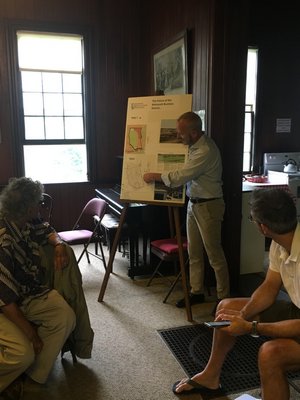
Bruce Solomon of the Wainscott Citizens Advisory Committee voicing his opinion about the 70-acre parcel in Wainscott on Saturday. ELIZABETH VESPE

Sara Davison and Carolyn Logan Gluck at the Wainscott Citizens Advisory Committee meeting on Saturday
The potential impact of a proposal before the East Hampton Town Planning Board to carve 50 lots out of a roughly 70-acre gravel and sand pit to make way for a commercial center in Wainscott raised serious concerns at the hamlet’s Citizens Advisory Committee on Saturday morning.
Marguerite Wolffsohn, the town’s planning director, told the CAC that the Planning Department will recommend a positive declaration under SEQRA, or the State Environmental Quality Review Act, for the subdivision at the Planning Board’s meeting on Wednesday, September 12, when the board is expected to vote on a declaration.
State law mandates the town to consider the impacts on the environmental, traffic, recreation, public health and other aspects of planned developments—and a positive declaration requires much more extensive and thorough review than a negative one.
“The SEQRA document discusses the potential adverse impacts of what the owner is proposing for the property,” Ms. Wolffsohn explained to committee members on Saturday. “The biggest impacts we see are the potential for groundwater pollution and traffic.”
According to Planning Department documents submitted to the Planning Board on Wednesday, September 5, the preliminary subdivision proposal that was submitted in January by John Tintle, the owner of the property through Wainscott Commercial Center LLC, “does not account for the construction that would most likely need to occur to create the subdivision, including … paving for streets, clearing and grading, fire protection, [and] adequate drainage facilities [for] runoff.”
In addition to asking for an integrated plan for long-term construction that would take the overall infrastructure into account, the planners asked for more information about two pre-existing uses, a concrete plant and a masonry and tile supply yard, that would be maintained under the proposal.
The department also identified potential surface water impacts on nearby Georgica Pond due to the “various intensive industrial uses and activities” at the reclaimed sand and gravel pit over more than 50 years, as well as the additional strain that 50 new commercial businesses could have on wastewater treatment and on groundwater.
Planners noted that the Suffolk County Department of Health Services has already found excess metal levels in groundwater at another sand and gravel pit on the East End—presumably Sand Land In Noyac, which is also owned by Mr. Tintle’s Wainscott Sand and Gravel.
At the same time, the Suffolk County Water Authority is in the process of extending water mains in the region to give residents access to drinking water after perfluorooctanesulfonic acid, or PFOS, and perfluorooctanoic acid, or PFOA, which is believed to have come from the East Hampton Airport property, was found in private wells.
The proposed commercial development would tap public water instead of digging new private wells to supply the numerous businesses created by the subdivision.
Other than the preexisting uses, most of the 50 lots would be about 1 acre each. Just 10 percent of the property would be designated for open space, which is typical for properties zoned for commercial-industrial use, according to the Planning Department.
The applicant has not yet submitted a traffic impact study. Town planners wrote in the report that the project would result in “a potentially extreme increase in traffic volume on Montauk Highway”: They expect that 50 businesses would add more than 1,100 weekday vehicle trips to the area.
Planners also said the proposal conflicts with a draft hamlet study that was finalized in January, which makes recommendations for long-term planning in Wainscott, including industrial development. Many have suggested that the parcel should not be subdivided until the final study is adopted and the Planning Board has better direction to ensure that development is consistent with those community plans.
After all, “it is the largest undeveloped parcel of land in Wainscott,” said CAC Co-chair Barry Frankel on Saturday.
The hamlet study also includes recommendations to include accommodations for pedestrians and bicyclists and how open space could be used to the public’s advantage. According to the report, “the proposed subdivision eliminates the potential for this future recreational resource” if the property is used entirely for businesses.
Mr. Tintle will have the chance to weigh in at the Planning Board’s work session on Wednesday before a decision on the SEQRA designation is made.
“Right now, we have 70 acres with no water testing. They refuse to test their water,” said CAC member Rick Del Mastro at Saturday’s meeting. “We believe there are contaminants in that water, but we can’t prove it.”
However, the senior vice president of the Wainscott Commercial Center, David Eagan, refuted that statement on Monday.
“The owner of the ‘pit’ has not been approached by any governmental agency, including the [Suffolk County Health Department] or the [Suffolk County Water Authority], with any request for water testing,” Mr. Eagan said.
In August, he had told East Hampton Town Board members that a hydrogeologic investigation of the property had been commissioned. “That study is currently being conducted and will be part of our site plan application pending before the Town Planning Board.” Mr. Eagan said at the time, adding, “Anyone saying otherwise is just trying to cause fear.”
Ms. Wolffsohn told Wainscott CAC members that the Planning Board was likely to make a positive declaration. “If they find even one potential large environmental impact, the applicant has to address that in the environmental impact statement,” she said.
The magnitude of the subdivision and eventual construction of retail and office buildings seemed to astonish some CAC members, who referred to the proposal as “the elephant in the room.”
“It maximizes the revenue they can get per acre. It’s a business thing. They’re looking to get as much money as they can out of that site,” Mr. Del Mastro said.
Mr. Eagan had said in an interview in June that he did not expect the development to be completed for decades. Historically, this is the beginning of what is often a several-year process before a subdivision is approved—let alone individual business properties being developed.
The East Hampton Town Board extended a moratorium on commercial development projects in the Wainscott business district for an additional six months on June 13. By the time the moratorium expires, town officials are expected to have fully reviewed the recommendations of the hamlet study.
“The hamlet study could become the basis for significant zoning changes,” said Town Councilman Jeff Bragman, who is the liaison to the CAC. “To some extent, the study could control development in our hamlet.”


 Elizabeth Vespe on Sep 11, 2018