


 4 Photos
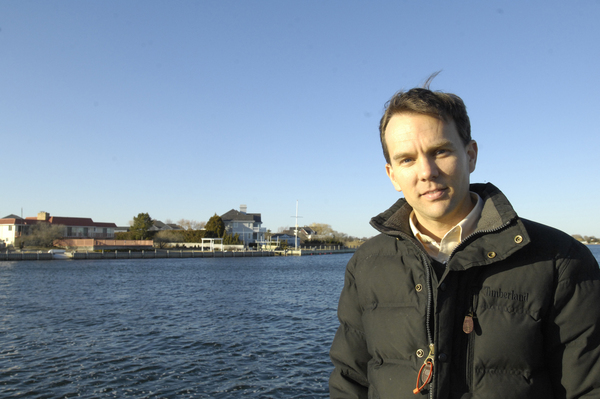
Christopher Gobler Ph.D.
at Moniebogue Bay in Westhampton Beach. Scientists and biologists have made a connection between the effects of residential septic systems and damage done to the estuarine environment.
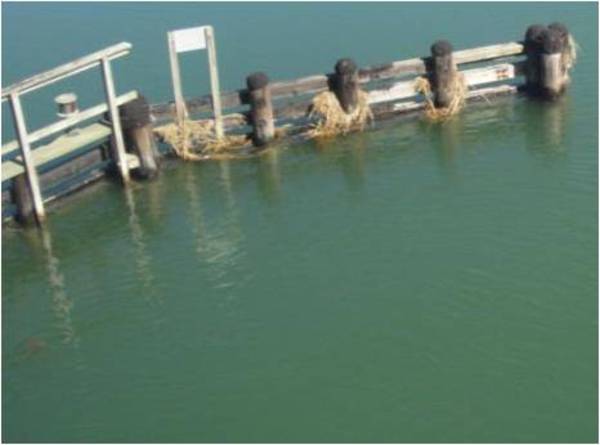
Bay water free of Brown Tide.
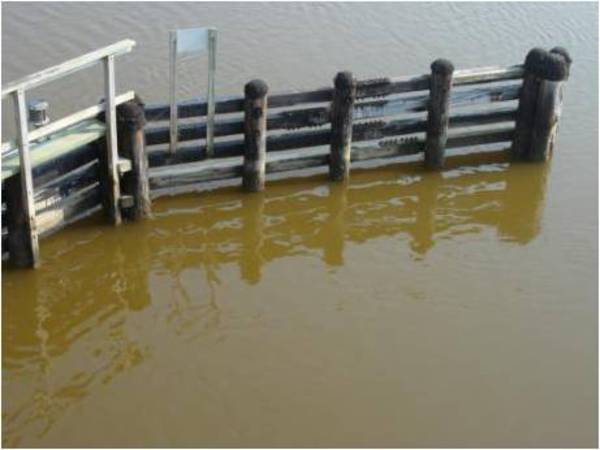
Bay water effected by Brown Tide.
As the East End’s estuaries begin to awaken from a winter slumber, a group of scientists from Stony Brook University say a host of recent research shows that the deluge of water quality problems that have beset Long Island’s ponds and tidal waters in the last three decades, wiping out shellfish populations and feeding waves of toxic algae blooms, is undeniably linked to residential overdevelopment.
Nitrogen from the septic systems of homes built too densely and too close to tidal waters has flooded into groundwater tables, ponds and fragile estuaries. While the nitrogen levels might not be high enough to exceed public health thresholds, the scientists say that the nutrients seeping into tidal waters feed blooms of algae that are destructive to aquatic vegetation and shellfish, and sometimes are so toxic they can kill swimming fish in less than an hour. Rather than focusing on pesticides, insecticides and road runoff as primary causes of bay pollution, the scientists say the focus should be sharply on the number of underground septic systems surrounding the estuaries.
The scientists, marine biologists from the Stony Brook University School of Marine and Atmospheric Sciences, will present their findings on Friday night at Stony Brook Southampton, during the Coastal and Estuary Research Program’s annual environmental symposium. The program’s head, Professor Christopher Gobler, Ph.D., said this week that the work by professors and graduate students connects the dots of a host of research compiled by various groups on the effects of residential septic systems on the estuarine environment in recent years, and traces a picture of destruction that is hard to miss.
“If you turn back the clock to 1980, there are no harmful algal blooms, the shellfish populations are robust, and the nitrogen levels are lower by 50 to 200 percent,” Dr. Gobler said. “Flash forward 20 years, and I can name four or five kinds of harmful algal blooms that appear on an annual basis, the shellfish populations are non-existent, and we can make direct links to nitrogen loading.”
The poster child for the wave of environmental degradation is the bay scallop, once among Long Island’s most lucrative natural resources. After the infamous brown tide—a bloom of algae that stained tidal waters the color of coffee as it spread rapidly across most of Long Island’s bays—appeared in 1985, the scallop populations collapsed and have never recovered.
In 1995, vast beds of eelgrass, an ecologically critical aquatic plant that many shellfish species rely on to shield themselves from predators, began dying off. In more recent years, ribbons of “red tide,” another deadly algal bloom, began appearing in eastern estuaries, sparking fears that it would knock out scallop populations that are finally showing faint signs of recovery.
In 2010, the State Department of Environmental Conservation listed all of the South Shore bays on Long Island as “impaired water bodies”—a designation usually applied to waters beset by contaminations of dangerous bacteria—simply because of the level of nitrogen found in their waters.
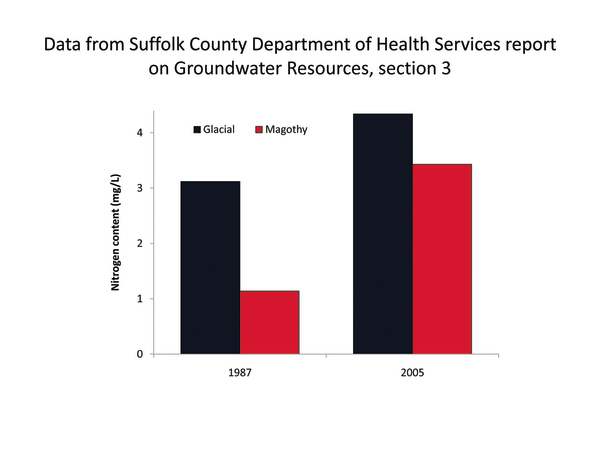
Dr. Gobler says the common denominator in it all is residential development. According to a report conducted by Suffolk County, in the last 18 years, the concentrations of nitrogen in groundwater tables have spiked by as much as 200 percent in some areas. And a recent study by researchers from the Woods Hole Oceanographic Institute, a leading marine research center, also showed that some 70 percent of the nitrogen found in the Great South Bay, where a once enormous commercial shellfish industry has effectively ceased to exist, can be traced back to household wastewater—mainly flushed toilets—despite the fact that about half of the homes in the bay’s watershed are connected to sewage treatment plants. The source of nitrogen in the waters of the East End, where 95 percent of homes flush their toilets into in-ground septic systems, would be easy to identify, Dr. Gobler says.
“We know where the nitrogen is coming from,” he said. “There’s a management plan for the South Shore bays, but it’s based around surface runoff, and it turns out that is not the main issue. The main contributor driving nitrogen in groundwater is not fertilized lawns but the number of homes you have per acre.”
The work being presented by the Stony Brook scientists is of particular interest to Kevin McAllister, the Peconic Baykeeper, a non-profit environmental advocate. Mr. McAllister has maintained that residential septic systems are degrading tidal waters and says the research compiled by the university scientists should spur Suffolk County to change course drastically in its approach to household septic systems.
Mr. McAllister said this week there a number of solutions that could be adopted which would take years but would start to reduce the amount of nitrogen being injected into the bays. The easiest would be to require all new homes and any homes that are sold have their septic systems upgraded to more modern systems that are far more efficient at removing nitrogen from sewage before it reaches the water tables. Many states, including Rhode Island, Massachusetts and New Jersey, and smaller municipalities around the nation, already require the upgrades. The new systems are more expensive, he said, but will pay off in the long run.
“Suffolk County has been kicking the can down the road for too long—the septic code needs a complete overhaul,” Mr. McAllister said. “It will be costly, but either we pay now or we pay later, in a very big way. We’ve had our head in the sand for too long.”


