


 1 Photo
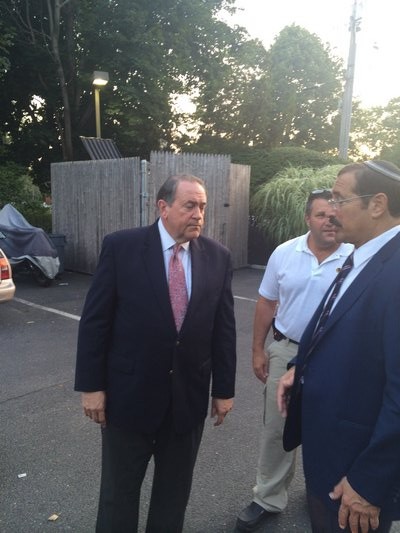
Governor Huckabee attends the Hampton Synagogue. Hampton Synagogue Security
The Hampton Synagogue in Westhampton Beach has become a regular stomping ground in the presidential campaign trail, hosting five Republican candidates over the summer during its Presidential Candidate Series, including, just in time for the season’s final weekend, former Arkansas Governor Mike Huckabee on Friday night.
The synagogue was full on Friday, with a few hundred people in attendance intent on asking Mr. Huckabee questions regarding Israel’s safety, the Iran nuclear deal, and reasons for the lack of accomplishments in both houses of Congress, despite the Republican majorities.
The synagogue’s founding Rabbi, Marc Schneier, began the Q&A by asking the former governor how he expected to win: “I believe you have a one in 17 chance,” he said. The modern orthodox congregation erupted into laughter.
Without hesitation, Mr. Huckabee explained how he came in second to John McCain in the 2008 Republican primary, and that he could have won if he had more money during that race. He added that, now that he knows what it feels like to lose from already having run for president once, and what it feels like to win from serving as the governor of Arkansas, “winning is much more fun,” he said.
He was asked how the congregation could help him to have a successful campaign, and nodded to one suggestion about using social media to express support, but quickly the conversation shifted its focus back to the topic of money. He explained that it really does matter.
Hence his fundraising stop at the synagogue, along with the four other presidential hopefuls who preceded him, including Senators Lindsey Graham and Marco Rubio, former New York Governor George Pataki and Florida Governor Jeb Bush.
Mr. Huckabee talked about his upbringing on Friday, and said that at one time, he never imagined going more than 50 miles from his house in Arkansas because he grew up “dirt poor.” Just last year, Mr. Huckabee said he traveled more than 200,000 miles on Delta Airlines alone. In his travels, however, he said he could identify more with the people working in the kitchen than the people sitting at the head of the tables. He noted that the American Dream was not a “phenomenon” to him. “I’ve lived it,” he said.
Rabbi Schneier said of the Presidential Candidate Series, “I think the Hampton Synagogue has become a neat platform in the Jewish world, and it is an extraordinary opportunity for these candidates to address a very distinguished and prominent audience.”
Not only that, Rabbi Schneier quipped that the Hampton Synagogue had become one of three important places for campaigning: Iowa, New Hampshire and the Hampton Synagogue.
“The Hampton Synagogue is not something of your conventional local house of worship,” Rabbi Schneier said. “It has become an international platform within the Jewish community to facilitate a discussion between these candidates and members of the congregation.”
By hosting the presidential candidates, the synagogue has aspired to “enlarge their interests and expand their sympathies,” Rabbi Schneier said. “I don’t impose my point of view but expose people to different views—that has become the trademark of the congregation.”
As for why Donald Trump has yet to walk through the synagogue’s doors, the rabbi said, “I still have next summer.”


 Alisha Steindecker on Sep 7, 2015